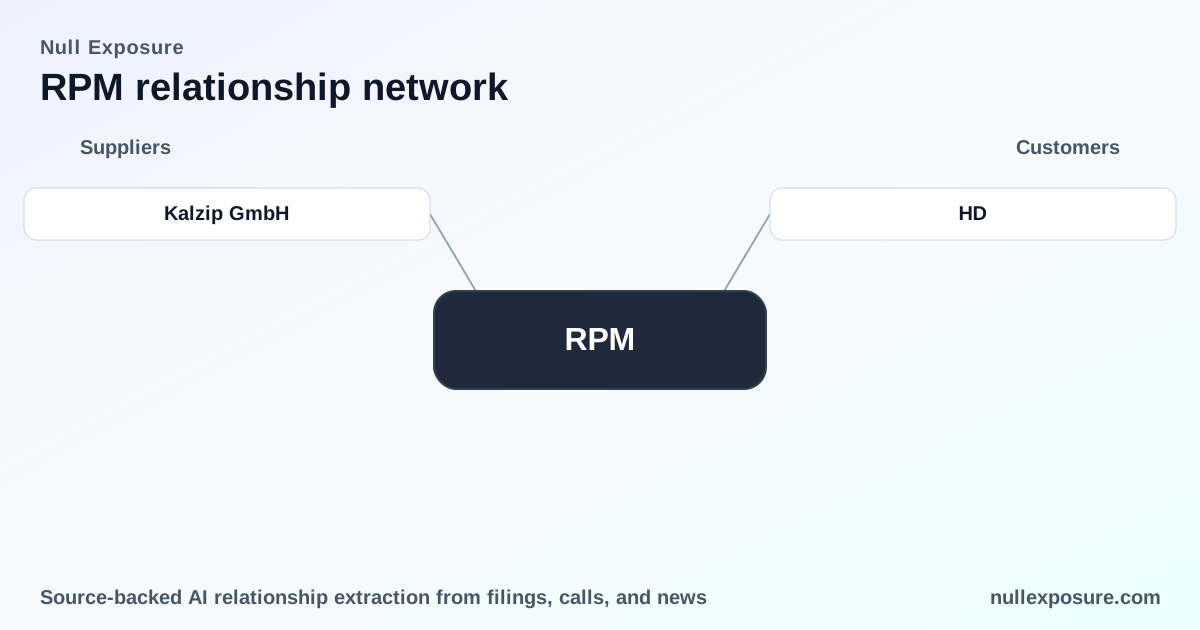
RPM Inc.: Customer relationships that shape working capital and distribution risk
Thesis — RPM International monetizes a diversified portfolio of specialty-chemical brands through manufacturing and distribution to large retail channels, contractors and industrial customers; it generates most revenue at the point of sale but retains a material program of long‑duration construction and installation contracts, and flags major retail customers as concentration exposures that affect working capital and bargaining power.
If you want a concise map of how RPM’s customer exposures influence cash conversion and route-to-market strategy, read on — and for more signal-driven coverage of corporate relationships visit https://nullexposure.com/.
Business model in plain English: manufacturing, distribution and selective services
RPM operates as a multi-brand specialty-chemicals group that manufactures and sells paints, coatings, roofing systems, sealants, adhesives and related installation services. The company monetizes through product sales to mass merchandisers and home‑improvement centers, direct commercial contracts for building systems, royalties and license fees from international arrangements, and services tied to installation and construction projects. RPM’s mix of point‑in‑time retail sales and over‑time construction contracts creates a hybrid revenue profile: high turnover on consumer SKUs combined with episodic, higher‑value service contracts that extend revenue recognition and credit exposure.
This structure gives RPM steady retail cash flows while exposing the company to working capital swings driven by payment terms, customer concentration with large accounts, and project delivery risks. For investors and operators analyzing customer risk, the critical signals are channel concentration, payment timing, and how much revenue comes from point sales vs. long‑duration contracts.
What the FY2025 filing reveals about contracting posture and market footprint
RPM’s FY2025 Form 10‑K lays out several operating constraints that matter for evaluating customer relationships:
- Payment and receivables profile: Customers generally pay within 30–60 days, which signals a short‑term receivables cycle that amplifies sensitivity to retailer payment practices and inventory turnover. This is a company‑level cash‑conversion constraint reported in the 10‑K.
- Contract mix: The bulk of revenue is recognized at a point in time, but RPM also records long‑term construction contracts (roofing, flooring and related services) using an over‑time model, producing a mix of spot sales and longer-duration revenue streams.
- Global reach with North American concentration: RPM markets products in roughly 163 countries and operates ~118 manufacturing sites worldwide, yet the Consumer segment’s manufacturing and distribution are primarily in North America, indicating geographic diversification with regional concentration in the consumer channel.
- Channel roles and distribution: RPM sells through mass merchandisers, home‑improvement centers, hardware and paint stores, craft shops and distributors, and it also receives royalties and license fees from international license agreements and runs a number of equity‑accounted joint ventures.
- Segmented operations: The business is effectively split between manufacturing product lines and services (construction/installation), which implies different margin and counterparty risk profiles across customer relationships.
Together these company‑level signals point to an operating model that is retailer‑centric, short receivable cycles with episodic long‑contract exposure, and global scale with North American retail concentration — all critical inputs when valuing customer dependency and negotiation leverage.
Named customer relationships surfaced in RPM’s FY2025 filing
Below are every customer relationship identified in the results returned for RPM’s customer scope, summarized with source language.
- HD — RPM lists “HomeDepotMember” under consumer segment revenue and tags the relationship in the filing as part of its customer concentration discussion; this identifies The Home Depot as a material retail customer in the Consumer segment. According to RPM’s FY2025 Form 10‑K, Home Depot is included in the customer concentration disclosure (rpm-2025-05-31, FY2025).
- Home Depot — The filing again names Home Depot in the consumer segment and classifies the account within the company’s customer concentration risk reporting, confirming a direct retail relationship that matters for sales and working capital. This is stated in RPM’s FY2025 Form 10‑K under the Consumer segment customer concentration section (rpm-2025-05-31, FY2025).
Key takeaway: RPM explicitly calls out Home Depot in its FY2025 10‑K as a consumer‑segment customer and includes it in customer concentration disclosures, signaling a potentially material buyer relationship for retail channels.
Investor implications: concentration, working capital and strategic resilience
From an investor perspective, the combination of facts above creates a neutral‑to‑constructive operational profile with focused risks:
- Concentration risk is real but targeted. The Home Depot relationship is a noteworthy concentration against a diversified global revenue base of ~$7.71 billion TTM; large retail customers increase negotiating leverage over pricing and payment terms, and create single‑account receivable risk when payment timing shifts.
- Cash conversion is short but volatile. With typical customer payment terms of 30–60 days and a heavy proportion of point‑in‑time revenue, RPM’s near‑term cash conversion hinges on retailer inventory dynamics and payment discipline; long‑term contracts layer on working‑capital variability through progress‑billing and contract margins.
- Channel diversity cushions exposure. The business sells through multiple channels — mass merchants, home‑improvement centers, distributors and contractors — and earns license/royalty income internationally; this reduces systemic exposure should a single retail partner change terms or scale back assortment.
- Services segment changes the risk profile. Construction and installation contracts introduce project execution risk and longer realization windows, which can increase earnings volatility relative to pure product sales.
- Operational maturity and scale are advantages. RPM’s global footprint and multi‑brand portfolio provide pricing and sourcing flexibility that larger competitors lack, and provide a platform to negotiate supplier and customer terms from a position of scale.
How to use this in a credit or equity review
For credit analysts, prioritize trending receivable days and payment timing with major retail partners and monitor backlog and margin progression on over‑time contracts. For equity investors, model scenario sensitivity to a 30–90 day elongation in retail receivables and a modest 1–2% decline in product margins if a major account demands price concessions.
If you want a deeper, signal‑driven map of RPM’s counterparty exposures and how they affect valuation and liquidity, explore our relationship analytics at https://nullexposure.com/.
Bottom line
RPM’s FY2025 filing identifies Home Depot as a material consumer‑segment customer, and the company’s operating model mixes fast retail sales with episodic long‑term construction contracts, global scale, and a distribution footprint anchored in North America. For investors, the story is one of diversified revenue with tangible retailer concentration and working‑capital sensitivity — a manageable risk profile if monitored against receivable trends, contract margins and retail channel behavior.