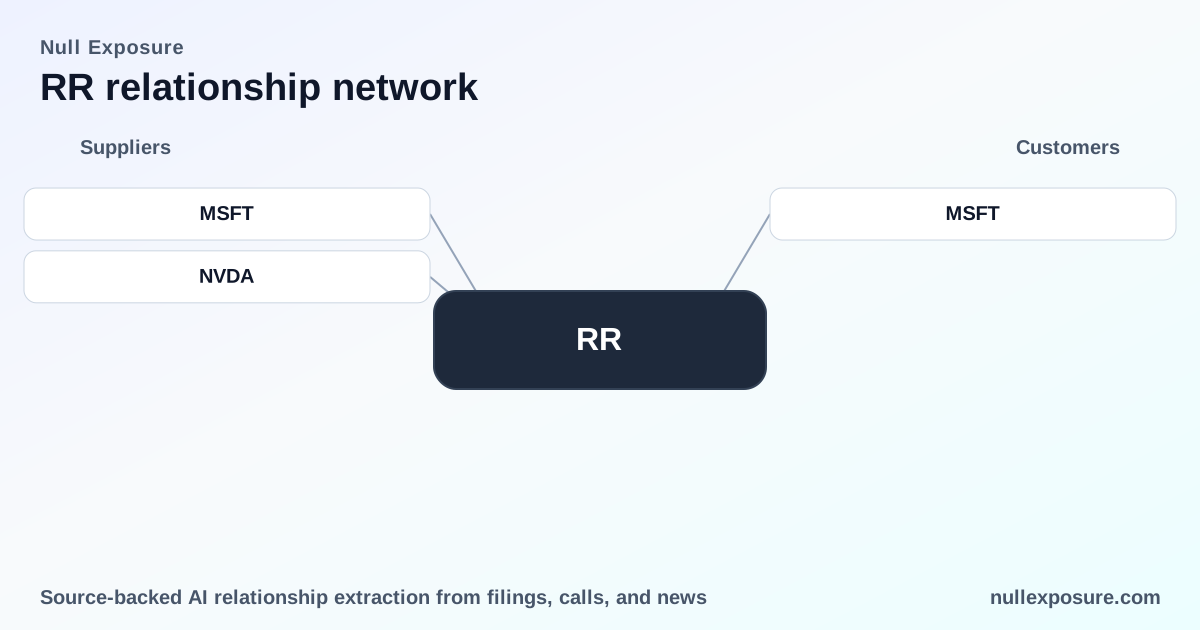
Richtech Robotics (RR): Customer relationships and what they mean for investors
Richtech Robotics sells and rents embodied-AI robotics into service industries using a mixed hardware-plus-subscription model: outright hardware sales, short-term rentals and installation, and a targeted Robots‑as‑a‑Service (RaaS) book of long‑term contracts that drives recurring monthly revenue and service economics. The company monetizes through hardware sales and recurring RaaS/maintenance fees, and its operating model shifts economics toward capitalized robotics assets and monthly service revenue — a change that materially affects gross margin and asset intensity.
If you want a consolidated view of customer signals and litigation-driven market reaction, visit https://nullexposure.com/ to see how this analysis integrates into broader counterparty intelligence.
How Richtech’s customer model actually operates — the quick read for investors
Richtech operates a hybrid go‑to‑market: product sales for customers that buy robots outright and subscription/RaaS contracts where customers pay monthly for hardware, software and support. Company disclosures and filing excerpts indicate a deliberate move toward RaaS: revenue for those contracts is recognized monthly, robots held for lease are capitalized, and management highlights a growing recurring backlog (55 RaaS contracts in fiscal 2025). This is a business that is increasingly dependent on long‑term contracted revenue, with supplementary short‑term rentals and installation services to smooth demand cycles.
- Contracting posture: Evidence points to a mix of long‑term and subscription contracts (RaaS), supplemented by short‑term leasing and maintenance agreements.
- Customer breadth and concentration: The company targets both small businesses (restaurants) and very large enterprises (major retailers and large auto dealership groups), creating a two‑tier concentration profile: diversified B2B footprint, but with strategically material enterprise engagements.
- Revenue recognition and materiality: A shift to leased‑robot accounting reduces upfront product revenue and capitalizes assets, expanding gross margin over time — this is a material change to the income statement and balance sheet.
- Geography and scale: Primary deployments are North America with some international installations; the go‑to‑market strategy includes planned European distribution partnerships.
- Stage and maturity: The relationship program is active and in a ramping phase, with significant new contract wins in FY2025 but limited historical recurring revenue scale.
Public customer relationships investors need to know
Microsoft (MSFT)
Richtech is at the center of multiple securities‑class actions that allege the company misrepresented a collaborative and commercial relationship with Microsoft. According to law‑firm notices and news releases in early 2026, plaintiffs claim Richtech stated it had a commercial partnership with Microsoft when Microsoft has publicly denied having a commercial relationship; independent coverage of the matter notes that the engagement Richtech referenced was an AI Co‑Innovation Lab prototyping engagement without a commercial element. Source: GlobeNewswire and PR Newswire coverage of class action filings and investor alerts (Feb–Mar 2026), and Seeking Alpha reporting on the AI Co‑Innovation Lab disclosure (March 2026).
NewConsultancy B.V.
Richtech announced a distribution agreement with NewConsultancy B.V. to support European market coverage, signaling the company’s first explicit commercial distribution push into Europe. The announcement was reported in May 2026 and frames NewConsultancy as a regional channel partner for deployments and support. Source: MarketScreener press coverage (May 2026).
What these relationships imply about counterparty risk and timing
The Microsoft litigation is a governance and disclosure risk with immediate market implications: claims that Richtech overstated a commercial partnership with Microsoft drove large intraday stock moves in late January 2026, and multiple plaintiff firms cited the same representation in their complaints and press notices (Q1–Q2 2026). That legal narrative reduces investor trust in management messaging and elevates volatility around partnership announcements. Source: trade press and law‑firm press releases compiled in March 2026.
The NewConsultancy agreement, by contrast, is a commercially constructive signal: it reflects management’s explicit strategy to convert product and RaaS opportunities into recurring European revenue via channel distribution. The impact will depend on SOW conversion rates and local deployment economics; given the company’s stated RaaS emphasis, distribution partnerships are the logical route to scale cross‑border recurring revenue. Source: MarketScreener (May 2026).
Operating constraints and business model characteristics investors should treat as facts
- Long‑term, subscription‑oriented contracting is core. RaaS contracts are recorded as monthly-recurring revenue and the company has explicitly described long‑term operating agreements for robotics fleets. This is a commitment to capital intensity and an ongoing service relationship rather than one‑off hardware sales. Evidence: company filing language on RaaS revenue and subscription recognition (company filings, 2024–2025).
- Mixed monetization & capital treatment. Management has shifted revenue recognition and balance sheet treatment: leased robots are capitalized and depreciated over contract life, reducing immediate cost of goods sold and increasing gross margin over time — a material accounting and economics shift that affects free cash flow timing.
- Customer mix spans mom‑and‑pop to enterprise. Filings indicate a diversified B2B base that includes small restaurants and very large enterprise MSAs with global retailers and major automotive dealers, which introduces both resilience and concentration risk from major accounts.
- Active ramp phase. The company reported 55 RaaS contracts in fiscal 2025, showing meaningful ramp in contracted backlog and recurring revenue potential.
- North America–centric with targeted international expansion. Majority deployments are in the U.S., supplemented by installations in Canada, Mexico and Australia, with new European distribution activity underway.
- Spend and funding profile. The company has significant financing and equity purchase arrangements (SEPA with Yorkville for up to $50 million) that support capital deployment into RaaS assets.
Key risks, catalysts and a short monitoring checklist
- Legal and disclosure risk: Litigation over the Microsoft relationship is an active near‑term catalyst; monitor filings and Microsoft statements for resolution. Source: law‑firm press coverage and GlobeNewswire (Q1–Q2 2026).
- Backlog conversion: Track SOW awards and deployment velocity from major enterprise MSAs and the NewConsultancy distribution pipeline.
- Revenue mix transition: Watch monthly RaaS bookings versus outright sales; the economics improve as lease assets depreciate rather than being expensed immediately.
- Cash intensity and financing cadence: With capitalized fleets, asset funding (SEPA and other arrangements) is critical to sustain deployment pace.
- Valuation vs. revenue: The market prices aggressive growth into current value—confirm topline scale before extrapolating margin expansion.
Want a deeper counterparty map and time‑series monitoring for these relationships? Explore integrated intelligence at https://nullexposure.com/ for client‑grade alerts and ongoing linkage tracking.
Bottom line for investors
Richtech is a small‑revenue, high‑ambition robotics company that is explicitly shifting to a capitalized, subscription‑driven model (RaaS). That strategy offers attractive recurring economics if enterprise deals scale, but the company currently faces a governance‑centric legal overhang tied to public claims about a Microsoft relationship and needs to demonstrate consistent conversion of new partner agreements (including European distribution) into predictable recurring revenue. Investors should treat relationship announcements as binary catalysts: they either validate the RaaS thesis through contract conversion, or they generate volatility if disclosures don’t align with counterparty statements.