Red Robin (RRGB) — Franchise relationships, revenue mechanics, and what operators should price in
Red Robin operates and monetizes through a hybrid model: company-owned restaurants drive immediate, material cash sales, while a network of franchisees extends brand reach and delivers usage-linked royalty streams. Investors should value Red Robin for its dual revenue engines—point-of-sale food & beverage sales in owned stores and recurring, percentage-based royalties and advertising contributions from franchisees—while underwriting sensitivity to same-store traffic and franchisee economics.
For a concise monitoring playbook and ongoing relationship tracking, see the Red Robin coverage at Null Exposure.
How Red Robin actually gets paid: the operating and monetization mechanics
Red Robin’s business is straightforward and investor-friendly in its visibility. Company-owned restaurants generate the bulk of reported revenue, recognized at point-of-sale when customers pay, which creates predictable short-cycle cash flows tied to guest visits and average check. Simultaneously, the franchising engine produces usage-based revenue: Red Robin collects royalties and advertising contributions that scale with a franchisee’s top-line performance, creating a natural hedge between owned-store volatility and fee income.
Key operating characteristics that flow from these mechanics:
- Contracting posture — long-duration franchise rights. The company discloses that franchise rights are typically granted for 20 years with an option to extend, creating long-lived contractual relationships that make franchise income sticky. According to the company’s disclosures, franchise grants typically include a 20-year term with a potential 10-year extension (company franchise disclosures).
- Revenue linkage — usage-based fees. Franchisees remit 4.0%–5.0% of revenues as royalties and can contribute up to 3.0% to national advertising funds, so royalty streams vary directly with franchisee sales trends (company filings).
- Geographic concentration — North America. Operations and franchising are focused in North America, concentrating macro‑economic and consumer-demand risk to that region.
- Materiality and role. The company states its primary revenue source is company-owned restaurant sales, and it operates as the seller of food and beverage to guests—an operational focus that places same-store sales and guest frequency at the center of near-term earnings drivers.
- Relationship maturity & analytics. Red Robin highlights an active loyalty program (the Red Robin RoyaltyTM with ~14.9 million members) and a new Customer Data Platform, signaling a shift toward data-driven guest reactivation and targeted offers to stabilize traffic.
These characteristics create a clear risk-reward profile: long-term contractual stability on the franchise side combined with sensitivity to consumer trends on the company-owned restaurant side.
The active franchise relationships in the record — what’s on file
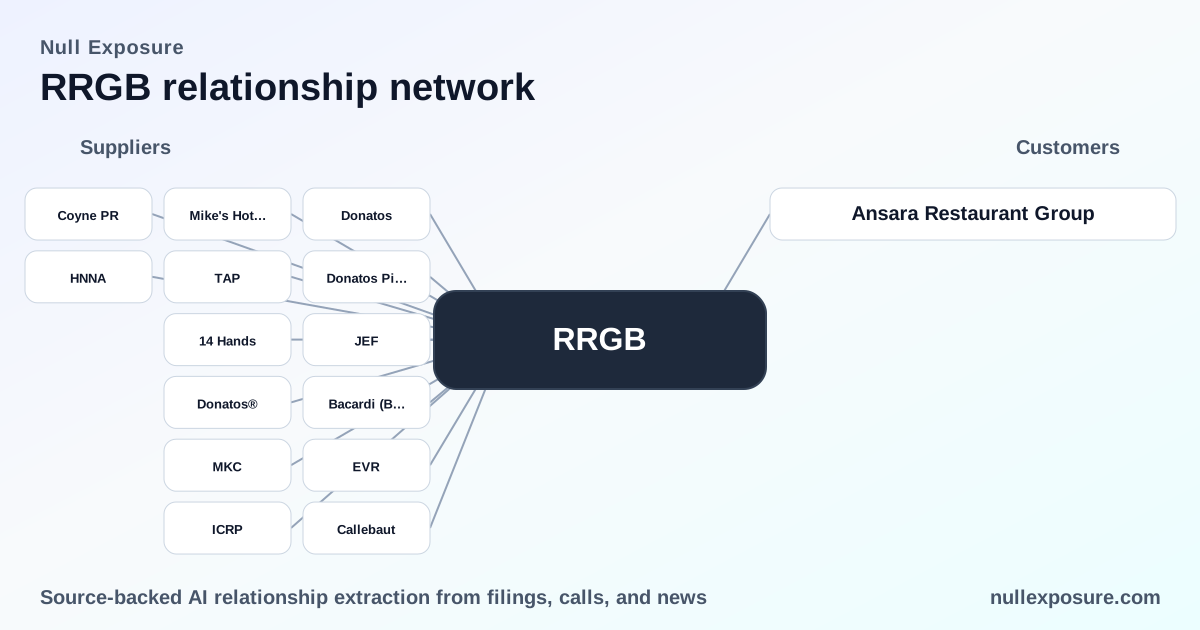
Red Robin’s documented customer/franchise relationships in the provided results are concentrated but visible. Below is the full list from the dataset and the plain-English takeaways.
Ansara Restaurant Group — an established Red Robin franchisee in Ohio
Ansara Restaurant Group operates Red Robin Rossford, which the company cites as the brand’s 18th location in Ohio; the firm is described as a longtime Red Robin franchisee. This is a straightforward franchise operating relationship that expands the chain’s geographic footprint in the Midwest. Source: Red Robin investor relations press release, March 10, 2026 (company IR site).
(This dataset includes one relationship entry; the summary above covers every relationship returned by the search.)
What the contractual constraints tell investors about risk and upside
The company-level constraints pulled from filings and disclosures reveal operational levers and counterparty profiles that should factor into valuation and credit assessment:
- Long-term franchise contracts increase revenue visibility. The 20-year standard franchise term (with a potential 10-year extension) creates a durable royalty base and reduces churn risk among franchise partners, supporting multi-year cash flow modeling (company franchise disclosures).
- Revenue sensitivity is built in via usage-based fees. Because royalties are percentage-based (4–5%) and advertising contributions can total up to ~3% of sales, franchise income scales with franchisee sales, amplifying the impact of either traffic recoveries or declines (company filings).
- Counterparty mix skews to individual operators and retail guests. The company recognizes revenue from transactions with guests and franchisees, reflecting a customer base composed of retail consumers and individual franchise operators rather than large institutional accounts; this implies higher volume but lower counterparty concentration.
- Geographic concentration in North America concentrates demand risk. Macroeconomic or regional dining trends in the U.S. and Canada will disproportionately affect both company-owned revenues and franchisee royalties.
- Materiality of company-owned operations. Since company-owned restaurant sales are the primary revenue source, same-store sales and unit-level profitability are immediate levers on GAAP revenue, with franchising providing complementary, usage-sensitive margin.
- Operational maturity and analytics are improving. Active loyalty membership and deployment of a Customer Data Platform indicate the company is investing in precision marketing, which supports guest frequency and higher-return promotions if executed well.
These constraints combine to produce an operating model where contractual durability (long franchise terms) coexists with top-line sensitivity (usage-based royalties and consumer-driven company sales)—a profile that rewards careful monitoring of traffic trends and franchisee P&Ls.
Practical implications for investors and operators
For investors assessing RRGB exposure and counterparties, focus on three actionable items:
- Monitor traffic and check trends: Because company-owned stores generate the majority of revenue and franchise royalties are usage-linked, guest visits and average checks are the primary leading indicators of earnings momentum.
- Watch franchise health and concentration: Long-term contracts reduce churn risk, but a localized franchisee downturn can compress royalties and brand strength; track any signs of franchisee distress or cluster underperformance.
- Evaluate data/marketing ROI: Red Robin’s investment in a Customer Data Platform and a large loyalty base is a lever for reactivation; execution on targeted offers will be determinative for margin recovery.
For operators and lenders, the long contract tenors and percentage-fee structure imply steady future claimability on royalties, which supports lending against royalty streams, provided franchisee unit economics remain intact.
If you want a periodic monitoring feed or deeper counterparty dossiers on Red Robin’s franchise base, visit Null Exposure for subscription options and relationship tracking.
Bottom line
Red Robin combines material, short-cycle company sales with durable, usage-linked franchise revenues. This hybrid model drives both volatility and optionality: short-term earnings pivot on consumer traffic while the franchise framework provides a long-lived, scalable royalty stream. Investors and operators should underwrite the company on the twin axes of guest demand recovery and franchisee sales health, and use the disclosed franchise terms and royalty mechanics to model downside protection and upside leverage.