Republic Services (RSG): Customer Relationships That Drive Waste-to-Value
Republic Services monetizes a capital-intensive, local-services business by selling collection, transfer, disposal and recycling services to municipalities, households and businesses, and by monetizing byproducts — recycled plastics and landfill feedstock — through commercial partnerships and renewables projects. With roughly $16.6B in trailing revenue and a market capitalization near $63.8B (latest quarter 2025), the company blends recurring municipal franchise economics with shorter-term commercial and subscription revenue and incremental margin capture from commodity and energy offtakes.
If you evaluate corporate counterparty exposure or the strategic upside of Republic’s renewables pipeline, this investor-focused overview synthesizes each disclosed customer and partner mention and explains the company-level operating constraints that shape risk and opportunity. For a consolidated view of supplier and customer relationships, visit https://nullexposure.com/.
How Republic’s customer model shapes cash flow and risk
Republic combines multiple contracting postures across its portfolio. It secures long-term, exclusive municipal and franchise contracts that create durable, predictable cash flows, while supplementing those with one- to three-year small-container and commercial service agreements and subscription residential accounts. This mixed contract maturity profile produces high revenue stickiness at the municipal level and greater price and volume sensitivity in the commercial segment, where commodity prices and customer churn influence margins.
Geographically, Republic operates across North America with the vast majority of revenue generated in the United States and a smaller but material presence in Canada. The business is a service provider at scale, delivering locally executed collection and processing through hundreds of collection operations, and increasingly acting as a seller of recyclable materials and a feedstock supplier for renewable-energy partners. These dynamics create a set of constraints investors should weigh: contract concentration by type (municipal vs commercial), commodity-price exposure on recycled plastics, capex requirements to convert landfills into RNG/energy assets, and the operational maturity that favors incumbents with local networks.
All relationships mentioned in recent coverage — what they mean for investors
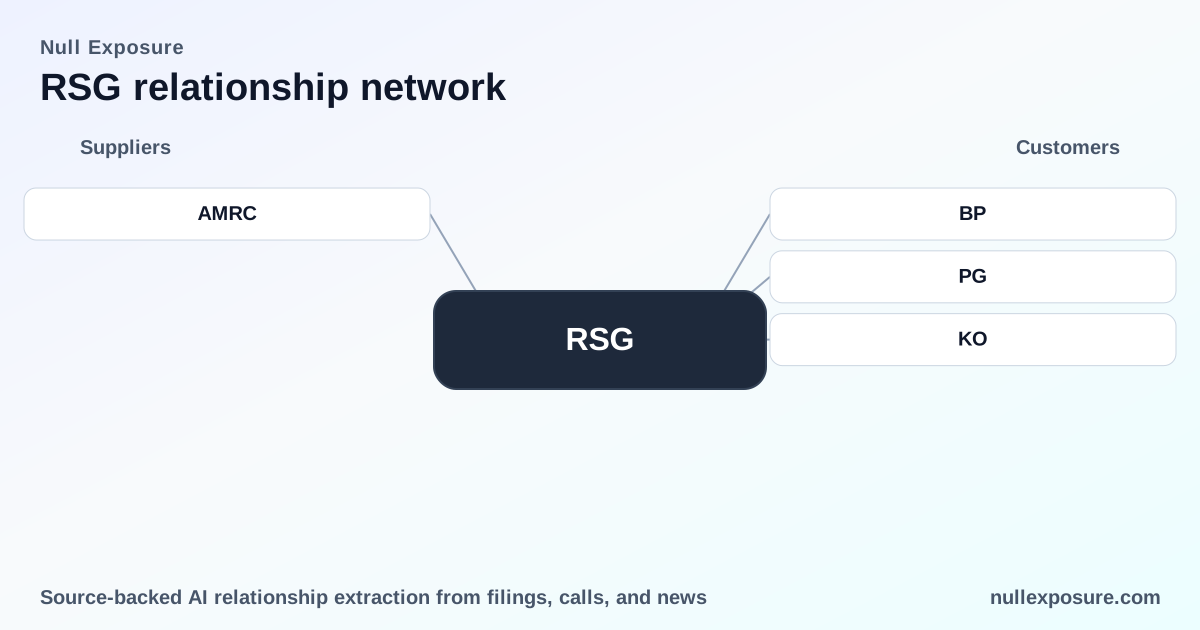
- Procter & Gamble (PG) — Republic sells recycled plastics directly to consumer-packaged-goods companies, with Procter & Gamble cited as a buyer of recycled resin. This illustrates Republic’s route-to-market for higher-value recycling output and the company’s ability to convert waste-streams into commercial-grade feedstocks. Source: MarketMinute (FinancialContent), February 23, 2026.
- The Coca‑Cola Company (KO) — Coca‑Cola is named alongside P&G as a buyer of recycled plastics; this underscores a strategic revenue line beyond collection and disposal: commodity sales tied to corporate sustainability purchasing. Source: MarketMinute (FinancialContent), February 23, 2026.
- bp p.l.c. (BP) — BP is leveraging Republic’s landfill feedstock for lower-carbon energy projects, indicating Republic’s role as a feedstock supplier for large energy firms and the commercial scale of its landfill gas resources. This relationship highlights upstream value capture from landfill-to-energy conversions. Source: MarketMinute (FinancialContent), February 23, 2026.
- City of San Pablo — Republic partnered with the City of San Pablo to deploy California’s first fully electric residential recycling and waste-collection fleet, demonstrating municipal-level strategic relationships that support fleet electrification and ESG commitments while likely preserving long-term municipal revenue streams. Source: City announcement via Sahm Capital press release, April 22, 2026 (reported May 3, 2026).
- OPAL Fuels (OPAL) — OPAL Fuels announced a joint venture with a Republic affiliate to build an RNG facility at Republic’s Charlotte Motor Speedway Landfill, with a long-term gas rights agreement underpinning the project’s feedstock supply; this is a direct example of Republic converting landfill gas into a contracted renewable natural gas revenue stream. Source: CityBiz, March 10, 2026.
Why these partnerships matter for valuation and strategic optionality
Republic’s relationships split cleanly into two monetization vectors:
- Core municipal and subscription collection, which produce predictable recurring cash flows and support valuation multiple stability.
- Waste-to-value commercial partnerships (recycled plastics offtakes, landfill-gas to RNG, and renewable-energy offtakes), which add incremental EBITDA and diversify revenue, but also introduce commodity and execution risk tied to project development and counterparty contracts.
The P&G and Coca‑Cola offtakes signal a structural move up the value chain from simply selling mixed recyclables at commodity prices to providing processed, saleable feedstocks — a margin-enhancing lever. BP and OPAL illustrate how Republic is monetizing landfill externalities into contracted energy revenues; these projects shift some cash flow from volatile commodity markets to long-term gas-rights or joint-venture receipts.
Constraints and operating signals investors should internalize
The company-level evidence indicates a mixed contracting posture: a material share of long-term municipal and franchise contracts coexists with numerous short-term (one- to three-year) commercial and small-container arrangements and subscription residential accounts. This produces several practical characteristics:
- Contracting posture: Blended — durable municipal exclusives plus shorter commercial agreements, which helps stabilize revenue but leaves per-ton pricing and mix exposed in commercial channels.
- Concentration and criticality: Local-market dominance matters; Republic’s scale and network confer competitive advantages in bidding municipal franchises and in siting energy projects adjacent to landfill feedstock.
- Revenue maturity: Mature core service revenue with growing but earlier-stage waste-to-energy and recycled-material sales, meaning incremental upside from renewables but with associated project execution and commodity profile risk.
- Relationship role: Republic operates primarily as a service provider and seller of processed materials/energy feedstocks, not as a downstream consumer of large corporate goods — although it is a buyer of inputs (fuel, equipment) for operations.
These are company-level signals derived from Republic’s public descriptions of contract types, customer billing practices and reported projects; they are not specific to any single counterparty unless explicitly stated.
Investment implications and risk checklist
- Positive: Recurring municipal contracts and subscription revenue create cash-flow resilience; recycling and RNG partnerships create a pathway to incremental EBITDA and ESG-aligned growth.
- Negative: Shorter-term commercial contracts and recycled-commodity exposure introduce margin volatility, and landfill-to-RNG projects require capital and execution discipline.
- Monitor: cadence of long-term gas-rights agreements, pricing terms in recycled plastics contracts with CPGs, and municipal contract renewal outcomes.
If you want a structured map of Republic’s counterparties and contract signals to support due diligence or vendor-risk modeling, explore additional relationship analytics at https://nullexposure.com/.
Bottom line — what investors should remember
Republic Services combines durable, local monopoly-style cash flows from municipal franchises with opportunistic commercial offtakes and renewables projects that expand margin potential. The named relationships with P&G, Coca‑Cola, BP, municipal partners such as the City of San Pablo and OPAL Fuels illustrate a deliberate move to monetize byproducts and landfill assets alongside the steady collection business. For investors, the key read-through is stability plus optionality: stable core earnings underpinned by municipal contracts, with measurable upside from waste-to-value commercialization that requires monitoring for execution risk and commodity-price sensitivity.