Rush Street Interactive (RSI): How customer ties drive growth and product strategy
Rush Street Interactive operates a direct-to-consumer online gaming franchise that monetizes by taking the house edge on casino games and margins on sports betting volume, while increasing lifetime value through product features and geographic expansion. The company runs branded sportsbooks and casino platforms across the U.S., Canada and Latin America and derives virtually all revenue from its B2C operations.
Quick investor take: scale, growth and the economic picture
RSI is a growth-oriented gaming operator with Revenue TTM of $1.24B and market capitalization near $6.46B as of the most recent quarter (latest quarter reported: 2026-03-31). The business shows high top-line momentum (quarterly revenue growth YoY ~41%) but relatively slim headline margins (profit margin ~3.0%, EBITDA ~$156M), reflecting the capital intensity of customer acquisition and regulatory compliance in gaming. Institutional ownership is high, supporting liquidity and analyst coverage; consensus sentiment skews positive with multiple buy ratings and an analyst target price around $29.64.
If you want a concise companion to this relationship analysis, visit the firm home page for context: https://nullexposure.com/
The customer relationships you need to know
Below I cover every customer relationship identified in public results and explain how each uses RSI’s platform.
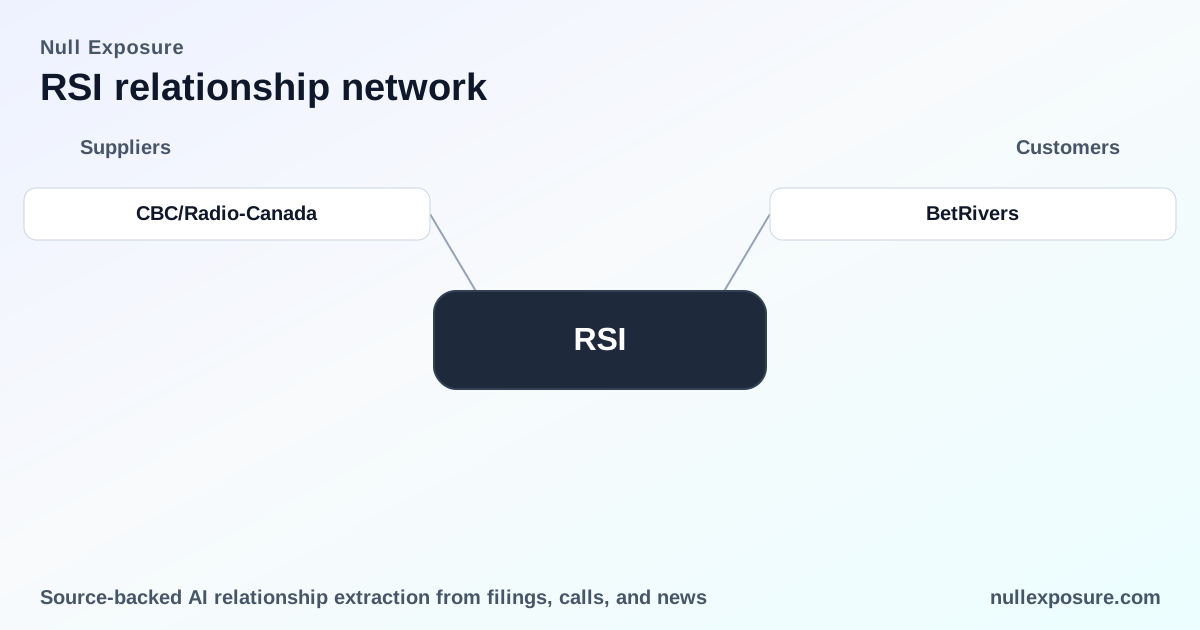
BetRivers — Rush Street Interactive’s flagship sportsbook and casino brand
- BetRivers is an RSI consumer-facing brand that delivers sportsbook and casino product to retail and online bettors; RSI recently introduced "PropPacks" to enhance same-game parlay (SGP) offerings, a product-level push to lift engagement and average revenue per user. According to a March 10, 2026 report on Casino.org, Rush Street Interactive debuted PropPacks for NBA parlays available to BetRivers sportsbook clients. (Source: Casino.org, March 10, 2026.)
How RSI’s operating model and relationship constraints shape outcomes
RSI’s customer-facing model is defined by a set of practical constraints and strategic choices that determine revenue visibility, scaling economics and risk.
-
Contracting posture: transactional/spot — The company’s core business is retail betting, where bets are placed on a spot basis rather than under long-term contractual commitments. This creates high revenue volatility tied to seasonal sports flows and marketing cadence and limits forward revenue visibility. The spot nature of wagers is intrinsic to online sports betting and casino operations.
-
Counterparty: individual retail customers — RSI is primarily a B2C operator; internal disclosures reference MAUs and ARPMAU and describe players’ receivables originating from end customers. That implies the counterparty risk that matters is payment-processing and churn among millions of small accounts rather than a handful of large counterparties.
-
Geographic footprint: North America and Latin America — The company explicitly cites operations across the U.S., Canada and Latin America and, as of Dec. 31, 2024, offered real-money products in 15 U.S. states and four international jurisdictions. Geographic diversification moderates jurisdictional regulation risk but also increases compliance complexity.
-
Role and product positioning: seller and service provider — RSI acts both as a seller of gaming services to consumers and as a service provider when it operates branded platforms that require continuous platform maintenance, regulatory reporting and payment integrations. The dual nature elevates operational intensity; product launches like PropPacks are an example of product-led growth executed from the service-provider side to boost seller economics.
-
Relationship maturity and stage: active, platform-led — The company reports that B2C operations accounted for over 98% of total revenue for 2023–2024, signifying mature, ongoing customer activity rather than experimental or lapsed partnerships.
-
Segment focus: services-centric — RSI is a services business delivering regulated gaming experiences; recurring engagement is the core unit of value rather than single large contracts.
These constraints should be treated as company-level signals that shape all customer relationships: high-frequency spot transactions with retail users across regulated geographies, delivered through RSI’s platform and product innovations.
Why product plays like PropPacks matter to investors and operators
New features such as PropPacks are not cosmetic; they are revenue levers. For a B2C operator with spot wagering economics, incremental lifts in engagement and ARPMAU directly translate to improved gross margin capture and better lifetime value economics. Prop-focused products are specifically designed to:
- Increase same-game parlay activity and ticket size.
- Improve retention during marquee sports seasons.
- Differentiate the BetRivers brand in crowded state markets.
A measured product rollout that scales across jurisdictions drives a better return on acquisition spend, especially when payments and account liquidity are managed tightly — players’ receivables are explicitly tracked by RSI in filings as collectible balances processed through third-party payments.
If you want to explore how these customer dynamics map to risk and opportunity frameworks, see the company overview at https://nullexposure.com/
Investment implications: what to watch and what matters
Investors and operators should prioritize the following surveillance points:
- User economics over headline growth — Track ARPMAU and MAU trends; product moves that increase engagement (prop packs, parlay features) change the numerator faster than cost of acquisition if retention improves.
- Regulatory and jurisdiction mix — Expansion into new states or Latin American markets raises near-term compliance and marketing spend but lengthens the runway for scale.
- Payments and receivables management — Because customers are retail and transactions are spot, payment friction or increased chargebacks can materially affect short-term cash flow.
- Concentration of B2C revenue — With over 98% of revenue from B2C, RSI’s fortunes are tied to consumer betting appetite and competitive dynamics in regulated states; this is the single largest strategic sensitivity.
Bottom line
Rush Street Interactive runs a product-driven B2C gaming platform that monetizes through casino margins and sportsbook wagering. Customer relationships — exemplified by the BetRivers brand and enhanced by product initiatives like PropPacks — are the primary growth engine. The business operates under spot contracting with retail counterparties across North America and Latin America, a structure that favors rapid expansion but imposes revenue seasonality and operational intensity. For investors, the key value levers are user engagement, jurisdictional expansion and disciplined payment/receivables management.
For a concise hub of relationship intelligence and further company-level context, visit https://nullexposure.com/