Rentokil Initial (RTO): Route-based services, recurring cash flow, asset-light execution
Rentokil Initial monetizes a global network of route-based pest control, hygiene and workwear services through high-frequency, recurring commercial contracts and franchised/licensed models. The company generates steady revenue per route via service contracts, consumables and periodic upgrades, producing a predictable cash flow profile supported by scale: TTM revenue of $6.91 billion and EBITDA of $1.233 billion. For investors and operators, the investment case is driven by service stickiness, geographic diversification, and margin expansion potential from cross-selling and operational levers. Explore more at https://nullexposure.com/ for granular customer relationship intelligence.
What the model actually looks like in practice
Rentokil’s business is route-first and contract-driven: technicians visit commercial and residential sites on a recurring cadence, billed either as subscription or per-service. This operating posture implies high service criticality to customers, predictable baseline revenue, and an emphasis on network efficiency and technician productivity to lift margins. The economics lean on four structural drivers:
- Recurring revenue per location from pest control, hygiene, and workwear contracts.
- Consumable replacement and additive services that raise wallet share over time.
- Route density and technician utilization as the principal cost and margin lever.
- Geographic diversification that reduces single-market concentration and allows margin mix optimization.
Financially, the market values Rentokil at a premium multiple today—market cap ~$16.85 billion, trailing P/E ~58.7 and forward P/E ~20.4—reflecting investor expectations for continued margin recovery and organic growth. The business trades at roughly EV/EBITDA ~17.1, consistent with high-quality service peers that combine recurring revenue and low capital intensity.
How customer relationships create value for investors
Customer relationships for a route-based operator are both the moat and the operational constraint. Rentokil’s customers provide stable, repeatable cash flows; the company converts those relationships into value via:
- High retention rates from service-critical offerings.
- Cross-sell opportunities across pest, hygiene, and workwear within the same customer footprint.
- Pricing power via contract renewals and product mix. These factors support a predictable cash flow profile which underpins capital allocation decisions—debt servicing, M&A for bolt-on expansion, and targeted reinvestment in route densification.
Visit https://nullexposure.com/ for relationship-level intelligence that connects these commercial dynamics to specific counterparties and transactions.
Transaction and customer relationships observed (complete list)
Below is every relationship item surfaced in the customer-scope results for RTO, presented verbatim with plain-English context and source attribution.
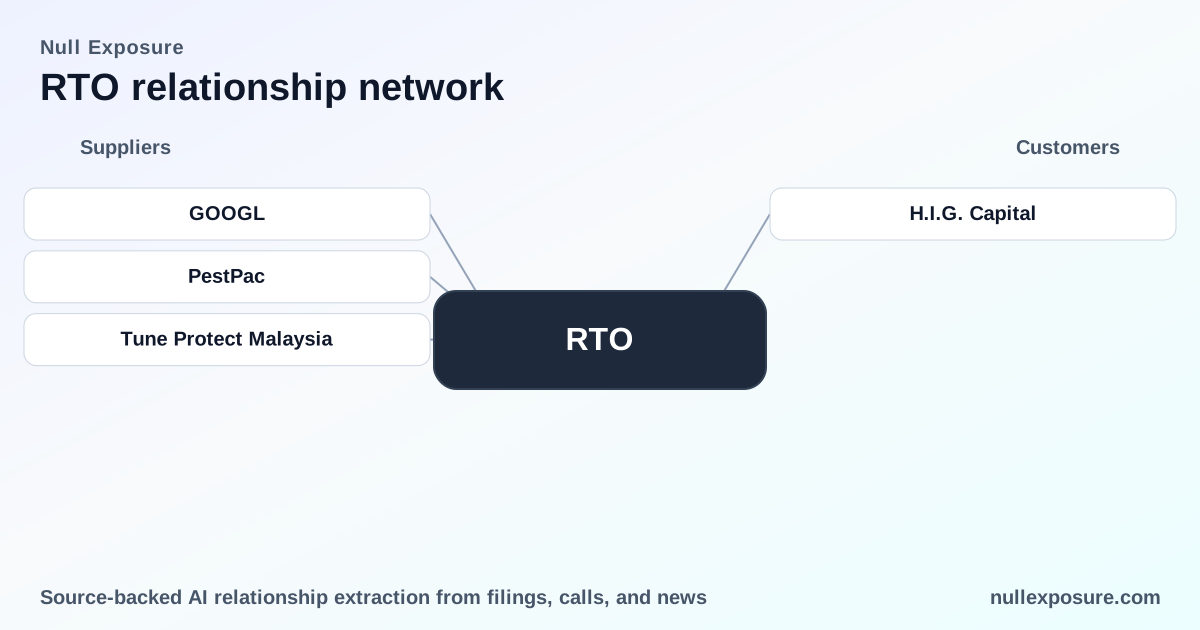
H.I.G. Capital — buyer of the France workwear business
Rentokil sold its France workwear business to H.I.G. Capital, indicating a portfolio pruning move that reduces exposure in that product-market and converts a non-core asset into liquidity. According to a Globe and Mail press release dated March 10, 2026, the transaction was announced as part of Rentokil’s strategic reshaping of regional workwear operations. (Source: The Globe and Mail press release, 2026-03-10.)
How that sale fits into customer-side strategy
The divestiture of the France workwear unit to H.I.G. is a strategic refocus rather than a market exit. For investors, the sale signals utility in two dimensions: (1) capital redeployment—management is freeing cash from lower-priority business lines to invest in core route-based services or higher-return M&A; and (2) portfolio simplification—reducing operational complexity in workwear while preserving global exposure where scale and margins are stronger. The buyer, H.I.G., is a private-equity operator that typically grows businesses via operational improvement and bolt-on deals, which implies Rentokil chose a trade buyer aligned to scale that asset outside its core route network.
Operational constraints and company-level signals
No explicit customer-level contractual constraints were returned in the dataset for these relationships; that absence itself is informative. At the company level, the following operational characteristics shape customer risk and opportunity:
- Contracting posture: Predominantly recurring, service-based contracts with periodic renewal windows; this produces predictable revenue but requires ongoing service quality and price management to avoid attrition.
- Concentration: Geographic diversification across North America, UK, Europe and Asia reduces single-market risk, though local regulatory and labor dynamics create differentiated execution risk by country.
- Criticality: Services are operationally critical for many commercial customers (food service, healthcare, manufacturing), producing high retention and low elasticity for core offerings.
- Maturity: The company operates a mature route network with established processes and steady organic growth; value creation is driven more by operational efficiency and cross-sell than by greenfield market penetration.
These company-level signals explain why divestments such as the France workwear sale are executed—management is sharpening focus on the most critical, scalable and margin-accretive customer relationships.
Risk and reward for investors focused on customers
- Upside: Improving technician productivity, price realization on renewals, and bolt-on acquisitions in high-margin geographies can expand EBITDA and compress the forward multiple toward peers. The forward P/E of ~20.4 suggests the market expects improved earnings delivery.
- Downside: Execution risk in field operations, labor cost inflation, and localized regulatory changes can pressure margins. Divestitures reduce complexity but create short-term volatility in reported revenue streams.
Key takeaways for analysts and operators
- Customer relationships are the primary asset—route density and retention convert directly into valuation multiple.
- Divestitures are being used as an active tool to recycle capital into higher-return parts of the business, exemplified by the sale of the France workwear unit to H.I.G. Capital (Globe and Mail, Mar 10, 2026).
- Operational execution trumps new logos in determining near-term EPS momentum; watch renewal pricing and technician utilization metrics.
If you want a targeted deep-dive on Rentokil’s customer counterparties and how transactions like the France workwear sale affect route economics, visit https://nullexposure.com/ for relationship-level analysis and transaction timelines.