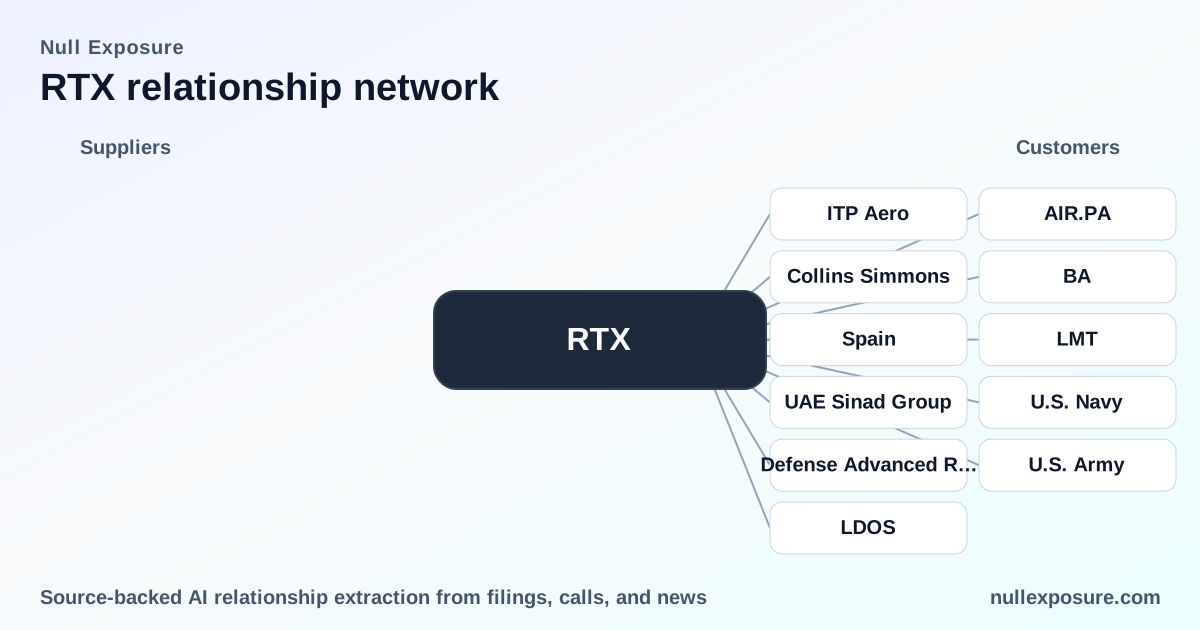
RTX customer relationships: a consolidated investor brief
Thesis: Raytheon Technologies (NYSE: RTX) monetizes through a blend of long-term defense contracts, OEM sales, and high-margin aftermarket services—Pratt & Whitney engines and Collins Aerospace avionics drive commercial OEM and aftermarket revenue while Raytheon-branded businesses deliver government systems and classified programs. Revenue is concentrated in long-duration government and aftermarket arrangements, giving RTX predictable cash flow but exposing it to program timing and geopolitical procurement cycles. For a deeper scan of structured customer exposures, visit https://nullexposure.com/.
How RTX sells value and where the cash comes from
RTX’s commercial model is dual-channel: OEM platforms (airframes and engines) generate cyclical revenue, while aftermarket services and long-term defense contracts create recurring, contractual cash flows. The company’s filing-level disclosures and earnings commentary show a contracting posture dominated by multi-year agreements and a government-heavy customer base — a profile that supports valuation stability but concentrates counterparty risk. Key operating signals from filings and calls:
- Contracting posture: Predominantly long-term engagements across Collins and Pratt & Whitney, with explicit long-term aftermarket and spare-parts commitments.
- Counterparty mix: Heavy government exposure; U.S. federal agencies and allied military customers account for a material share of defense sales.
- Geography: The business is global in scope but generates a large share of sales in North America.
- Role mix: RTX is primarily a seller/service provider (OEM + aftermarket) and also provides financing to airline customers in its commercial aerospace units.
- Materiality and maturity: Government sales are material and many contracts are mature, multi-year programs with predictable revenue profiles.
If you want to translate these signals into an exposure map for portfolio risk, see the product at https://nullexposure.com/ (company homepage).
Mapping every named customer and partner (source-by-source)
Below I list every relationship documented in the collected results with a short, plain-English summary and the original source context.
Collins Simmons — RTX disclosed completion of the divestiture of the Collins Simmons business during the Q4 2025 earnings call, signaling a structural change in Collins Aerospace’s asset base. Source: RTX 2025 Q4 earnings call (Mar 2026).
ITP Aero — RTX announced ITP Aero (Spain) joined the Pratt & Whitney GTF MRO network as a new maintenance, repair and overhaul partner during the Q4 2025 earnings call. Source: RTX 2025 Q4 earnings call (Mar 2026).
UAE Sinad Group — The Q4 2025 earnings call recorded the UAE Sinad Group joining the GTF MRO network, expanding Pratt & Whitney’s regional aftermarket footprint in the Middle East. Source: RTX 2025 Q4 earnings call (Mar 2026).
Spain (government) — RTX booked $1.2 billion to supply Spain with additional Patriot air- and missile-defense systems, reflecting a material government procurement award disclosed on the Q4 2025 call. Source: RTX 2025 Q4 earnings call (Mar 2026).
Lockheed Martin (LMT) — sensor delivery — Raytheon delivered a second missile-warning sensor to Lockheed Martin for the U.S. Space Force Next‑Gen OPIR GEO Block 0 satellite program, per RTX press release April 28, 2026. Source: RTX news center (Apr 28, 2026).
DVLT — A third‑party (DVLT) earnings call referenced collaboration with Raytheon and other defense primes on an R&D system leveraging federal labs and international collaborators, indicating RTX participation in joint development work. Source: DVLT Q3 2025 earnings call transcript (cited Mar 2026).
U.S. Space Force — Multiple outlets reported RTX selection by the U.S. Space Force to design and develop space‑based interceptor prototypes, adding a new layer to RTX’s space and missile‑defense pipeline. Source: industry coverage (SimplyWallSt / markets commentary, FY2026).
Lockheed Martin (program partner) — Coverage reiterated that Raytheon delivered a sensor to Lockheed Martin for Next‑Gen OPIR GEO Block 0, underscoring RTX’s role as a subsystem supplier on national space programs. Source: RTX news center (Apr 28, 2026).
Lockheed Martin (competitive context) — Analyst commentary positions Lockheed Martin as a primary defense rival while noting RTX’s strength as a subsystem supplier even on platforms it does not build. Source: FinancialContent/Finterra outlook piece (Mar 2026).
Boeing (BA / OEM) — Market analysis highlights RTX revenue split between original equipment for OEMs like Boeing and high-margin aftermarket services, confirming Boeing as a major commercial OEM customer. Source: Finterra/market analysis (Mar 2026).
Embraer (EMBJ / ERJ) — Pratt & Whitney was recognized by Embraer as Best Supplier of the Year for 2026 for collaboration on the PW1900G‑powered E2 family, reflecting strong OEM supplier relations. Source: RTX press release and Embraer recognition (Apr 2026).
Airbus — Multiple analyses and reports list Airbus as a major OEM customer for RTX’s GTF engines and avionics, and they document production‑timing frictions tied to engine deliveries. Source: market analysis and industry reports (Feb–Mar 2026).
Volaris (VLRS) — Volaris’ filings and earnings releases note compensation arrangements with Pratt & Whitney related to GTF engine inspections/groundings, evidencing contractual remediation flows from RTX to affected carriers. Source: Volaris financial reports and press releases (FY2025–FY2026).
Horizon Aircraft (HOVRW) — A press release shows Horizon selected Pratt & Whitney’s PT6A engine for a hybrid eVTOL program, indicating Pratt & Whitney’s presence in new‑mobility propulsion. Source: Horizon press release / industry coverage (FY2025).
AIR (AAR / AIR as customer/partner references) — Industry coverage documents OEM and overhaul joint ventures and distribution agreements involving Collins Aerospace, showing RTX’s channel partnerships for nacelle and maintenance services. Source: trade reporting and company disclosures (FY2026).
DARPA — RTX’s BBN Technologies won a DARPA contract under the XENA program to advance battlefield situational awareness, showing engagement in high‑risk, early‑stage government R&D work. Source: iConnect007 / program announcement (FY2026).
Leidos (LDOS) — Reports note Pratt & Whitney received a follow‑on contract to supply TJ150 engines for Leidos’ small cruise missile, indicating RTX propulsion tech is used in third‑party weapons development. Source: Finviz / market commentary (FY2026).
TransDigm (TDG) — TransDigm agreed to acquire Simmonds Precision Products from RTX for about $770 million, illustrating RTX divestitures of non‑core or surplus component units. Source: SimplyWallSt / acquisition reporting (Jun 30, 2026 announcement).
U.S. Navy — RTX secured a $256.26 million contract modification supporting the F135 propulsion system for the F‑35 program, reaffirming RTX’s central supplier role on tier‑one defense platforms. Source: program contract announcement (FY2026).
U.S. Army — A $183.68 million Army contract for Patriot hardware to the UAE was reported, extending RTX’s global defense supply chain reach and foreign military sales channel. Source: market reporting / contract disclosure (FY2026).
ASLE — Aerospace supply‑chain commentary cited ongoing challenges tied to Pratt & Whitney GTF engine disruptions, with suppliers like ASLE flagging exposure to engine delivery risk. Source: earnings call transcript coverage (FY2026).
JetBlue (JBLU) — JetBlue’s public commentary flagged higher operating costs and parked aircraft tied to Pratt & Whitney GTF inspections, reflecting direct airline impact and contractual remediation considerations. Source: market news and airline commentary (FY2025–FY2026).
Embraer (additional reporting) — Industry reporting on Embraer production plans reiterates the E2 family’s reliance on Pratt & Whitney GTF engines and the supplier relationship implications. Source: AirInsight and RTX news (FY2025–FY2026).
Additional industry analyst coverage (Airbus / AIR.PA entries) — Several analyst notes documented Airbus revising A320 production targets due to GTF delivery delays, underscoring program timing risk for RTX’s commercial engine business. Source: Trefis / analyst research (Feb–Mar 2026).
Key takeaways for investors
- Concentration and criticality: Government contracts and long‑term aftermarket agreements are material to RTX’s cash flow and valuation; U.S. federal sales account for a large portion of defense revenue.
- Contracting posture: The business skews toward long‑term, high‑maturity contracts, which stabilizes revenue but concentrates execution risk.
- Operational constraints: Engine delivery schedules and MRO network expansions are commercial levers that directly affect airline customers and supplier relationships—these are visible in multiple carrier filings and earnings calls.
- Global exposure: RTX is global by design, but North America remains the largest revenue region; geopolitics and allied procurement cycles will influence backlog and timing.
For a practical exposure map linking contracts, counterparties, and program timing, see our company coverage at https://nullexposure.com/.