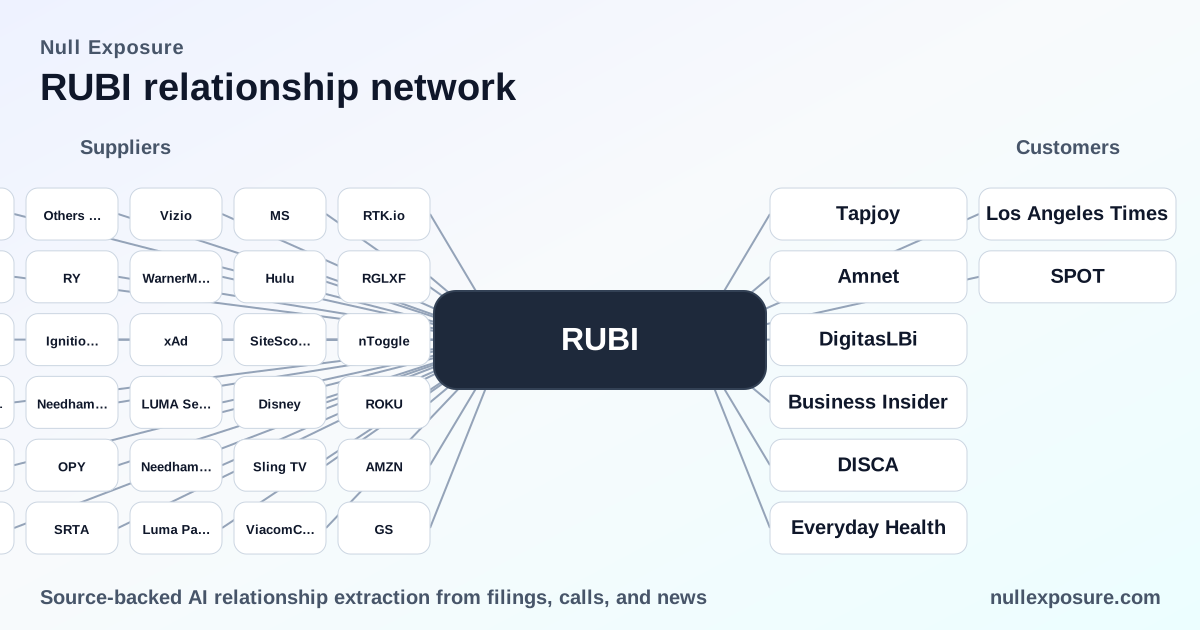
Rubico Inc. (RUBI) — Customer relationships that shape a programmatic marketplace business
Rubico operates a technology-first marketplace that automates the buying and selling of digital advertising inventory, monetizing primarily through platform fees and transaction-driven margins on private marketplace (PMP) and programmatic exchanges. The company generates revenue by embedding itself in publisher stack and buy-side workflows—selling access, yield tools and integration services to publishers and buy-side partners who route spend through Rubico’s systems. For investors, the key thesis is simple: Rubico is a platform play whose valuation depends on continued adoption by large publishers and buy-side ecosystems, plus the stickiness of its monetized integrations. Learn more about our coverage at https://nullexposure.com/.
Market signal summary and what relationships mean for revenue mix
Rubico’s disclosed customer relationships across publishers, demand-side partners and exchanges demonstrate a mixed portfolio: publisher-focused yield tools (Demand Manager, header-bidding), proprietary PMP integrations, and programmatic audio/video placements. These relationships show Rubico winning both publisher distribution and buy-side partnerships — a dual-sided model that supports volume-based monetization and pricing power on fees. Below I break down every customer relationship surfaced in the records and cite the original reporting.
Customer relationships (each relationship from the results, with source)
-
Tapjoy
Rubico was selected as Tapjoy’s exclusive programmatic provider at the launch of Tapjoy’s private exchange, positioning Rubico as a preferred supply-side partner for mobile-first inventory. Source: Martech coverage of the Tapjoy launch (FY2016) — https://martech.org/tapjoy-private-exchange-launch-rubicon-project/ -
Amnet
Rubico signed Amnet as a buy-side partner, reflecting adoption by global agency demand teams and expanding Rubico’s buyer footprint. Source: AdExchanger reporting on Rubico growth and partner signings (FY2015) — https://www.adexchanger.com/investment/rubicon-project-reports-62-growth-37-2-million-revenue/ -
DigitasLBi
DigitasLBi joined as another buy-side partner alongside Amnet, signaling early agency-level distribution for Rubico’s programmatic inventory. Source: AdExchanger partner coverage (FY2015) — https://www.adexchanger.com/investment/rubicon-project-reports-62-growth-37-2-million-revenue/ -
Business Insider
Business Insider is listed among publishers using Rubico’s Demand Manager product, indicating Rubico’s penetration into major digital media publishers’ yield stacks. Source: AdExchanger article about Rubico’s acquisition and product distribution (FY2019) — https://www.adexchanger.com/platforms/rubicon-project-buys-header-bidding-tech-startup-rtk-io-for-11-million/ -
DISCA (Discovery, Inc. reporting ticker)
Discovery Inc. (reported under DISCA) is named as a Demand Manager customer, representing a large media group relationship and potential high-volume supply for Rubico’s marketplace. Source: AdExchanger on Demand Manager publisher roster (FY2019) — https://www.adexchanger.com/platforms/rubicon-project-buys-header-bidding-tech-startup-rtk-io-for-11-million/ -
Discovery Inc.
Discovery Inc. is separately listed in the same publisher roster as a Demand Manager user, reinforcing that Rubico’s product is deployed across multiple properties within large media companies. Source: AdExchanger (FY2019) — https://www.adexchanger.com/platforms/rubicon-project-buys-header-bidding-tech-startup-rtk-io-for-11-million/ -
Everyday Health
Everyday Health appears as a publisher customer using Demand Manager, signaling Rubico’s reach into specialized health vertical publishers and diversified content categories. Source: AdExchanger reporting on Demand Manager customers (FY2019) — https://www.adexchanger.com/platforms/rubicon-project-buys-header-bidding-tech-startup-rtk-io-for-11-million/ -
Los Angeles Times
The Los Angeles Times is listed among publishers deploying Demand Manager, providing Rubico exposure to large regional news inventory and potential premium CPMs. Source: AdExchanger (FY2019) — https://www.adexchanger.com/platforms/rubicon-project-buys-header-bidding-tech-startup-rtk-io-for-11-million/ -
Google’s DoubleClick (Bid Manager integration)
Rubico integrated its Private Marketplace deals directly into Google’s Bid Manager, embedding Rubico supply into a dominant buy-side interface and easing buyer access to Rubico-managed inventory. Source: MarketingDive report on the partnership (FY2017) — https://www.marketingdive.com/news/google-doubleclicks-new-partnership-with-rubicon-project-could-have-indust/507926/ -
SPOT (exchange symbol for Spotify listing)
Rubico was one of the programmatic suppliers supporting Spotify’s programmatic audio advertising initiative, demonstrating product applicability to audio inventory. Source: MusicBusinessWorldwide on Spotify’s programmatic audio deal (FY2016) — https://www.musicbusinessworldwide.com/spotify-is-asking-brands-to-bid-on-ad-slots-based-on-your-music-tastes/ -
Spotify
Beyond the ticker reference, Spotify specifically adopted Rubico’s programmatic audio capabilities along with other programmatic specialists, which expands Rubico’s addressable supply beyond display into audio streaming inventory. Source: MusicBusinessWorldwide (FY2016) — https://www.musicbusinessworldwide.com/spotify-is-asking-brands-to-bid-on-ad-slots-based-on-your-music-tastes/
Operating model and business-model characteristics investors need to weigh
No contract-level constraints were provided in the reviewed records; treat the absence of explicit contract disclosures as a company-level signal of limited public contract detail rather than a relationship-specific limitation. From the relationship set above, the operating dynamics are clear:
- Contracting posture: Platform and integration-focused. Rubico locks in publishers via product installs (Demand Manager, header-bid integrations) and locks in buyers through marketplace/DM integrations like Bid Manager, favoring high switching costs once integrations are live.
- Concentration: Mixed but industry-focused. Relationships include both major publishers and large buy-side entities; this indicates revenue concentrations can arise from a handful of large publishers or DSP integrations but also shows distribution across content verticals.
- Criticality: High for connected partners. For publishers and buyers that route programmatic flows through Rubico’s stack, Rubico performs a critical routing and yield function—meaning these relationships are strategically valuable and revenue-relevant.
- Maturity: Commercialized, with visible product expansion. The timeline of PMP, Demand Manager adoption and header-bidding acquisitions suggests a company past early product-market fit and into scale/monetization.
Mid-article note: for institutional readers seeking ongoing relationship monitoring and alerts, see https://nullexposure.com/ for continuous coverage and signals.
Risk and opportunity synthesis
- Opportunity: Distribution into large publishers and native buy-side integrations (e.g., Google Bid Manager, agency partners) creates long-term volume tailwinds and fee capture; audio inventory wins (Spotify) broaden monetizable inventory types.
- Risk: Dependency on major publisher and exchange integrations means that any disintermediation or competitive re-platforming by publishers or dominant exchanges could have outsized revenue impact. The available records do not disclose long-form contract terms or revenue concentration metrics.
Bottom line
Rubico’s customer signal set demonstrates a classic two-sided marketplace strategy: secure supply via publisher tools and monetize through integrated buyer access. That business model drives scalability when adoption penetrates large media groups and buy-side systems, but it also concentrates risk where a handful of integrations drive meaningful transactional volume. Investors should prioritize monitoring publisher concentration, integration persistence (e.g., long-term PMP and Demand Manager deployments), and any public contract disclosures that would clarify revenue persistence.
Key takeaway: Rubico monetizes by embedding in the programmatic supply chain; its value to investors is driven by the scale and stickiness of those embedded relationships.