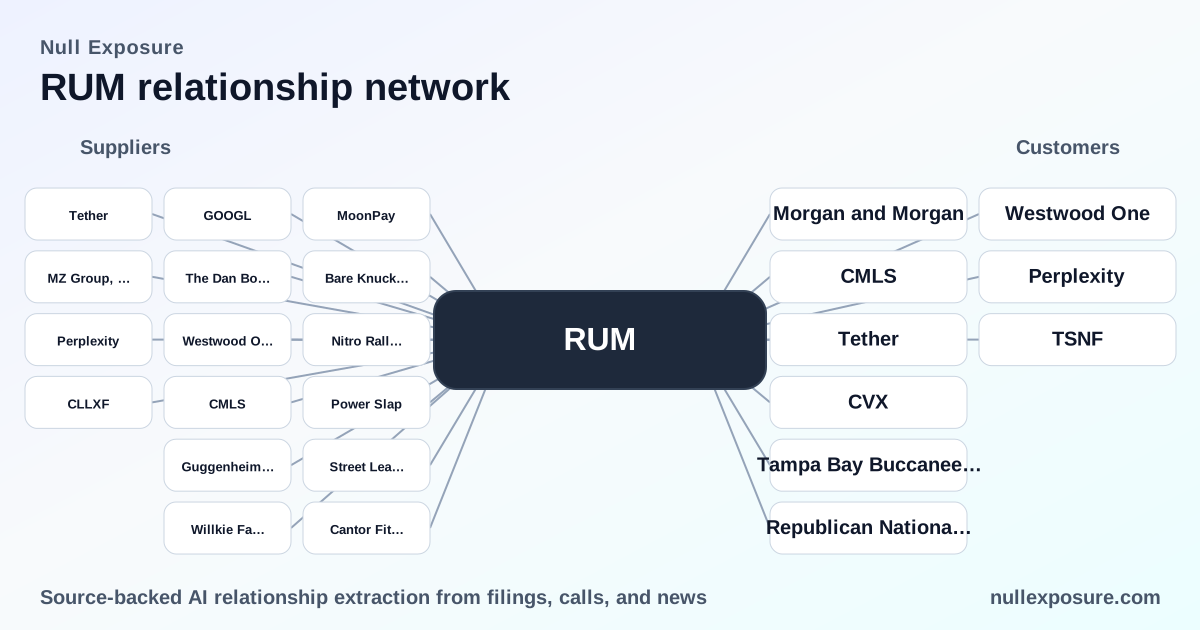
Rumble Inc. (RUM): Customer Relationships That Drive an Ad-First Platform with a Growing Infrastructure Business
Rumble operates a video-sharing platform that monetizes primarily through advertising while expanding higher-margin infrastructure and cloud services under the Rumble Cloud banner. The firm generates revenue as a publisher and ad-seller while layering subscription and usage-based infrastructure contracts and content-licensing deals, creating a blended monetization mix that increases revenue diversity but keeps advertising concentration as a central risk.
For a fast read on Rumble customer exposures and commercial posture, see a short company analysis at https://nullexposure.com/ — the following commentary focuses on counterparties cited in public filings and press coverage that materially inform revenue concentration, customer mix, and strategic direction.
How Rumble actually signs customers and gets paid
Rumble’s commercial profile is a hybrid model: ad inventory monetization and platform licensing are the legacy cash engines, while Rumble Cloud brings subscription and consumption billing to the mix. Public disclosures and management commentary indicate Rumble sells advertising inventory (where it acts as principal), licenses content to third parties, and offers IaaS-style cloud services with both subscription and usage-based pricing. These operating realities imply:
- Contracting posture: a combination of self-serve ad buys plus negotiated, multi-year commercial agreements for cloud and large advertiser commitments.
- Concentration & criticality: advertising remains dominant (66% of revenue in 2024), with a single large customer historically responsible for a meaningful share of revenue (16% in 2024; 46% in 2023).
- Maturity & segmentation: Rumble Services (video, streaming marketplace, RAC) are the established revenue engines; Rumble Cloud is early-stage infrastructure but strategically prioritized for scale and higher-margin revenue.
- Revenue recognition posture: mix of variable-consideration licensing and principal-driven ad sales combined with subscription/consumption billing for cloud services.
These company-level signals guide how investors should think about counterparties: advertising customers can be transient and concentrated, while cloud customers create recurring, contract-backed revenue if Rumble successfully scales its infrastructure offering.
Customer roll call — what management and the press disclosed
Below are the explicit customer relationships disclosed in Rumble’s call transcripts and in news reports. Each entry is a plain-English summary with a concise source reference.
Cumulus Media (CMLS) / Westwood One
Rumble announced a strategic partnership that integrates Cumulus Radio stations, the Westwood One network, and Cumulus’s podcast network, expanding Rumble’s distribution and ad inventory reach beyond video into audio and podcast audiences. According to Rumble’s Q2 2025 earnings call and a subsequent press release picked up by Yahoo Finance (2025–2026 reporting window).
Westwood One (as distribution partner)
Westwood One will distribute audio and video content on Rumble’s platform, effectively syndicating content and increasing monetizable impressions for the RAC advertising engine. This distribution deal was described in the joint Cumulus/Westwood One announcements and reported by Yahoo Finance in late 2025.
Chevron (CVX)
Management cited Chevron as an early brand win that has re-upped a campaign, signaling that mainstream, blue-chip advertisers are committing repeat spend on Rumble’s ad platform. The reference to Chevron was made on Rumble’s Q2 2025 earnings call (management remarks, March 2026).
Morgan and Morgan
Rumble disclosed that Morgan and Morgan, a large injury law firm, onboarded in Q2 2025, representing continued traction with large direct-response advertisers that buy targeted video inventory. This onboarding was stated on the Q2 2025 earnings call (March 2026).
Tether
Tether emerges as a strategically significant commercial and financial counterparty: multiple filings and press releases describe an equity investment, an advertising commitment (reported as $100 million total, $50 million per year beginning 2026), and a multi-year GPU leasing commitment of up to $150 million over two years tied to Rumble’s broader Northern Data transaction plans. Sources include Rumble corporate releases (Dec 2024 investor announcement), DatacenterDynamics and BeBeez coverage of the 2025 Northern Data transaction, and Benzinga/Reuters reporting in late 2025 and early 2026.
Tampa Bay Buccaneers
Rumble provides infrastructure to store and serve all of the Tampa Bay Buccaneers’ video content, highlighting enterprise media-hosting use cases for Rumble Cloud and its content-management capabilities. This customer relationship was reported by DatacenterDynamics in November 2025.
Perplexity
Rumble and Perplexity entered a strategic partnership to integrate AI-driven video discovery, combine subscription offers, and coordinate advertising promotion for Perplexity’s Comet product — an example of platform-level product integration that can boost user engagement and multi-product ARPU. The partnership was described in a GlobeNewswire-type summary picked up by industry outlets in December 2025.
Republican National Committee (RNC)
Rumble announced an online streaming partnership with the Republican National Committee for the first Republican presidential primary debate (August 2023), demonstrating that political streaming events are part of Rumble’s content and commercial playbook. The partnership was described in a Rumble corporate blog post summarizing the 2023 streaming arrangement.
Truth Social (TSNF)
Rumble Cloud hosts Truth Social’s platform, reflecting Rumble’s role as an infrastructure provider for politically aligned social media and content platforms; coverage appeared in DatacenterDynamics and related reporting around the Rumble–Northern Data transaction in late 2025. The DatacenterDynamics piece specifically notes Truth Social is hosted on Rumble Cloud (November 2025).
What these relationships imply for investors
- Diversification trajectory: The mix of traditional advertisers (Chevron, Morgan and Morgan), media partnerships (Cumulus/Westwood One, RNC) and infrastructure customers (Tampa Bay Buccaneers, Truth Social, Tether GPU commitments) shows Rumble is intentionally diversifying revenue away from pure ad reliance toward contract-backed cloud and GPU services. This reduces volatility potential if execution scales.
- Concentration risk persists: Despite diversification, public disclosures show advertising still drives the majority of revenue (66% in 2024) and a single customer historically accounted for a materially large share — a structural concentration risk that underpins top-line volatility.
- Commercial cadence: Contracts show a mix of self-serve ad buys and negotiated multi-year commitments; infrastructure sales are described as subscription and consumption-based, creating predictable recurring revenue if Rumble retains enterprise customers.
- Strategic optionality with Northern Data/Tether: The Tether commitments and Northern Data transaction, if consummated, insert a large anchor GPU/customer that could materially change revenue mix and gross margins through higher-margin infrastructure leasing and advertising commitments reported in late 2025 coverage.
Key takeaways for operators and researchers
- Rumble is an ad-first platform building an infrastructure revenue engine. Advertising remains the revenue core, but infrastructure contracts (subscription + usage-based) are the strategic growth lever.
- Customer mix now spans direct-response advertisers, legacy broadcasters/publishers, political event partners, sports franchises, and a large strategic investor/customer (Tether). This broad footing reduces single-channel exposure but does not eliminate concentration risk.
- Contracts are a mix of licensing, principal ad-sales, and recurring infrastructure billing. Investors should model continued advertising concentration while stress-testing scenarios where Rumble scales cloud revenue per the Tether/ Northern Data disclosures.
If you want a concise, investor-facing summary of counterparty exposures and contract types to integrate into financial models, visit https://nullexposure.com/ for structured exposure reports and contextualized customer intelligence.