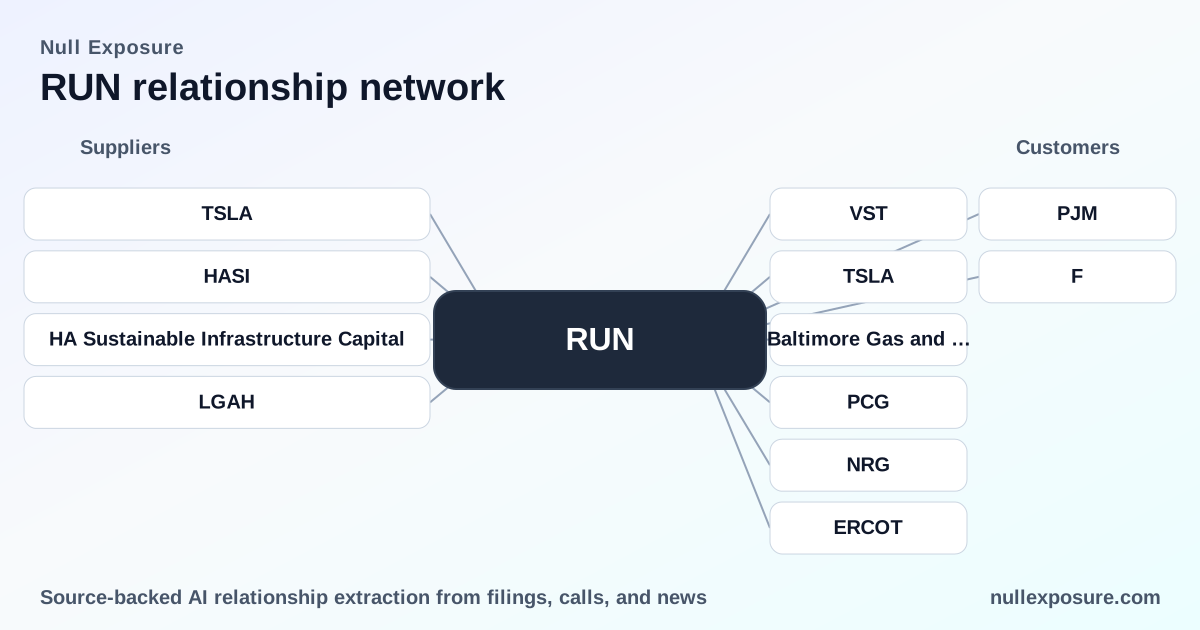
Sunrun (RUN) — customer relationships that drive the virtual power plant thesis
Sunrun operates and monetizes through long-term residential solar and storage subscriptions: the company installs and retains ownership of rooftop systems, sells the generated energy under 20–25 year customer agreements, and layers grid services revenue by coordinating enrolled home batteries and EVs into distributed power plants for utilities and retail energy providers. These customer relationships produce steady, contractually anchored cash flows from homeowners and create high-margin ancillary revenue streams when utilities or retailers call on Sunrun capacity. For a deeper view of partner exposures and source documents, visit Null Exposure.
Why the partner mix matters for investors
Sunrun’s economic model blends stable, long-dated consumer contracts with opportunistic utility and retail partnerships that monetize flexibility. The provided evidence establishes several company-level operating characteristics:
- Contracting posture: Customer Agreements are typically long-term (20–25 years) and Sunrun markets services as a subscription; this creates a predictable revenue base with asset-level longevity.
- Counterparty profile: Primary customers are individual residential homeowners in the U.S., which reduces single-customer concentration but increases exposure to aggregate homeowner churn and regional adoption dynamics.
- Geographic footprint: Operations are U.S.-centric, with concentration in California, Arizona, New Jersey, New York, Maryland, Illinois and Massachusetts—useful for modeling state-level incentive and utility program risk.
- Segment orientation: Revenue is driven by services (subscription energy sales and coordination of exported energy/SRECs) rather than one-off hardware sales.
- Financial signal: Warranty reserves are recorded as immaterial; fleet vintage is young (average age < 6 years), indicating recent growth and lower near-term replacement spend.
These constraints translate into a hybrid risk profile: low counterparty concentration but high dependency on regulatory and utility program design for the incremental grid-services revenue line. For the primary source documents used in this analysis, see the company and press coverage collated at Null Exposure.
Partner-by-partner: the customer and utility relationships that matter
NRG / NRG Energy
Sunrun announced a partnership to pair its solar+storage offerings with NRG’s retail electric plans, integrating optimized rate plans and enabling activation of Sunrun capacity for retail customer benefit and market participation. Source: Q4 earnings commentary summarized in an InsiderMonkey earnings-transcript report (FY2026; InsiderMonkey, Mar 10, 2026 — https://www.insidermonkey.com/blog/sunrun-inc-nasdaqrun-q4-2025-earnings-call-transcript-1706229/).
Vistra’s TXU Energy (VST)
In Texas, Sunrun’s distributed power plant with Vistra’s TXU Energy was dispatched more than 200 times during extreme heat events, demonstrating the scale and operational reliability of customer-enrolled capacity to provide critical energy and cost control. Source: Globe and Mail press release coverage of Sunrun’s distributed power plant (FY2026; Mar 10, 2026 — https://www.theglobeandmail.com/investing/markets/stocks/RUN/pressreleases/37380226/).
Pacific Gas and Electric Company (PG&E / PCG / PCG-P-I / Pacific Gas and Electric Company)
Sunrun expanded a distributed power plant partnership with PG&E to more than 1,000 enrolled systems, where customers were paid to share stored solar energy and Sunrun collected coordination fees for exporting capacity that reduces grid constraints and defers infrastructure upgrades. Source: Solar Power World and IndexBox reporting on the PG&E collaboration (FY2026; Feb–Mar 2026 — https://www.solarpowerworldonline.com/2026/02/pge-expands-sunrun-solar-storage-projects-for-backup-grid-power/; https://www.indexbox.io/blog/sunrun-and-pge-expand-distributed-power-plant-partnership-to-over-1000-systems/).
Tesla / Tesla Electric / TSLA
Sunrun referenced programs launched with Tesla that integrate retail electricity plans and storage subscriptions, indicating revenue opportunities from retail partners that offer combined electricity plans and distributed resource coordination. Source: Sunrun Q4 remarks captured by InsiderMonkey (FY2026; Mar 10, 2026 — https://www.insidermonkey.com/blog/sunrun-inc-nasdaqrun-q4-2025-earnings-call-transcript-1706229/).
Baltimore Gas and Electric Company
Sunrun launched the nation’s first residential vehicle-to-grid distributed power plant in partnership with Ford and Baltimore Gas and Electric Company, demonstrating EV battery aggregation for peak-demand stabilization and localized grid support. Source: Globe and Mail press release summarizing the V2G program (FY2026; Mar 10, 2026 — https://www.theglobeandmail.com/investing/markets/stocks/RUN/pressreleases/37380226/).
Ford (F)
Ford is a named partner in the vehicle-to-grid distributed power plant project with Baltimore Gas and Electric and Sunrun, supplying EV battery capacity as a grid asset and opening a new customer channel for managed charging and V2G payments. Source: Globe and Mail program coverage (FY2026; Mar 10, 2026 — https://www.theglobeandmail.com/investing/markets/stocks/RUN/pressreleases/37380226/).
ERCOT (regional operator)
Analyst and sector commentary highlight ERCOT as an active market that calls on Sunrun capacity; monitoring call frequency and pricing in markets like ERCOT is material to projecting segment-level revenue for grid services. Source: Sahm Capital analysis on Sunrun’s virtual power plant dynamics (FY2026; Feb 6, 2026 — https://www.sahmcapital.com/news/content/sunruns-growing-virtual-power-plant-recasts-rooftop-solar-and-grid-services-2026-02-06).
PJM (regional operator)
PJM is another jurisdictional program referenced by analysts as a potential caller of Sunrun capacity; exposure to PJM/ISO program rules and settlement prices affects the upside of grid-services monetization. Source: Sahm Capital commentary (FY2026; Feb 6, 2026 — https://www.sahmcapital.com/news/content/sunruns-growing-virtual-power-plant-recasts-rooftop-solar-and-grid-services-2026-02-06).
What investors should watch next
- Activation cadence and pricing disclosure: Frequency of utility/retailer calls (ERCOT, PJM, California programs) and published compensation terms will determine whether grid-services become a material, repeatable revenue stream. Watch upcoming segment disclosures for monetized revenue and margin contribution.
- Customer churn and contract economics: Long-term customer agreements provide durability, but subscriber economics (retention, system performance, and any localized program opt-outs) will shape lifetime value.
- Regulatory design and utility adoption: The pace at which large incumbents (PG&E, Vistra/TXU Energy, NRG) widen deployments into new territories will set the scale for coordination fees and market participation revenue.
Investment implications and verdict
Sunrun’s model combines durable subscription cash flow with a nascent, high-margin grid-services growth vector. The partner map shows broad engagement across utilities, retailers and OEMs—a necessary condition for scaling virtual power plant economics. For an investor, the key valuation lever is how quickly Sunrun converts dispatch activity into reported revenue and sustainable margins.
For the underlying document set and a consolidated, source-linked view of these customer relationships, visit Null Exposure.