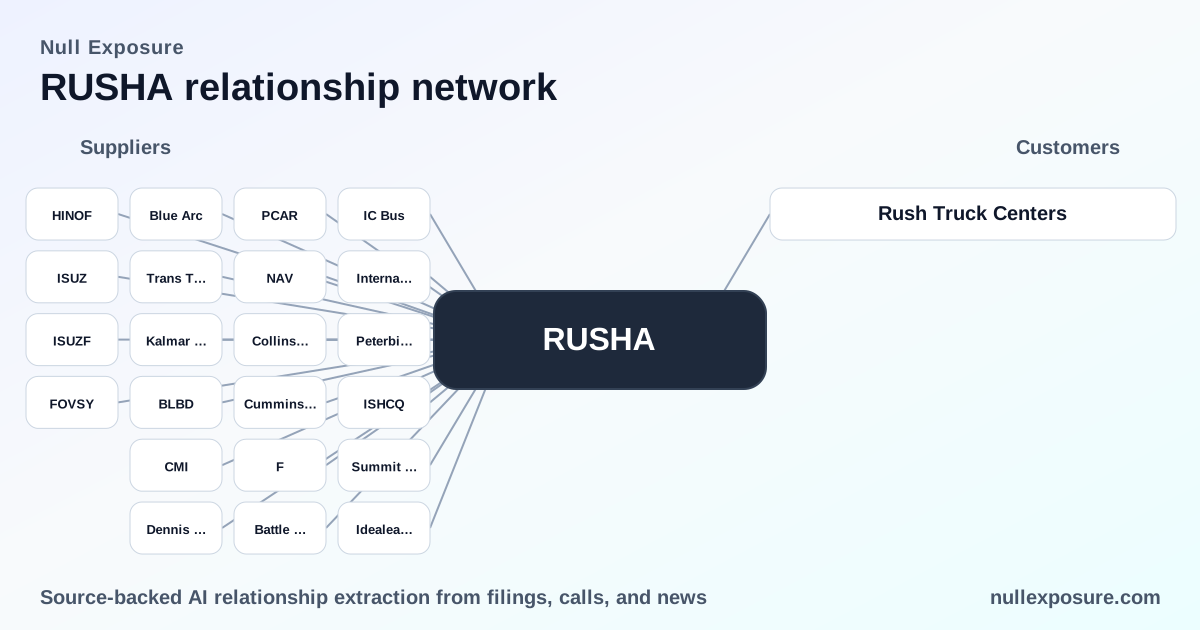
Rush Enterprises (RUSHA) — Customer Relationships and Commercial Dynamics
Rush Enterprises operates an integrated, vertically oriented commercial vehicle retail and services platform that earns durable margins from new and used truck sales, parts and service, and captive financing and insurance. The company monetizes by selling new heavy-duty trucks (the largest revenue driver), retaining inventory risk as a principal reseller, and capturing recurring aftermarket revenue through parts, service, leasing and finance products. For investors, the key investment case is a stable North American franchise with diversified revenue streams and a backlog mechanism tied directly to dealer orders. For further platform-level analysis and comparable customer coverage see https://nullexposure.com/.
The concise investment thesis
Rush runs a dealer-first business where new truck sales drive top-line scale while parts, service, finance and leasing convert that scale into repeatable cash flow. Revenue concentration in new commercial vehicle unit sales is offset by higher-margin aftermarket services and a captive leasing/finance posture that extends customer lifetime value; management reports backlog and unit flows centrally through its Rush Truck Centers network.
How Rush monetizes across the value chain
Rush captures value at multiple touchpoints:
- Hardware sales: New commercial vehicle sales constituted the largest portion of revenue — management reported approximately $4.553 billion in new vehicle sales for 2024, representing the core cash engine of the business (FY2024 Form 10‑K).
- Services and parts: Aftermarket parts, collision and repair facilities provide recurring, higher-margin revenue that smooths vehicle-sales cyclicality.
- Financial products: Rush extends financing, leasing and insurance, creating a captive-like relationship that deepens customer stickiness and generates interest and fee income over multi-year horizons.
Market snapshot as of the latest quarter (2026-03-31): TTM revenue $7.27B, EBITDA $638.7M, market cap ~$5.51B, and forward P/E ~14.5, positioning Rush as a mid-cap operator with defensive aftermarket earnings and cyclical exposure to truck OEM cycles.
What Rush Truck Centers means for investors
Rush Truck Centers is the company’s retail and fulfillment network — the customer-facing engine where orders, deliveries and service converge. According to the FY2024 Form 10‑K, backlog is calculated by multiplying the number of new commercial vehicles ordered at Rush Truck Centers by recent average selling prices, directly linking dealer order flow to near-term revenue recognition and inventory planning (FY2024 Form 10‑K, filed 2026). This operational linkage provides investors with a transparent, volume-driven signal for revenue cadence and working-capital exposure.
Relationship entry: Rush Truck Centers
Rush Truck Centers is the company-owned dealer network that takes inventory risk, determines selling price, and serves as the primary channel for new and used commercial vehicle sales and associated services. According to the FY2024 Form 10‑K, Rush determines backlog by tallying orders placed at its Rush Truck Centers and applying average selling prices, making these centers the operational fulcrum for near-term revenue (FY2024 Form 10‑K, FY2024).
Operational constraints and what they reveal about risk and resilience
The company filings deliver actionable signals about contracting posture, customer mix and geographic concentration that should inform counterparty and operational risk assessments.
-
Contracting posture — mixed tenor. Rush uses both long-term leases (1–10 year finance and operating leases) for vehicle lease exposure and predominantly short-term service contracts (monthly) for repair and parts revenue, indicating a revenue base that blends durable lease cash flows with high-frequency, transactional service income (FY2024 Form 10‑K). This mix reduces single-source timing risk: lease revenue smooths cycles while services provide cash convertibility.
-
Counterparty mix — fleet scale plus local government and small operators. The customer base includes national and regional fleets, corporations, local and state governments, and owner‑operators, which provides diversification across public and private buyers; the company explicitly notes greater financing exposure to owner‑operators and smaller fleets, though these comprised a smaller share of 2024 commercial vehicle sales (FY2024 Form 10‑K). The presence of government fleet customers introduces credit quality diversity but also procurement seasonality.
-
Geographic concentration — North America-centric. Rush operates principally across the United States and Ontario, Canada, with market share concentrated in U.S. Class 8 sales (~6.1% market share in 2024) and a small Canadian footprint (~1.7% of Canada Class 8 sales), making the business sensitive to North American trucking cycles and regulatory regimes (FY2024 Form 10‑K).
-
Role clarity — principal dealer and service provider. The company is the principal in commercial vehicle transactions, retaining inventory risk, setting selling prices, and delivering vehicles; it also operates as a buyer, seller, reseller and service provider through its integrated Truck Segment, which centralizes sales, parts, service and finance (FY2024 Form 10‑K). That posture supports margin capture but embeds inventory and residual value risk.
-
Relationship maturity — large fleet relationships are mature. Management reports a significant portion of new sales are to large fleets, and the network’s geographic scale enables national fleet servicing and remarketing of used trade-ins, indicating mature, repeat customer relationships that underpin recurring revenue (FY2024 Form 10‑K).
-
Segment mix — hardware-led with service acceleration. New commercial vehicle sales remain the largest revenue generator, while aftermarket products and services represent an important margin-enhancing stream; the company reports one consolidated Truck Segment that spans both hardware and services, which creates natural cross-sell opportunities and margin diversification (FY2024 Form 10‑K).
For a deeper look at the customer-contract mechanics and how backlog translates to liquidity management, see detailed coverage at https://nullexposure.com/.
Investment implications — drivers and risk factors
- Driver — recurring aftermarket and captive finance income. Aftermarket parts, maintenance and financing convert episodic vehicle sales into predictable cash flow and protect margins during OEM-driven new-unit downturns.
- Risk — cyclical demand and inventory/used-vehicle residuals. Heavy dependence on Class 8 unit sales exposes Rush to freight-cycle volatility and used-vehicle price swings that can stress working capital and used-asset valuations.
- Balance-sheet nuance. The coexistence of long-term leases and short-term service contracts creates a blended receivable and asset profile; investors should monitor lease receivables, inventory days and finance yield spreads.
- Valuation context. At current multiples (EV/EBITDA ~15, forward P/E ~14.5) the market prices Rush as a mid-cycle operator with modest growth assumptions; successful execution depends on sustaining aftermarket margin and preserving fleet relationships.
Bottom line: what to watch next quarter
- Monitor backlog changes at Rush Truck Centers and unit order flow as a forward indicator of revenue; the company ties backlog directly to dealer orders in the FY2024 10‑K.
- Watch used-vehicle realizations and finance spread compression as leading indicators of working capital stress.
- Track revenue mix shifts between new vehicle sales and aftermarket/service — rising service penetration improves margin defensibility.
For authoritative tracking of RUSHA customer relationships and signals across filings, visit https://nullexposure.com/ for ongoing updates and annotated filing excerpts.