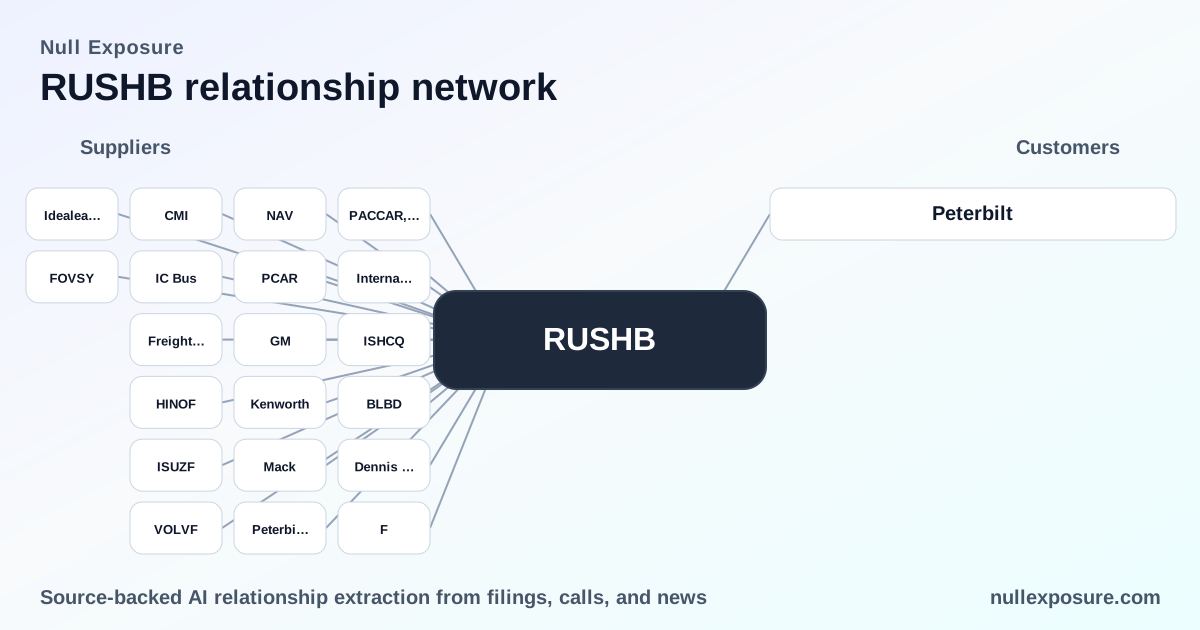
Rush Enterprises (RUSHB) — Customer relationships, constraints and investment implications
Rush Enterprises operates a coast-to-coast network of Rush Truck Centers that retail and service commercial vehicles and monetize through the sale of new and used trucks, high-margin aftermarket parts and maintenance services, and related finance and insurance products. The company’s economics are driven by high-volume vehicle turnover (62.6% of revenue) and disproportionately large gross profit contribution from aftermarket services (60.4% of gross profit) — a business mix that combines lower-margin inventory sales with recurring, higher-margin service revenue. For a concise look at detailed relationship mapping and contract posture, visit the NullExposure coverage page: https://nullexposure.com/.
Investment thesis up front
Rush is a retail and service platform that captures both transactional upside from vehicle sales and recurring margin from parts and service. Investors should value Rush as a hybrid retailer/service operator: vehicle sales drive scale and market share, while aftermarket and maintenance contracts drive margin stability and higher lifetime customer revenue. Geographic concentration across North America and a diversified customer base that includes fleets, governments and owner-operators give Rush a defensive channel for commercial vehicle demand cycles.
How Rush actually works — the operating model in plain English
Rush buys, holds and retails commercial trucks, retains inventory risk, sets selling prices, and delivers vehicles to customers; concurrently it operates service bays and parts distribution centers that convert installed customer bases into recurring revenue. This structure creates two complementary economic engines:
- Volume-driven retail: new and used truck sales generate the majority of top-line revenue and require inventory financing and working capital management.
- High-margin aftermarket: parts, service and maintenance contracts provide steady gross margin and improve cash conversion.
The company presents itself as the principal in transactions — taking inventory risk and setting customer pricing — which aligns revenue recognition and margin control with ownership of the retail channel.
What the filings say about customer relationships and contract posture
Rush’s filings and disclosures surface a set of operational constraints that matter to investors:
- Contracting posture — short-term service contracts. The company discloses that its service contracts are predominately short-term (contract terms of one month or less). That structure delivers flexible revenue but limits contractually guaranteed revenue tails, increasing sensitivity to service demand fluctuations.
- Customer mix — diversified across segments. Customers include national and regional fleets, corporations, local and state governments and owner‑operators, indicating a mix of large-enterprise, government and individual customers with different payment and service profiles.
- Geographic concentration — North America-centered. Operations and sales focus on the United States and Ontario, Canada, with U.S. Class 8 sales representing the dominant market exposure.
- Revenue concentration and margin dynamics. Commercial vehicle sales accounted for 62.6% of total revenues in 2024; aftermarket products and services generated 32.2% of revenue but contributed ~60.4% of gross profit — a structural margin concentration that makes services the true profit engine.
- Balance-sheet signal — limited long-duration contract assets. The company reports no material contract assets or liabilities on the balance sheet as of year-end, signaling limited locked-in long-term receivables or prepayments.
- Role and maturity. Rush is both a principal seller (retailer holding inventory risk and transacting as the seller of record) and a service provider (maintenance contracts covering thousands of vehicles), and the business is actively operating with substantial transaction volumes year-over-year.
These constraints collectively indicate a business with high operational scale, short contractual tails on service revenue, and a profit profile concentrated in aftermarket services — a combination that rewards volume management, parts distribution efficiency and service utilization.
Customer relationships: the specific counterparties in the filings
Peterbilt — an authorized, nonexclusive dealer arrangement
Rush has entered into nonexclusive dealership agreements with Peterbilt that authorize Rush to act as a dealer of Peterbilt trucks, enabling Rush Truck Centers to sell and service Peterbilt vehicles across its dealership network. According to Rush’s FY2024 Form 10‑K, this relationship is contractual and commercial in nature and is part of the company’s primary retail offering. (Source: Rush Enterprises 2024 Form 10‑K, filed for FY2024.)
Key takeaway: The Peterbilt arrangement is a standard manufacturer-dealer channel relationship that supports Rush’s core revenue engine — new truck retailing — under nonexclusive terms that preserve supply flexibility but do not create exclusive dependence.
How these relationships and constraints change the risk/return profile
- Revenue cyclicality with margin insulation. Vehicle sales volatility drives revenue swings; however, aftermarket and maintenance services provide margin insulation and recurring cash flows, reducing headline earnings volatility relative to pure retail peers.
- Short contract duration increases throughput risk. With service contracts typically monthly, revenue is sensitive to near-term fleet utilization and discretionary maintenance cycles; retention and utilization metrics are operationally critical.
- Counterparty diversity reduces concentration risk. Serving fleets, governments and owner-operators reduces single-name counterparty concentration, but geographic exposure to North America leaves macro and freight-cycle risks correlated across the portfolio.
- Inventory and working capital are operational levers. As the principal seller retaining inventory risk, Rush’s performance depends on inventory turns, used-vehicle margins, and floorplan financing terms.
What investors and operators should monitor next
- Service penetration and parts gross margin trends. Given aftermarket services generate a disproportionate share of gross profit, improving service attach rates and parts margins is the fastest path to durable EPS expansion.
- Inventory days and used-vehicle realization. New-vehicle volumes drive revenue but used-vehicle pricing and turns will materially affect net working capital and margins.
- Contract counts and vehicles under maintenance. Growth in vehicles under contract maintenance (2,942 vehicles reported under contract service) signals rising recurring revenue; increasing that base materially improves predictability.
- Manufacturer relationships and exclusivity. Nonexclusive dealership agreements, such as the Peterbilt relationship, preserve flexibility but require dealers to manage multi-brand inventories and relationships effectively.
For access to relationship maps, document-level sourcing and continuous monitoring tools, visit NullExposure: https://nullexposure.com/.
Final read
Rush Enterprises is a scale retailer with a high-margin service backbone. The company’s model blends cyclical vehicle sales with more stable and lucrative aftermarket revenues; the contractual environment (short service terms, nonexclusive manufacturer agreements) requires operational excellence to keep utilization and attach rates high. Investors should value Rush on a dual axis: top-line scale and market share in Class 8 sales, and durable, high-margin aftermarket penetration that converts one-off truck buyers into recurring revenue streams.