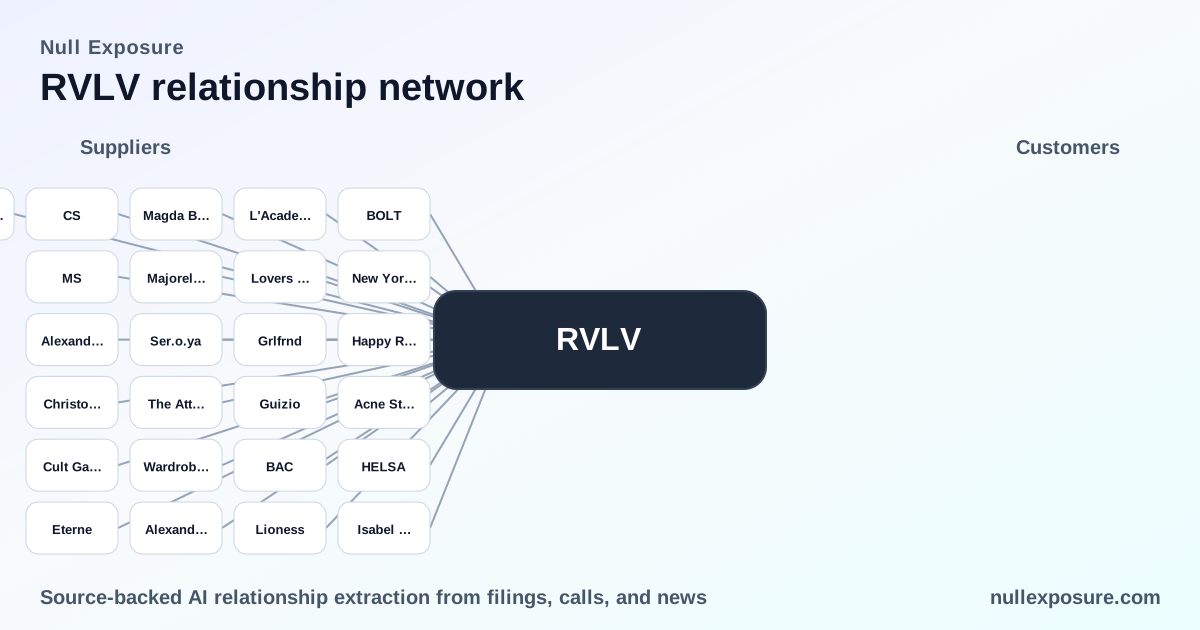
Revolve Group (RVLV) — customer relationship profile and investor takeaways
Revolve Group operates a two-segment direct-to-consumer fashion platform—REVOLVE and FWRD—that sells premium apparel, footwear, accessories, beauty and home products online, monetizing primarily through retail sales and complementary subscription rental products. The company generated roughly $1.23 billion in trailing revenue with a premium average order value (~$302 in 2024) and a high-repeat customer base that drives the bulk of sales. For a concise view of how these customer relationships translate to revenue and risk, see https://nullexposure.com/.
Business model in one line: platform retail with a dual-brand approach (REVOLVE + FWRD), supplemented by subscription rental offerings that generate ratable, recurring revenue.
How Revolve monetizes customers and what that implies for operators and investors
Revolve’s economics are anchored in premium unit economics and customer frequency rather than single large buyer contracts. The company sells merchandise through two complementary segments that leverage a single commerce platform, and it recognizes rental product revenues ratably over subscription periods—a business feature that converts one-off buyers into predictable, recurring revenue streams. Company filings and reporting show 2.7 million active customers (2024) and net sales of approximately $1.13 billion in 2024, with the United States accounting for roughly 80% of net sales. This combination of premium average order value and a concentrated geography creates both stability in unit economics and exposure to U.S. consumer cycles.
Key operating characteristics:
- Contracting posture: Subscription rental contracts have minimum terms (three months) and renew automatically, producing steady recognized revenue rather than lump-sum sales.
- Customer concentration: No single external customer accounted for over 10% of net sales in recent years, indicating low counterparty concentration but high internal customer concentration—existing customers contributed ~81% of net sales in 2024.
- Geographic exposure: While global shipping capability exists (150+ countries), North America—particularly the U.S.—remains the dominant revenue base (~80% of net sales).
- Customer type and spend profile: The base is consumer/individual retail customers with premium AOV (~$302) and substantial repeat purchase behavior.
- Relationship stage and maturity: The customer base is active and mature, with established retention patterns and a diversified brand assortment across REVOLVE and FWRD.
The platform split matters — REVOLVE versus FWRD and why that’s relevant
Revolve intentionally operates two retail segments on one technology and fulfillment platform. That architecture reduces incremental marginal cost for new brands and initiatives while allowing differentiated assortments and pricing strategies across REVOLVE and FWRD. For operators, this means supply-chain and merchandising tools are shared; for investors, it implies scalable gross margin leverage as GMV grows across both segments.
- Single shared platform: Management has stated the two segments leverage one platform, enabling centralized operations while offering distinct customer experiences and assortments. This is a structural driver of margin upside as fixed backend costs are amortized across both revenue streams.
See more on platform economics at https://nullexposure.com/.
All reported customer relationships (complete list)
This section covers every relationship identified in the provided results.
FWRD — an internal, complementary retail segment
FWRD is one of Revolve’s two reportable retail segments and shares the company’s platform; certain products are described as being available exclusively on REVOLVE and FWRD platforms, indicating coordinated assortment strategy across both storefronts. According to an industry news piece dated May 3, 2026, product availability is tied to those two channels, underlining that FWRD functions as an integral sales channel rather than an independent external counterparty (Investing.com, May 3, 2026). Company disclosures also identify REVOLVE and FWRD as complementary segments sold through the same platform, confirming the operational link between the two channels.
Contract and company-level constraints that shape customer economics
These signals are drawn from company disclosures and summarize how Revolve structures customer relationships and the implications for revenue stability and risk.
- Subscription contracts for rental products: Rental revenues are recognized ratably over subscription periods with a minimum three-month commitment and automatic monthly renewals thereafter, creating predictable recurring revenue flows that smooth seasonality.
- Customer type — individual consumers: The business targets Millennial and Gen Z consumers and operates primarily as a consumer-facing retailer, which shapes cost-to-serve, marketing cadence, and lifetime-value dynamics.
- Geographic footprint — U.S. dominant but global reach: While Revolve ships to 150+ countries and offers expedited international delivery for core markets, ~80% of net sales are U.S.-based, concentrating exposure to North American consumer trends.
- Materiality profile: No single customer represented over 10% of net sales in recent years (immaterial concentration), yet loyal, existing customers account for ~81% of net sales, making retention and LTV optimization critical.
- Role and segment orientation: Revolve is fundamentally a seller across two core product segments (REVOLVE and FWRD), which are core to its reported results and growth strategy.
- Spend band and unit economics: The company’s average order value (~$302 in 2024) positions it as a premium online retailer, limiting exposure to low-margin, high-volume discount players.
What investors and operators should watch next
- Retention and LTV: Given that existing customers generate the majority of revenue, improvements in retention or declines in repeat purchase rates will have outsized effects on revenue growth. Retention metrics are the primary leading indicator for top-line predictability.
- Subscription penetration: Growth of the rental subscription product increases recurring revenue and margin stability; monitor roll-out cadence, average subscription life, and churn metrics disclosed in quarterly filings.
- U.S. consumer sensitivity: With heavy U.S. concentration, macro consumer indicators (employment, discretionary spending, fashion trends) will directly affect demand.
- Platform leverage and assortment differentiation: Continued margin expansion depends on scaling both REVOLVE and FWRD assortments without proportionally increasing logistics and marketing spend.
Bottom line
Revolve is a premium, platform-driven eCommerce operator that monetizes through high-AOV retail sales and subscription rentals, with strong repeat customer economics and concentrated U.S. exposure. Operational leverage comes from the shared REVOLVE/FWRD platform and subscription revenue recognition, while investor focus should remain on retention, subscription growth, and U.S. consumer dynamics. For a structured view of customer relationships and contract-level signals, visit https://nullexposure.com/.
Sources: company filings and disclosures for FY2024 (net sales, active customers, AOV and subscription description) and an industry report on product availability across REVOLVE and FWRD (Investing.com, May 3, 2026).