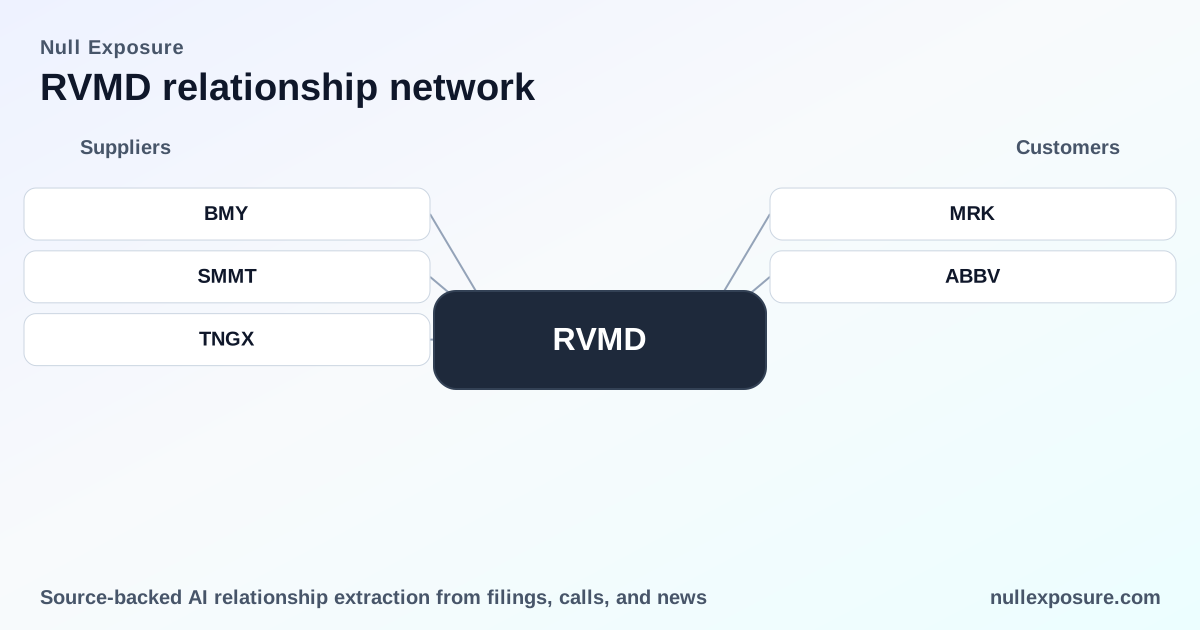
Revolution Medicines (RVMD): Commercial posture, partner signal, and customer relationships investors should track
Revolution Medicines is a precision oncology developer that builds value by advancing RAS-targeted drug candidates through clinical milestones and monetizing assets via commercialization or strategic partnerships and financing arrangements. The company operates as a clinical-stage developer with very low product revenue but material enterprise value—it leverages licensing, combination trials with other biopharma companies, and structured financing to derisk late-stage development and capture upside from approvals or M&A outcomes. For investors evaluating customer and counterparty exposure, the critical focus is on partnership-driven development programs, external funding that secures downstream economics, and how market M&A narratives influence valuation.
Explore a structured view of Revolution’s counterparty relationships and what each connection signals about commercial strategy and risk. If you want a quick company relationship snapshot, visit https://nullexposure.com/ for the platform that aggregates these signals.
Why these relationships matter
- Revolution is still pre-commercial: Revenue TTM is $742k against a $31.4B market capitalization, confirming a business model driven by R&D value creation and partner monetization rather than product-level cash flow.
- High institutional ownership (94.3%) and heavy market sensitivity to deal speculation indicate investor positioning that prizes strategic outcomes (partnering, royalties, or M&A) over near-term revenue.
- Commercialization posture is hybrid: public disclosures flag both the option and the cost of building direct commercialization capabilities, creating a strategic tension between partnering and own-launch scenarios.
Key relationships — what investors need to know
Tango Therapeutics (TNGX): Combination collaborator for RAS(ON) programs
Tango is running combination studies pairing its epigenetic inhibitor vopimetostat with Revolution’s RAS(ON) inhibitors, with ongoing Phase 1/2 enrollment and initial safety/efficacy readouts expected in 2026. Multiple company announcements and press releases in FY2026 reference robust enrollment and planned data presentations for these combination arms. (See Tango press releases via GlobeNewswire, Jan–Apr 2026, and a Sahm Capital note referencing the combination study in FY2026.)
Sources: Tango Therapeutics press releases on GlobeNewswire (Jan–Apr 2026) and a Sahm Capital news note referencing FY2026 trial enrollment and early data.
Merck & Co. (MRK): Strategic acquirer interest that has driven market moves
Merck was named in widespread reporting as a potential acquirer in late-January 2026, and the subsequent market reaction—sharp share price swings—stemmed directly from those M&A narratives; later reporting characterized talks as stalled, creating a material valuation shock. The market commentary in FY2026 explicitly ties Revolution’s volatility to Merck acquisition chatter and its apparent cooling. (See FinancialContent/MarketMinute coverage and Simply Wall St reporting in early 2026.)
Sources: MarketMinute report on FinancialContent (Feb 2026) and Simply Wall St coverage noting Merck interest (FY2026).
Royalty Pharma (RPRX): Large structured funding and synthetic royalty on daraxonrasib
Royalty Pharma executed a funding agreement that provides up to $2 billion to support Revolution’s clinical development while securing a synthetic royalty stream of up to $1.25 billion tied to daraxonrasib, Revolution’s Phase 3 candidate. This is a material non-dilutive financing structure that transfers future product-level economics in exchange for near-term development capital, reported in FY2025 financial coverage. (See Royalty Pharma coverage on Yahoo Finance and TradingView tied to FY2025 announcements.)
Sources: Royalty Pharma funding agreement coverage on Yahoo Finance and TradingView (FY2025).
AbbVie (ABBV): Part of broader M&A rumor-set influencing sentiment
AbbVie was cited in media narratives as another large pharmaceutical name linked to M&A speculation around Revolution, contributing to the stock’s sensitivity to deal expectations and clinical updates—particularly those around the lead candidate zoldonrasib. These references were consolidated in FY2026 commentary that links prior share swings to AbbVie-related rumors. (See Simply Wall St reporting in FY2026.)
Source: Simply Wall St commentary on FY2026 M&A and clinical sensitivity.
Operational constraints and what they imply about the business model
-
Commercialization trade-off is explicit: Company disclosures flag the timing and costs of establishing sales, medical affairs, and distribution infrastructure should Revolution decide to commercialize products independently or jointly. This is a company-level signal that Revolution retains the option to self-commercialize but recognizes that doing so is capital- and time-intensive, which drives its reliance on partners, royalties, or structured financings. (Evidence excerpt from company disclosures cited in FY2026 materials.)
-
Partner dependence and structured finance are strategic levers: The Royalty Pharma arrangement illustrates how Revolution monetizes late-stage value without traditional revenue, trading future upside for immediate development capital—a hallmark of clinical-stage biotech commercialization strategy.
-
Concentration and criticality: With institutional ownership at roughly 94%, shareholder concentration amplifies sensitivity to strategic outcomes (partnerships, readouts, M&A). Clinical milestones for zoldonrasib and daraxonrasib are therefore critical value inflection points.
-
Maturity and capital posture: Financials show negligible product revenue and large operating losses, positioning Revolution as a development-stage enterprise whose valuation hinges on external validation events and partner transactions rather than current cash-flow generation.
Risks and upside through a relationship lens
-
Upside: Partnerships like Tango’s combination trial and Royalty Pharma’s funding accelerate clinical programs while preserving upside through milestone-linked economics or royalty recapture. Successful Phase 3 readouts or an M&A outcome would directly monetize these collaborations and financing deals.
-
Risk: Reliance on external partners and capital markets exposes valuation to rumor and deal-flow dynamics, as evidenced by sharp share moves tied to Merck and AbbVie headlines in FY2026. The company’s explicit acknowledgment of commercialization costs also signals execution risk if it attempts an independent launch.
Middle call-to-action: For a live, relationship-tracked view of Revolution and peer counterparty activity, see https://nullexposure.com/.
Investment takeaway
- Revolution is a classic partner-driven biopharma investment: value accrues through clinical de-risking and external monetization (royalties, licensing, M&A, or structured funding). Royalty Pharma’s funding and Tango’s combination trials are the most consequential relationships for near-term clinical and financial readouts, while Merck/AbbVie narratives drive market sentiment and volatility.
- Monitor clinical timelines and deal disclosures—these will be the primary drivers of re-rating, not current product revenue or operating income.
If you want ongoing coverage of counterparty events and how they affect valuation, visit https://nullexposure.com/ for a consolidated view of partner signals and market implications.