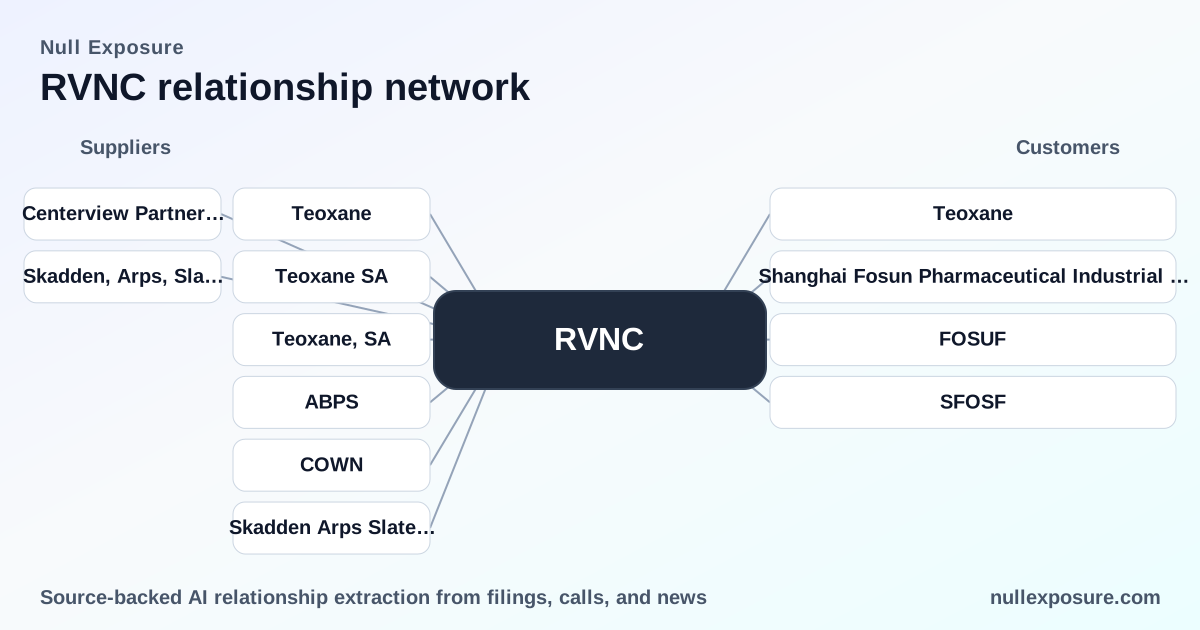
Revance Therapeutics (RVNC): Customer relationships that underwrite commercialization and geographic expansion
Revance monetizes its proprietary neuromodulator portfolio primarily through product sales in the U.S., licensed commercialization agreements in key international territories, and strategic co-development partnerships for adjacent product lines. Revenues combine direct retail/channel sales for consumer brands with milestone and royalty payments tied to regional licensees — a hybrid model that transfers regulatory and go‑to‑market execution risk to partners while keeping product IP and high-margin manufacturing optionality in house. For access to structured diligence and relationship mapping, visit https://nullexposure.com/.
Relationship log: the contracts and partners that matter
Teoxane — PR Newswire (Mar 10, 2026)
Revance executed an ANZ Distribution Agreement appointing Teoxane as the exclusive distributor and licensee for Australia and New Zealand, giving Teoxane primary responsibility to commercialize DAXXIFY® in those markets. This contract reflects Revance’s strategy of using exclusive regional partners to accelerate local market penetration. Source: PR Newswire, March 10, 2026.
Teoxane — TradingView SEC 10‑Q summary (Mar 2026)
The company’s SEC reporting reiterated the ANZ Distribution Agreement with Teoxane as the mechanism to expand DAXXIFY®’s market reach in Australia and New Zealand, confirming the deal’s materiality to international launch plans. Source: TradingView summary of Revance SEC 10‑Q, March 2026.
Shanghai Fosun Pharmaceutical Industrial Development Co., Ltd. — NAI500 blog / historical announcement (FY2018)
Revance granted Fosun’s subsidiary exclusive rights to develop and commercialize its clinical-stage product RT002 (DaxibotulinumtoxinA for Injection) across mainland China, Hong Kong and Macau under a license agreement signed in 2018. That early licensing created a long-term route to market in Greater China built around local regulator navigation and commercialization by Fosun. Source: Revance announcement via NAI500 summary, 2018.
Amazon — PR Newswire (May 3, 2026)
Revance’s consumer skincare brand StriVectin expanded retail channels so that select Barrier Restore products are sold online via Amazon in addition to the company website. This places Revance into a broad e‑commerce channel for consumer sales, diversifying distribution beyond clinical/physician channels. Source: PR Newswire, May 3, 2026.
Ulta — PR Newswire (May 3, 2026)
The same PR Newswire release reports StriVectin Barrier Restore products are now available in Ulta stores and online at Ulta.com, adding a major specialty retailer to Revance’s consumer distribution footprint. Access to Ulta provides scale, merchandising reach, and a consumer marketing amplifier for over‑the‑counter brand sales. Source: PR Newswire, May 3, 2026.
FOSUF (Fosun) — TradingView SEC 10‑Q summary (FY2024)
Revance disclosed that China’s NMPA approval for DAXXIFY® (glabellar lines) in September 2024 triggered a milestone payment from Fosun, indicating that licensing agreements include concrete regulatory‑triggered economics. The milestone demonstrates a clear revenue pathway from international licensees tied to local approvals. Source: TradingView summary of Revance SEC 10‑Q, March 2026 (reporting FY2024 milestones).
Fosun — TradingView SEC 10‑Q summary (FY2024)
The company’s filings affirm the same China approval and associated milestone payment from Fosun following NMPA clearance for DAXXIFY®, underlining Fosun’s role as a primary commercialization partner in Greater China. Source: TradingView summary of Revance SEC 10‑Q, March 2026.
SFOSF (Shanghai Fosun Pharmaceutical) — PR Newswire (Mar 2026)
A corporate communication reiterates Revance’s partnership with Shanghai Fosun Pharmaceutical to commercialize DAXXIFY® in China and notes a separate co-development relationship with Viatris for a biosimilar program, signalling a two‑track approach to growth: licensed commercialization in China and external R&D partnerships for pipeline expansion. Source: PR Newswire amendment to merger-related release, March 2026.
Shanghai Fosun Pharmaceutical — PR Newswire (Mar 2026)
PR Newswire confirms the ongoing commercialization arrangement with Shanghai Fosun Pharmaceutical and positions Fosun as a linchpin for Revance’s China strategy. The release highlights Fosun’s active economic role rather than a passive licensee status. Source: PR Newswire, March 2026.
What these relationships collectively reveal about Revance’s operating model
- Contracting posture — selectively exclusive and milestone-driven. Revance relies on exclusive regional distribution and licensing agreements (Teoxane in ANZ, Fosun in China) that transfer commercialization execution while embedding milestone and royalty economics back to Revance. This structure accelerates global rollout without duplicative in‑market capex.
- Concentration risk — geographic and counterparty concentration is material. A small set of large partners (notably Fosun in China and Teoxane in ANZ) carry outsized responsibility for revenue in large markets, which creates single‑counterparty operational risk if execution lags.
- Criticality — partner performance is revenue‑critical. The Fosun milestone following NMPA approval demonstrates that partner success directly converts to cash inflows, making partner regulatory and commercial execution central to near‑term revenue realization.
- Maturity and diversification — staged and expanding. The China license dates to 2018 and matured into regulatory milestones by 2024, while retail channel expansion (Ulta, Amazon) is recent (2026) and diversifies Revance’s revenue profile beyond prescription channels into consumer retail.
For a mapped dossier of these counterparties and their commercial terms, see our platform at https://nullexposure.com/ (investor access).
Investment implications and risk profile
- Upside levers: Regulatory milestones and successful channel rollouts provide discrete, high‑visibility revenue events (as evidenced by the Fosun NMPA milestone). Exclusive distribution agreements offer scalable expansion without proportionate SG&A increases.
- Key risks: Partner concentration and reliance on milestone-triggered payments create episodic cash flows; any execution failure by Fosun or Teoxane would materially delay revenue realization. Retail channel competition and SKU performance at Ulta/Amazon will determine whether consumer sales become a meaningful, recurring revenue stream.
- Valuation sensitivity: Given negative margins and net losses reflected in recent financials, partnership execution and the cadence of milestone receipts will be the dominant drivers of near‑term enterprise value.
Conclusion — what investors should watch next
Monitor three items closely: (1) commercial rollout metrics from Teoxane in ANZ, (2) Fosun’s sales and regulatory follow‑ons in China beyond the initial milestone, and (3) retail velocity and replenishment rates at Ulta and Amazon for StriVectin. Each is a lever that converts contractual arrangements into predictable top‑line growth or reveals execution gaps that depress realized value.
For a consolidated, source‑level view of Revance’s partner contracts and to track milestone events over time, explore our research at https://nullexposure.com/.