Retractable Technologies (RVP): Customer Relationships That Drive the Business
Retractable Technologies designs, manufactures and sells safety syringes and related injection devices, monetizing primarily through product sales to healthcare providers and, periodically, through licensing of its intellectual property. Revenue is concentrated in its core injection-device portfolio and heavily weighted to the U.S. market and episodic government programs, with modest, intermittent licensing receipts. For deeper customer intelligence and historical relationship tracking, see https://nullexposure.com/.
How Retractable makes money — the simple operating model investors need to know
Retractable’s model is straightforward: design and produce safety syringes, sell them to healthcare providers and distribution partners, and opportunistically recognize licensing fees. Company filings show its dominant revenue generators are injection devices, domestic sales account for the large majority of revenue (88.9% in 2024), and licensing has been an immaterial but recurring line item — $189k in 2024 and $778k in 2023. Gross profit and operating margins are under pressure, and the firm reported net losses in recent trailing periods, reflecting both a concentrated product mix and lumpy demand tied to public health programs.
- Core revenue driver: safety syringes and injection devices sold into U.S. healthcare and distribution channels.
- Supplemental income: small, periodic licensing fees for intellectual property.
- Market footprint: heavily domestic with limited international sales.
If you want situational updates on RVP’s customer signals and contract announcements, NullExposure maintains tracking across public filings and press activity — visit https://nullexposure.com/ for the full feed.
Customer relationships that materially affect revenue today
Below I summarize every customer relationship noted in the available results and provide a concise, source-linked description for each.
CCPA Purchasing Partners, LLC — new Premier contract (FY2026)
CCPA Purchasing Partners announced a new Premier contract offering with Retractable Technologies in a May 3, 2026 press release, positioning the company’s automated retraction syringes for purchase discounts through CCPA’s purchasing network. This is a distribution-channel win that broadens access to institutional buyers via a group purchasing contract. (Source: CCPA press release, May 3, 2026.)
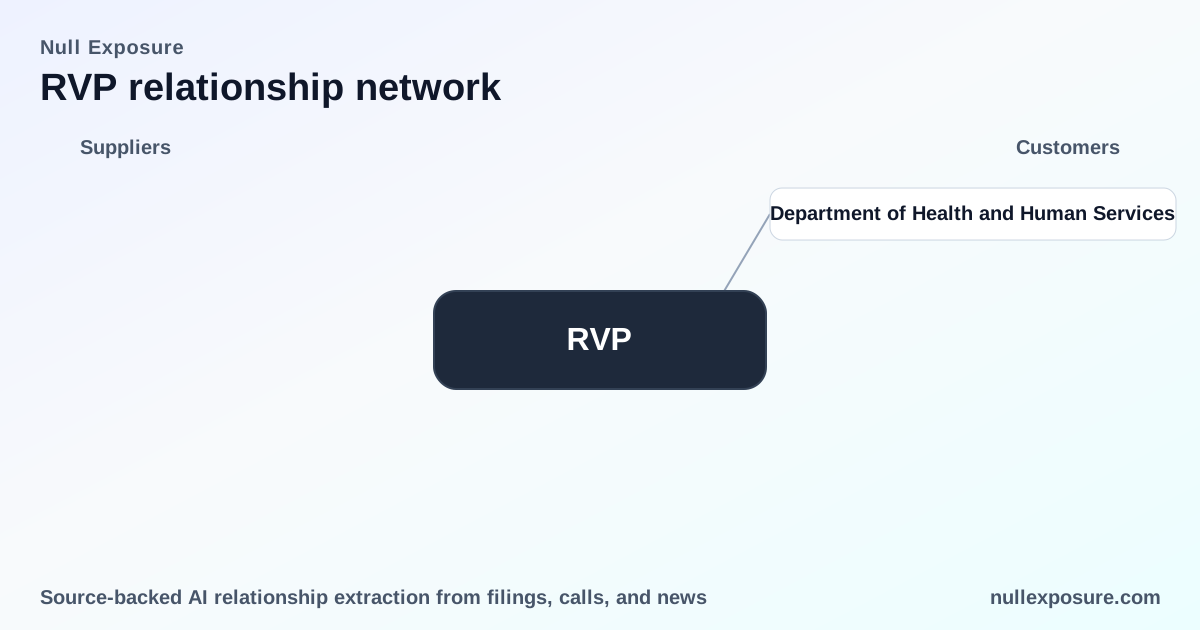
Department of Health and Human Services — major government orders during 2020
Reporting on the COVID-19 response recounts that in late March 2020 the Department of Health and Human Services began drafting an $83.8 million order for RTI to supply the bulk of needles and syringes for a potential mass-vaccination campaign, highlighting a period when the U.S. government became a significant and concentrated customer for the company. That government demand materially boosted sales in 2020–2022. (Source: NBC News feature recounting FY2020 events.)
Constraints and what they imply about RVP’s operating posture
Company-level excerpts and disclosures reveal a set of structural characteristics investors should treat as persistent constraints on the business model:
- Contracting posture — transactional and episodic. RVP recognizes revenue from unit sales and occasional licensing agreements; licensing fees amounted to $189k in 2024 versus $778k in 2023, indicating licensing is an ancillary, low‑magnitude revenue stream rather than a strategic, recurring monetization lever (company filings).
- Customer concentration risk. Historical reliance on U.S. government purchases during the COVID vaccination campaigns created large, lumpy revenue inflections — sales to U.S. government totaled material amounts across 2020–2022 ($31.6M in 2020; $113.7M in 2021; $15.7M in 2022) — and those programs have since wound down, removing a prior growth engine (company disclosures).
- Geographic concentration — predominantly North America. Domestic sales represented 88.9% of revenues in 2024, underscoring exposure to U.S. procurement cycles and health-system purchasing behavior rather than diversified global demand (company filings).
- Role diversity — seller and distributor relationships. Disclosures reference both direct sales to healthcare providers and arrangements that implicate distributors (rebates credited to distributors and allowance charge-offs), suggesting a two-tiered go-to-market that can compress margins and create credit/rebate liabilities.
- Maturity and spend band. Government program orders have pushed single-customer spend into the $10M–$100M band in certain years, but these were episodic rather than sustained long-term contracts; the business remains small-cap with limited recurring high-value contracts outside those public-health spikes.
Collectively, these constraints indicate an operating model that scales through product adoption in institutional channels but is vulnerable to program timing and distribution economics. For investors, that combination creates upside tied to market penetration and downside tied to demand lulls once government programs conclude.
What investors and operators should watch next
- Penetration via purchasing groups and distributors. The CCPA Premier contract is strategically useful because it reduces friction for institutional buyers; continued wins through group purchasing organizations would translate into steadier volumes if pricing and rebate structures are well managed. (Source: CCPA press release, May 2026.)
- Post‑pandemic revenue normalization. Historical government orders created outsized revenue in 2020–2022; the company’s challenge is to replace that demand with consistent commercial and distributor-led sales. (Source: company disclosures and media reporting on FY2020–2022.)
- Margin compression from distribution and rebate obligations. The presence of distributor rebates and allowance charge-offs in disclosures implies operational pressure on gross margins if channel economics are not optimized.
- Corporate scale and ownership profile. Retractable is a micro‑cap with high insider ownership (about 59% insiders), limited institutional ownership, and constrained liquidity — factors that amplify both upside and downside volatility around contract news and quarterly results.
Bottom line for allocators and operators
Retractable is a focused medical-instrument vendor whose revenue profile is dominated by its core syringe business and shaped by episodic government demand. Recent activity — a Premier purchasing contract with CCPA — is a positive distribution development, while the historical Department of Health and Human Services engagements demonstrate the company’s ability to secure material government orders when public-health programs activate. Investors should treat future financial performance as a function of the company’s success converting these distribution footholds into recurring commercial volumes and managing channel economics. For continuous updates on RVP’s customer signals and contract flow, visit https://nullexposure.com/.
Key takeaway: growth depends on converting episodic, high-value government demand into steady institutional sales through purchasing groups and distributors while limiting margin dilution from channel rebates.