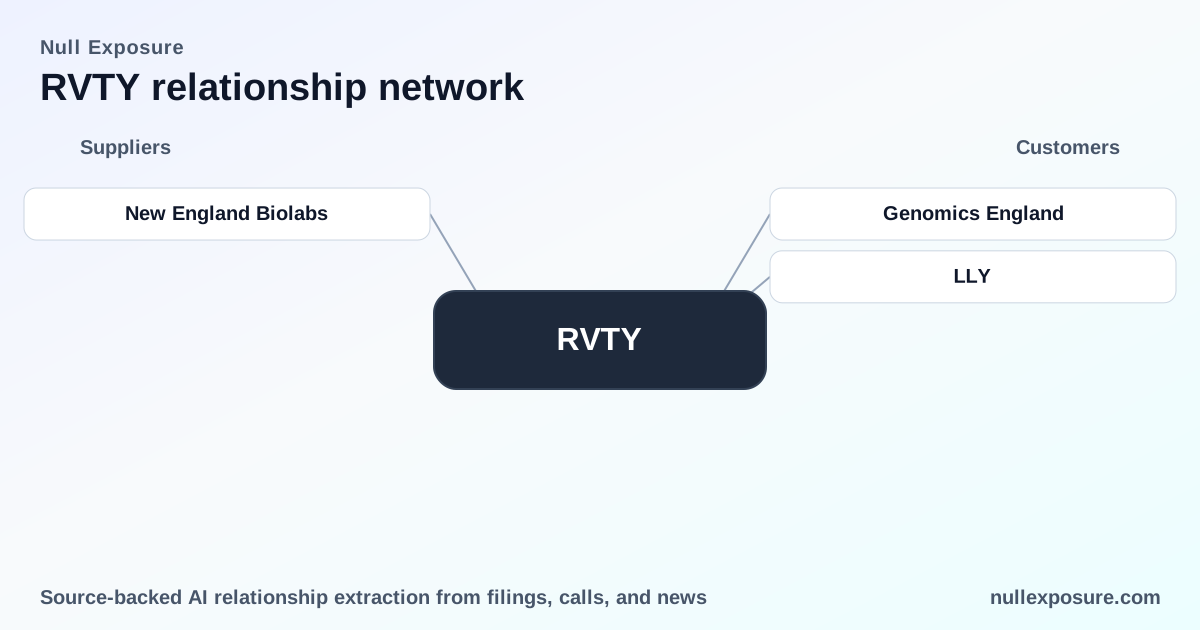
Revvity (RVTY) — Customer map and commercial implications for investors
Revvity sells a blended business of instruments, reagents, software and fee-for-service lab work to diagnostics, life‑sciences and applied markets; it monetizes through equipment sales, consumable repeat revenue, SaaS/subscription contracts and services. That hybrid model creates a mix of recurring, ratable revenue (software/subscriptions and lab services) and lumpy capital sales (instruments and hardware), while global scale and government customers make FX and compliance risk central to the investment thesis. For more context on platform-level customer signals and relationship intelligence, see Null Exposure’s research hub: https://nullexposure.com/.
How Revvity actually makes money — the operating logic investors should track
Revvity’s revenue engine rests on three complementary levers: instruments and consumables that drive high-margin repeat sales, software and cloud subscriptions that provide ratable recurring revenue, and services/contract lab work that delivers differentiated, higher-margin workflows. Public disclosures indicate the company markets directly via specialized sales forces and recognizes SaaS and subscription revenue over the contract term, which supports predictable recurring cash flow even as instrument sales remain cyclical.
This mixed contracting posture produces characteristic constraints for investors:
- Contracting posture: A meaningful portion of revenue is ratably recognized from SaaS/subscriptions and cloud services, reinforcing recurring revenue visibility.
- Concentration and materiality: No single customer has historically exceeded 10% of net revenue, which signals low single‑counterparty concentration.
- Geographic exposure and FX sensitivity: Roughly 60% of revenue is generated outside the U.S., with substantial presence in EMEA and APAC — this creates both market diversification and currency risk.
- Role and delivery model: Revvity functions primarily as a seller of hardware and software and as a service provider delivering workflows and diagnostics, which implies both capital sales cycles and ongoing service commitments.
- Segment mix: Life sciences revenue includes instruments, reagents, software/subscriptions and extended warranties; Diagnostics and Services increase customer stickiness but add regulatory and reimbursement complexity.
These are company‑level signals derived from filings and public commentary and should be used to interpret customer relationships rather than attributed to any single counterparty unless explicitly named.
Customer relationships: who’s on the roster and what they mean
Below are the customer and partner references surfaced in the data, summarized in plain English with source context.
- Genomics England — Revvity acts as a sequencing partner for the Generation Study, integrating extraction and sequencing to accelerate newborn genomic screening results; the collaboration is positioned to generate evidence on sequencing in newborn screening. According to a Technology Networks article covering the announcement (March 10, 2026), Genomics England described Revvity as one of its sequencing partners for the study.
- Eli Lilly (LLY) — Revvity announced a collaboration tied to the Synthetica product launch and Lilly’s TUNE lab initiative, indicating a commercial or scientific partnership that supports platform adoption in pharma R&D workflows. This relationship was described on Revvity’s 2025 Q4 earnings call (March 7, 2026).
- VolitionRx (VNRX) — Revvity’s platform is being used to offer CE‑marked kits and assays in Europe, and VolitionRx referenced that Revvity already offers their assays in Europe with analytics covering multiple applications; that positions Revvity as a commercial channel and technical host for third‑party assays. The CE‑mark kit note appeared in a market report hosted by InsiderMonkey (May 4, 2026), and VolitionRx reiterated the Europe assay availability during its 2025 Q3 earnings call (first publicly noted March 7, 2026).
Why each relationship matters to Revvity’s economics
- Genomics England: Partnering on the Generation Study positions Revvity at the center of a public‑health genomics initiative and highlights government/public health counterparty exposure and the company’s ability to win sequencing contracts that can generate recurring service volume. (Technology Networks, March 2026)
- Lilly: A pharma collaboration tied to Synthetica and the TUNE lab initiative signals validation by a large biopharma customer that can accelerate enterprise sales of software and services, and it supports higher‑value, longer‑term contracts. (RVTY 2025 Q4 earnings call, March 2026)
- VolitionRx: Hosting third‑party CE‑marked assays and analytics in Europe demonstrates the platform’s utility as a commercial distribution and services channel for external assay providers — a revenue multiplier for consumables and SaaS. (InsiderMonkey market report, May 2026; VNRX 2025 Q3 earnings call, March 2026)
What the relationship set implies for investors — concentration, runway and risk
- Low counterparty concentration is a structural positive: public filings show no single customer >10% of revenue, so wins and losses with individual partners are unlikely to destabilize top-line materially.
- Recurring revenue is meaningful but not exclusive: subscription and lab services tilt the model toward ratable revenue, improving predictability, while instrument sales keep cash flows lumpy. Expect quarter-to-quarter volatility driven by capital deployments, offset partially by SaaS and service bookings.
- Global footprint heightens FX and regulatory risk: with ~60% of revenue outside the U.S. and significant activity in EMEA and APAC, currency swings and regional reimbursement or approval changes will impact reported results.
- Government and institutional contracts raise procurement and compliance dynamics: government customers increase contract size potential but lengthen sales cycles and introduce procurement risk.
- Platform positioning opens monetization vectors: hosting third‑party assays and partnering with both public health organizations and pharma customers creates cross‑sell opportunities for consumables, analytics subscriptions and services.
Risks to watch and near‑term catalysts
- Monitor instrument replacement cycles and consumables attach rates as leading indicators of durable revenue growth.
- Watch FX trends and regional revenue mix disclosure — a sizable shift toward APAC or EMEA can compress margins if currencies weaken.
- Follow further pharma collaborations (additional Synthetica customers) and public health contracts (Generation Study volume) for evidence of scalable, multi‑year service commitments.
Bottom line: investable strengths and cautions
Revvity’s commercial model is deliberately hybrid — recurring SaaS and services alongside capital equipment — which provides revenue resilience but introduces execution complexity across sales, regulatory and FX vectors. Customer references to Genomics England, Lilly and VolitionRx validate the platform across public health, pharma and third‑party assay channels, supporting a diversified go‑to‑market strategy that reduces single‑counterparty concentration risk.
For a deeper look at customer-level signals and how they map to revenue predictability, visit Null Exposure’s research center: https://nullexposure.com/.