Ryvyl Inc (RVYL): Customer Relationships and What They Signal for Revenue and Risk
Ryvyl (formerly GreenBox POS) operates a blockchain-enabled payments platform that monetizes primarily through payment processing services and transaction-based fees—charging percentages and per-transaction amounts for card acceptance, remittances and cross‑border settlement. The business combines merchant acquiring, card services and integrations with global rails to drive volume across North America, EMEA and APAC; recurring, usage‑based revenue is the core economic engine. For a deeper look at how provider‑level customer exposures shape valuation and counterparty risk, visit https://nullexposure.com/.
How Ryvyl actually operates and the structural constraints investors should track
Ryvyl’s reported disclosures and public commentary establish a clear operating model: usage‑based contracts, geographically diversified processing, and a services-heavy revenue mix. Company filings describe transaction fees tied to a percentage of payment value or fixed per‑transaction amounts, and the firm highlights operations across North America, Europe and Asia and ambitions to support more than 200 markets and 140 currencies. The company also reports two reportable segments—North America and International—confirming a bilateral operating posture between domestic scale and international expansion.
- Contracting posture: Predominantly usage‑based payment processing agreements that scale with transaction volume and value.
- Concentration: Management discloses no single customer accounts for more than 5% of revenue, indicating a low customer concentration risk at present.
- Criticality and maturity: The business is service‑focused (card acceptance and processing) and dependent on third‑party rails and integrations, which creates integration and timing risk as the company internationalizes.
- Economic scale: Public numbers indicate modest scale—Revenue TTM ~$11.13M, Market Cap ~$9.16M, and negative EBITDA, reinforcing execution sensitivity during integrations and go‑lives.
If you want a succinct analysis of counterparty exposures and how they map to Ryvyl’s monetization model, check https://nullexposure.com/ for our platform view.
Customer and partner roll call: every reported relationship and what it implies
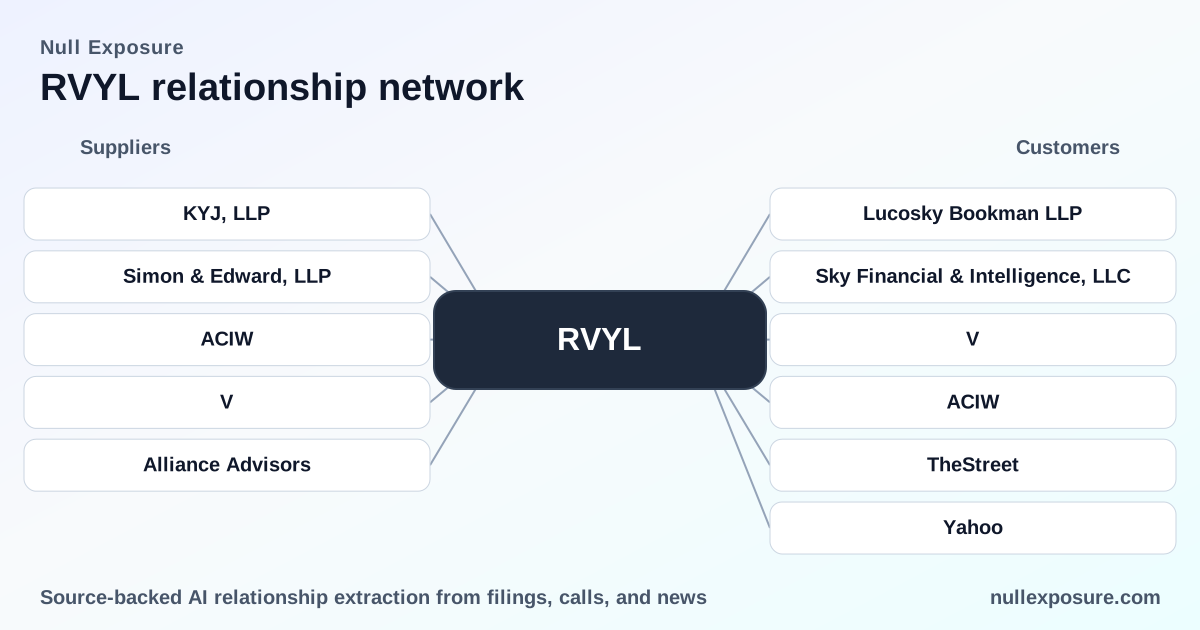
Lucosky Bookman LLP
Lucosky Brookman provided legal services to Ryvyl through July 2023, indicating standard external legal counsel use rather than a commercial customer engagement. This is disclosed in Ryvyl’s FY2024 Form 10‑K.
Sky Financial & Intelligence, LLC
Sky Financial used Ryvyl’s QuickCard payment system as its main payment processing infrastructure in 2018, via Sky’s relationship with Mtrac—an historical proof point of commercial deployments for niche fintech customers, cited in the FY2024 10‑K.
Visa (listed also as “V” in earnings call transcripts)
Ryvyl expanded its Visa Direct integration to additional countries, bringing the footprint to 13 of a targeted 80 markets as of the 2024 Q3 earnings call; this underscores Visa as a strategic rail for Ryvyl’s cross‑border payout and remittance ambitions (2024 Q3 earnings call).
ACI (listed also as “ACIW” in transcripts)
Management noted that companies “like ACI and Visa” experienced delays in going live and implementation, which confirms third‑party processor integration risk—delays with ACI affect timing for merchant activation and revenue recognition (2024 Q3 earnings call).
TheStreet
Ryvyl cited partnerships targeting “millions of monthly consumers” with outlets such as TheStreet in press material tied to a transformational merger vote; that placement signals distribution partnerships as a potential growth lever for merchant or consumer acquisition (press release aggregated on The Globe and Mail, March 2026).
Yahoo
Yahoo is named repeatedly as a channel or client partner tied to distribution ambitions—both in the company’s press commentary around a merger with RTB Digital and in press coverage of the same transaction—indicating Ryvyl’s strategy to monetize payments through publisher and media distribution (press release coverage: March–May 2026).
Paris Saint‑Germain football club
Press reports around a planned merger with RTB Digital reference Paris Saint‑Germain (PSG) as an example client whose audience and commerce could be monetized via combined payments and media distribution; this signals Ryvyl’s attempt to link payments infrastructure with marquee consumer brands to accelerate volume (Investing.com coverage, May 2026).
Note: The public record contains duplicate mentions for several of these names (Visa/V; ACI/ACIW; Yahoo across multiple press items). Each mention aligns to either regulatory filings (FY2024 10‑K) or investor communications (2024 Q3 earnings call and 2026 press coverage) and collectively demonstrates both operational partnerships (rails and processors) and commercial distribution relationships (publishers and branded clients).
What these relationships mean for revenue growth and risk
- Revenue upside is distribution‑driven. Partnerships with publishers (Yahoo, TheStreet) and high‑visibility brands (PSG) create scalable channels to embed payments and drive transaction volume—this is critical to converting the company’s processing capability into sustainable usage‑based revenue.
- Execution is the binding constraint. The earnings call’s repeated reference to implementation delays with Visa and ACI is a direct signal that integrations—rather than market demand—are the near‑term gating factor for revenue realization. Timing slippage therefore translates to cash‑flow and margin volatility.
- Low counterparty concentration is a strength. Management’s disclosure that no single customer exceeds 5% of revenue reduces client‑specific credit and retention risk; however, the company’s small scale and negative EBITDA make it vulnerable to integration setbacks and any adverse change in processing volumes.
- Global ambition increases operational complexity. Support for North America, EMEA and APAC and planned expansion across dozens of currencies expands addressable market but requires robust compliance, rails connectivity and localized partnerships—each an execution vector with cost and timing implications.
Bottom line for investors and operators
Ryvyl is a small, usage‑fee payment processor with clear upside tied to distribution partnerships and rail integrations, but its valuation and near‑term revenue are highly contingent on flawless execution of international integrations and publisher channel rollouts. Key monitoring items for investors: progress on Visa Direct and ACI go‑lives, merchant activation rates through Yahoo/TheStreet channels, and the commercial impact of the RTB Digital merger on monthly transaction volumes.
For a transaction‑level view of Ryvyl’s counterparty exposures and historical filings, explore our platform at https://nullexposure.com/.