Runway Growth Finance (RWAY): Customer Relationships and Commercial Signals
Runway Growth Finance is a specialty business development company that originates and holds senior secured loans and selective equity instruments to growth-stage, venture-backed companies—predominantly in technology, healthcare and business services—and monetizes through contractual interest, fees and occasional equity upside. For investors, RWAY’s returns derive from secured yield on multi-year loans plus capital gains on exits, with portfolio dynamics exposed to the financing cadence of high-growth private companies. For a concise portal to more relationship intelligence, visit https://nullexposure.com/.
How Runway’s customer relationships translate into returns
Runway operates as an externally managed, non‑diversified closed‑end investment vehicle that provides credit solutions (36–60 month stated terms) and selective preferred equity to companies that prefer debt to dilution. This operating model produces predictable coupon income when loans perform, while realized principal repayments and equity conversions create episodic capital gains. RWAY’s posture is that of a lender and structured capital provider rather than a pure operating partner: unfunded commitments and on‑balance sheet loans represent its economic obligations and upside.
Key operating signals:
- Contracting posture: long‑term senior secured lending, with typical stated debt maturities in the 36–60 month range.
- Geographic focus: U.S. domiciled borrowers, indicating domestic credit concentration.
- Relationship role: service provider / lender, with exposure coming from on‑balance sheet loans and unfunded credit commitments.
- Sector tilt: concentrated in software and data/services, consistent with a technology/life sciences growth-investment strategy.
Customer roll call — who RWAY is lending to and exiting from
Below are the discrete customer relationships surfaced in public disclosures and media, with concise takeaways and source references.
CarNow — a meaningful growth commitment
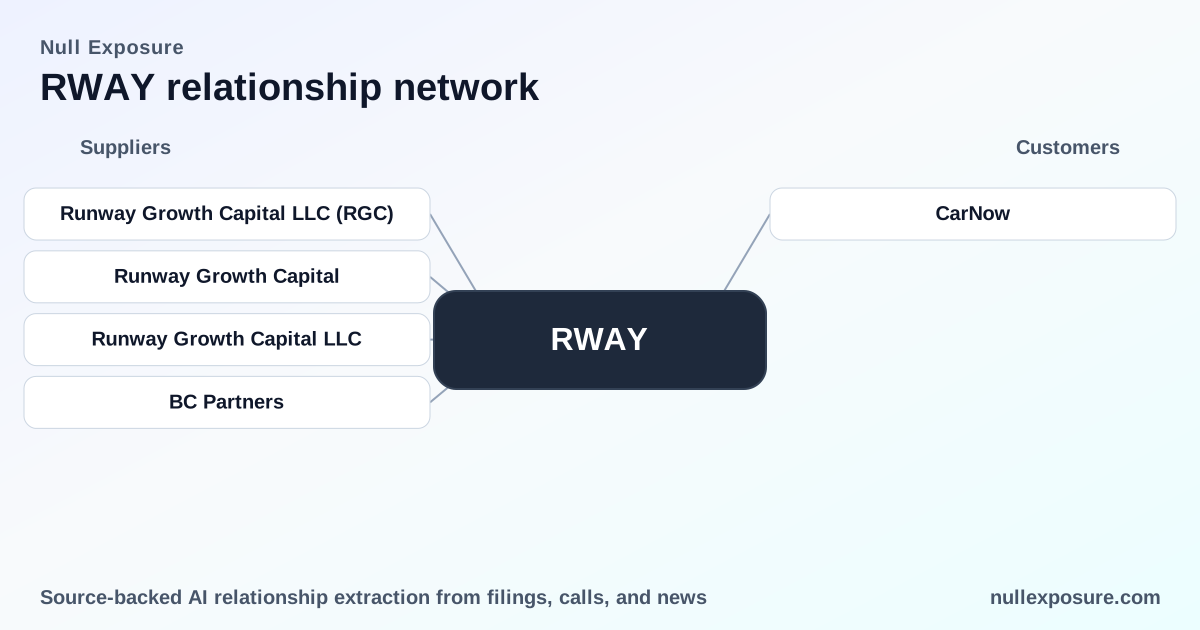
CarNow received a $40 million growth loan commitment from Runway Growth Capital LLC, representing a focused credit deployment into automotive retail technology aimed at supporting commercial expansion without equity dilution. Source: press release, PR Newswire (March 10, 2026): https://www.prnewswire.com/news-releases/runway-growth-capital-provides-a-40-million-growth-investment-to-carnow-302117064.html.
13 Scents Inc. (Dossier) — sizable additional debt facility
Runway completed an additional debt commitment of $46.3 million to 13 Scents Inc., doing business as Dossier, indicating ongoing capital deployment into consumer‑oriented brands that are scaling through credit rather than equity. Source: news report (May 3, 2026): https://www.bitget.com/amp/news/detail/12560605343869.
HR Pharmaceuticals Inc. (HR Healthcare) — blended financing (debt + preferred equity)
Runway closed a $7.5 million investment into HR Pharmaceuticals (HR Healthcare), funding $5.5 million of debt at close plus $2.0 million of preferred equity, demonstrating Runway’s willingness to structure hybrid financings when economic terms require equity sweeteners. Source: news report (May 3, 2026): https://www.bitget.com/amp/news/detail/12560605343869.
Shepard Intermediate, LLC (FHAS) — partial principal repayment
Runway reported a partial principal repayment of $0.3 million on its senior secured term loan to Shepard Intermediate (Federal Hearings and Appeals Services, “FHAS”), reflecting ongoing portfolio reduction or credit resolution in smaller middle‑market credits. Source: news report (May 3, 2026): https://www.bitget.com/amp/news/detail/12560605343869.
Moximed, Inc. — full loan repayment (realized liquidity)
RWAY recorded a full principal repayment of $15.0 million on its senior secured term loan to Moximed, Inc., a liquidity event that crystallizes both return of capital and any accrued interest—evidence of portfolio turnover and realized credit outcomes. Source: news report (May 3, 2026): https://www.bitget.com/amp/news/detail/12560605343869.
Pivot3 Inc. — asset-sale proceeds to creditor
Runway recognized $2.0 million in proceeds from asset sales of Pivot3 Inc., signaling partial recovery from a distressed or restructuring scenario and illustrating recovery dynamics on non-performing or winding‑down credits. Source: news report (May 3, 2026): https://www.bitget.com/amp/news/detail/12560605343869.
Shutterstock (SSTK) — platform partnerships and model integration
Shutterstock’s public materials reference an operational relationship integrating Runway’s tools and resources—Runway is listed among AI and content partners used by Shutterstock to enhance creative workflows, indicating B2B product integrations that influence content and model development pipelines. Sources: Shutterstock press coverage (March 19, 2026) and Runway customer case page (March 10, 2026): https://www.sahmcapital.com/news/content/shutterstock-announces-major-expansion-of-licensed-training-datasets-to-power-the-next-generation-of-generative-ai-2026-03-19 and https://runwayml.com/customers/how-shutterstock-and-runway-are-transforming-the-future-of-creative-content.
AMC Networks (AMCX) — strategic commercial deployment
AMC Networks announced a partnership to incorporate Runway’s AI models and tools into marketing and programming development, demonstrating Runway’s commercial reach beyond pure lending into technology provision and licensing relationships with media companies. Source: company news (Q2 2025 financial release summary reported March 9, 2026): https://www.quiverquant.com/news/AMC+Networks+Reports+Q2+2025+Financial+Results%3A+Streaming+Revenue+Growth+and+Increased+Free+Cash+Flow+Outlook.
What the relationship set reveals about portfolio construction and risk
Collectively, these relationships show an active deployment strategy across growth-stage software, consumer and healthcare companies, and occasional commercial technology partnerships. Important portfolio signals:
- Deployment cadence and liquidity dynamics: New sizable commitments (CarNow, Dossier, HR Healthcare) offset principal repayments and asset-sale recoveries (Moximed, Pivot3), reflecting continuous origination and turnover.
- Credit structure diversity: Runway uses senior secured loans as its core instrument but will layer preferred equity where necessary, increasing potential upside while expanding downside complexity.
- Concentration and geography: Public disclosures indicate U.S.-centric portfolio concentration and a heavy tilt into application software and data/outsourced services—beneficial for sector expertise but increasing exposure to technology cycle risk.
- Contract tenors and counterparty role: The company’s lending posture is multi-year and contractually fixed, with unfunded commitments functioning as a latent liability that determines future capital needs.
Investor takeaways and what to watch next
- Earnings driver: Interest income from long‑dated senior secured loans will remain the primary yield source; watch deployment versus realized repayments to assess future yield sustainability.
- Credit health signals: Full repayments like Moximed are positive; asset-sale recoveries like Pivot3 are mixed—monitor recovery rates and non-performing exposures.
- Structural risk: Sector concentration in software and services increases cyclicality; the company’s U.S. domicile focus concentrates macro and regulatory risk domestically.
- Active origination: Recent large commitments (CarNow, Dossier) show continued originations and capital deployment, supporting near‑term interest income growth.
For a concise monitoring feed and to track how these customer relationships evolve against RWAY’s balance sheet and yield profile, see https://nullexposure.com/.
Conclusion: Runway Growth Finance’s disclosed customer interactions present a clear lending-first business model with selective equity participation and active portfolio recycling—an attractive income vehicle for investors who accept sector concentration and the credit execution risks inherent to venture-backed lending.