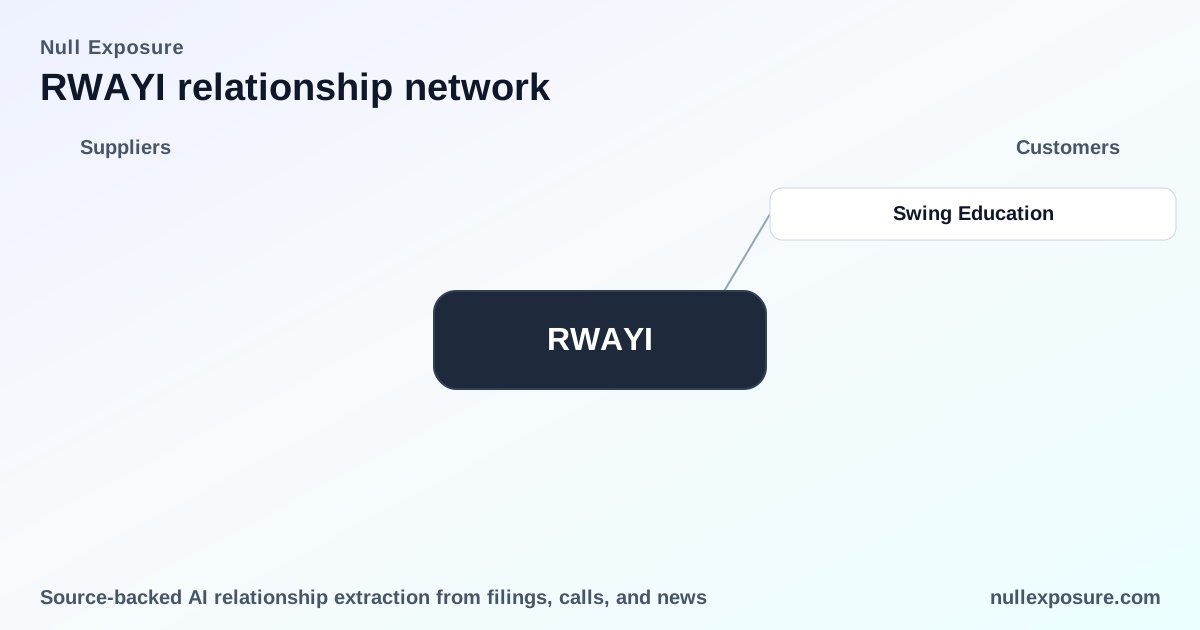
Runway Growth Finance (RWAYI) — Customer Relationships That Drive Yield and Liquidity
Runway Growth Finance operates as a specialty finance vehicle that originates senior-secured loans and related debt instruments to high-growth companies across technology, healthcare and business services, and realizes returns through cash interest, principal repayments and selective equity upside. The firm monetizes by pricing credit risk in the mid-market and small-business corridor — typically single-digit to mid-teens cash interest plus occasional equity or warrants — and by recycling capital from liquidity events back into new originations. Learn more about the firm’s coverage and portfolio signals at https://nullexposure.com/.
A compact Q1/FY2026 portfolio update — what moved the P&L and balance sheet
Runway’s public updates for first-quarter 2026 show active deployment and meaningful liquidity. The company funded a set of new and follow-on commitments totaling roughly $17.6 million in discrete investments while realizing approximately $19.0 million of liquidity from portfolio repayments and asset sales. These moves produced both cash interest and principal recoveries that reduce fair-value exposure and increase available capital for further deployments. (See Runway’s April 7, 2026 release on GlobeNewswire and related coverage on Yahoo Finance and Investing.)
How Runway’s operating model shapes its customer relationships
Runway’s deal behavior generates a predictable credit profile for investors. From company disclosures and investor communications, several firm-level signals emerge as structural characteristics of its business model:
- Long-term, secured lending posture. Runway principally invests in senior secured term loans and related senior debt, occasionally purchasing second-lien paper — a contracting posture that prioritizes downside protection over short-term yield churn.
- Mid‑market orientation with small-business coverage. The firm’s sweet spot is originations in the $30–$150 million loan size (with Runway allocations of $20–$45 million), while the portfolio also includes smaller loans to high-growth private companies — a mix that balances higher spread in smaller credits with lower concentration on any single mega-borrower.
- North American domicile and sourcing. Offices in Chicago, Menlo Park and New York and a U.S.-domiciled portfolio point to predominantly North American counterparties, limiting geographic sovereign risk but concentrating exposure to U.S. economic cycles.
- Active portfolio management and maturity. Since initiating investments in 2016, Runway has funded dozens of companies and continues to transact actively, indicating a mature, repeatable originations engine and ongoing portfolio rotation.
- Sector breadth across services, software and hardware. Investments range across software, hardware, and business services, which diversifies idiosyncratic risk but keeps the portfolio concentrated in higher-growth, higher-volatility industries.
- Typical commitment size. Most debt positions are between roughly $6 million and $75 million, consistent with a spend band that targets meaningful but not undiversified exposures.
These characteristics make Runway a credit-forward manager: downside mitigation through secured structures and active portfolio recycling, coupled with selective equity participation to enhance returns.
Deal-level relationship notes — concise investor-ready summaries
Below are plain-English summaries for every customer relationship noted in Runway’s public disclosures for FY2026 and FY2025.
13 Scents Inc. (dba "Dossier")
Runway completed an additional debt commitment of $46.3 million to 13 Scents (Dossier), with partial funding scheduled in Q2 2026, indicating a significant follow-on financing to support that borrower’s growth or recapitalization. This was reported in Runway’s first-quarter update and covered by GlobeNewswire and Investing on April 7, 2026, and by Yahoo Finance on May 3, 2026.
HR Pharmaceuticals Inc. (dba "HR Healthcare")
Runway funded a $7.5 million investment in HR Pharmaceuticals during Q1 2026, consisting of $5.5 million of debt at close and $2.0 million of preferred equity, reflecting a blended debt-and-equity structure used to control downside while retaining upside. This transaction appears in Runway’s Q1 portfolio update (GlobeNewswire, April 7, 2026) and related press coverage (Yahoo Finance; Investing).
Moximed, Inc.
Runway recorded a full principal repayment of a $15.0 million senior secured term loan from Moximed, delivering immediate liquidity and principal recovery to the portfolio in Q1 2026. The repayment and its contribution to first-quarter liquidity were disclosed by Runway (GlobeNewswire, April 7, 2026) and summarized across financial news outlets.
Shepard Intermediate, LLC (dba Federal Hearings and Appeals Services, “FHAS”)
The company received a partial principal repayment of $0.3 million on a senior secured term loan to Shepard Intermediate (FHAS), a modest liquidity event that reduced outstanding exposure and demonstrates active servicing of smaller credits. Runway’s Q1 statement on GlobeNewswire and subsequent coverage detail this repayment.
Pivot3 Inc.
Runway reported $2.0 million of proceeds from the sale of assets from Pivot3 Inc., a realized cash event that contributed to Q1 liquidity; the return is consistent with asset disposition as a component of Runway’s workout and recovery playbook. This was noted in Runway’s April 2026 portfolio update and in Yahoo Finance reporting.
Swing Education
During FY2025 Runway’s growth-lending arm committed $20 million in a growth loan to Swing Education, the online marketplace for substitute teachers, reflecting the firm’s strategy to provide growth capital to scaled, revenue-generating marketplaces. The commitment was announced via PR Newswire on March 10, 2026 and frames Runway’s exposure to education‑technology platforms.
What investors should focus on next
Runway’s disclosed relationships show a disciplined, secured-lending strategy with active portfolio rotation and selective equity participation. Key implications:
- Liquidity profile: Principal repayments (e.g., Moximed) and asset-sale proceeds (Pivot3) materially replenish the fund for redeployment and reduce mark‑to‑market concentration risk.
- Concentration and ticket sizes: Commitments like the $46.3 million to Dossier and the $20 million to Swing indicate occasional large single‑borrower allocations that must be assessed against overall portfolio concentration limits.
- Risk/return mix: The blend of secured lending and small preferred equity stakes (HR Pharmaceuticals) signals an approach to capture equity upside while protecting principal — a structure that changes loss severity assumptions relative to pure debt funds.
- Operational scale: The firm’s active originations history and geographic focus on North America provide a repeatable sourcing pipeline, but also bind performance to U.S. growth and credit cycles.
Investors evaluating Runway should weigh the trade-off between secured protection and concentrated mid-market commitments, monitor upcoming funding tranches (e.g., Dossier partial funding in Q2 2026), and track portfolio liquidity events that set the pace for redeployment.
For a deeper look at portfolio relationships and ongoing coverage, visit https://nullexposure.com/ — we provide concise, investor-focused summaries and source-traced reporting on credit investors and their counterparties.
Final takeaways
- Runway is a specialist credit originator that favors senior-secured instruments with occasional equity attachments, delivering yield through interest and principal recovery.
- Q1/FY2026 activity shows both deployment and realized liquidity, with notable commitments and repayments that materially affect available capital.
- Key risks are concentrated ticket sizes and sector volatility, balanced by secured structures and active workout management.
These dynamics define Runway’s customer relationships and are the principal drivers investors should monitor going forward.