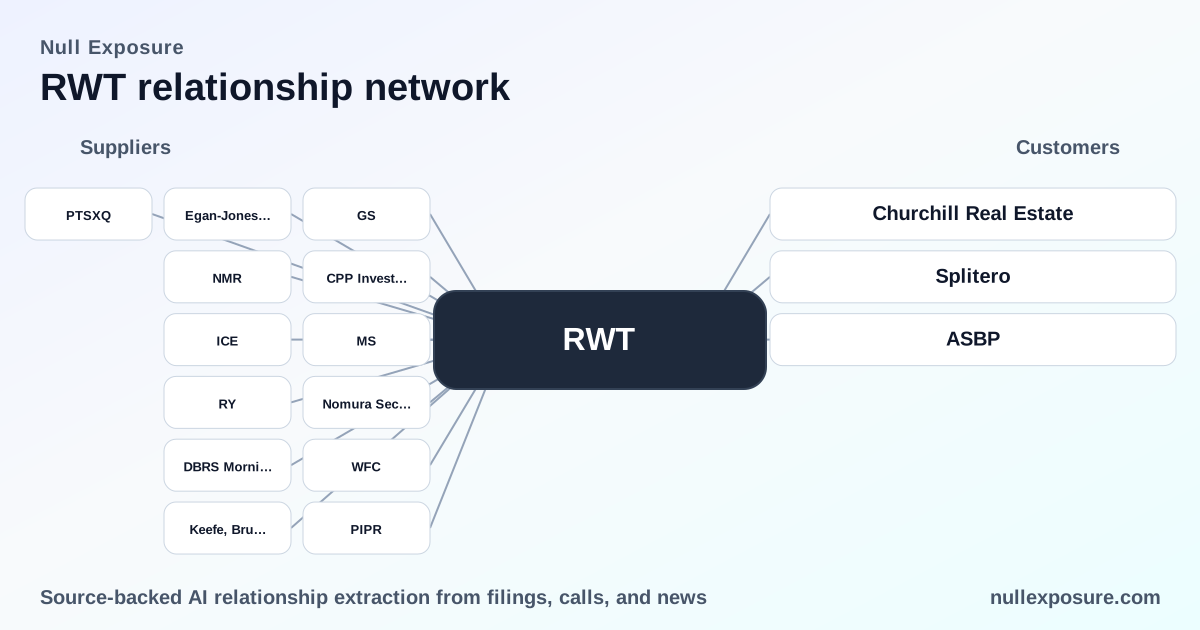
Redwood Trust (RWT) — customer relationships that drive a non-bank mortgage finance franchise
Redwood Trust is a specialist mortgage finance company that earns through spread income, whole‑loan sales, and securitization arbitrage: it acquires or finances residential investor and non‑QM loans, packages them into ABS, sells whole loans to alternate buyers, and holds securities that generate yield. Revenue is a mix of interest income and fees plus gains/losses from securities and loan dispositions, supported by a modest market capitalization (~$700M) and a dividend yield north of 12% on the latest quote — a capital‑returns posture that underwrites active balance‑sheet management. For a focused view of how customer links translate to capital deployment and execution risk, see more at https://nullexposure.com/.
How to read this relationship map: what matters to investors
Redwood’s customer relationships are not simply sales outlets; they represent execution channels for originating, distributing, or partnering on housing credit. Customers and partners can be equity investors in joint ventures, conduits for loan flow, or counterparties for securitization and whole‑loan exits. Each relationship below is summarized in plain English with source context so you can assess where Redwood places capital, how it converts pipeline to liquidity, and what counterparties matter to earnings.
Churchill Real Estate — a partnership stake with optional loan purchases
Redwood invested with Churchill Real Estate in a transaction that gives Redwood a share of Churchill’s profits and optional rights to acquire some of its loans, aligning Redwood’s economics with the originator’s performance and offering a secondary channel for whole‑loan purchases. This arrangement was reported by The Real Deal in April 2021 (transaction details and the optional loan purchase language are in the press report). (Source: The Real Deal, Apr 2021 — https://therealdeal.com/new-york/2021/04/26/churchill-real-estate-snags-funding-to-expand-residential-loan-biz/)
Splitero — loss of a committed investor relationship
HousingWire reported that home equity investment firm Splitero lost Redwood Trust as its principal investor, creating a change in capital support that reduces future flow or committed capital from this counterparty. The item was described in a HousingWire story covering Splitero’s investor dynamics for FY2023. (Source: HousingWire, FY2023 — https://www.housingwire.com/articles/home-equity-investment-firm-splitero-loses-main-investor-750m-in-committed-capital/)
ASBP — securitization partner for non‑QM distribution
Redwood signaled plans to launch ASBP’s inaugural non‑QM securitization, positioning the partner channel as a securitization execution option beyond whole‑loan sales and thereby expanding Redwood’s capital markets outlets for non‑QM product. National Mortgage Professional covered the announcement and the near‑term timing in a FY2026 item. (Source: National Mortgage Professional, FY2026 — https://nationalmortgageprofessional.com/news/redwood-trust-signals-bigger-non-qm-push-aspire-securitization-plans-capital-partner-talks)
Aspire — channel development for non‑QM inventory
In the same National Mortgage Professional article, Redwood indicated it will launch Aspire’s first non‑QM securitization, which creates an additional distribution and funding lane for non‑QM loan inventory and reduces dependence solely on whole‑loan buyers. This is presented as a near‑term execution plan in FY2026 coverage. (Source: National Mortgage Professional, FY2026 — https://nationalmortgageprofessional.com/news/redwood-trust-signals-bigger-non-qm-push-aspire-securitization-plans-capital-partner-talks)
What constraints reveal about Redwood’s operating model and counterparty posture
The observable constraints across Redwood’s disclosures and public reporting speak to a multi‑modal funding and distribution strategy:
- Contracting posture: mixed long‑ and short‑term exposure. Redwood explicitly categorizes residential investor loans as both “term” (3–30 years) and “bridge” (12–36 months), and notes that most ABS outstanding have contractual maturities beyond five years — a balance between durable, longer‑dated securitizations and shorter bridge financing. This structure gives Redwood flexibility to match funding tenor to product economics.
- Geographic focus: national U.S. market. The company states its role in providing liquidity across the United States rather than in a single region, which reduces single‑market concentration but ties performance to U.S. housing cycles broadly.
- Relationship role: seller and distributor. Redwood repeatedly positions itself as a seller of whole loans and as a securitization sponsor, indicating reliance on secondary markets and ABS execution as essential liquidity outlets.
- Business segment orientation: service and capital markets execution. The firm’s public description emphasizes delivering customized housing credit investments via securitization platforms, whole‑loan distribution, and public securities — a services‑oriented franchise that monetizes structuring and distribution capabilities as much as balance‑sheet spread.
These are company‑level signals, not relationship‑specific attributions unless the source explicitly names the counterparty.
Investment implications: how these relationships and constraints translate to value and risk
Redwood’s customer links show deliberate diversification of execution channels — joint ventures, conduit partnerships, and securitization sponsors — which reduces single‑counterparty concentration but increases execution complexity. Key implications for investors:
- Execution and market‑access risk is central. Success depends on timely securitizations and whole‑loan exits; the Aspire/ASBP securitization plans are evidence Redwood actively enlarges its funding toolbox.
- Counterparty volatility can alter flows quickly. The Splitero example illustrates that a lost investor commitment can remove an expected capital source and requires redeployment or alternative funding.
- Balance‑sheet sensitivity to housing credit cycles remains high. Redwood’s core earnings engine is interest and securitization gains; the company reported negative EPS and a sizable negative profit margin in the latest trailing metrics, underscoring operating leverage to loan performance (see company filings for current margins and EPS).
- Structural flexibility is a competitive advantage. The firm’s ability to both sell whole loans and issue ABS gives it optionality to optimize funding costs and timing across cycles.
For a concise checklist: consider (1) securitization pipeline execution, (2) the stability of principal investor commitments, (3) the quality of underlying loan originators (partners like Churchill), and (4) macro U.S. housing and rate trends.
If you want a deeper mapping of counterparties to potential liquidity outcomes and scenario modeling, visit https://nullexposure.com/ for extended relationship analytics and primary‑source links.
Bottom line: a capital‑markets operator whose customer map equals its funding map
Redwood is a specialist that monetizes origination and distribution capacity through an active use of joint investments, whole‑loan sales, and securitization. The relationships documented — Churchill, Splitero, ASBP, and Aspire — collectively illustrate how Redwood both sources loan flow and creates execution options to convert that flow into liquidity. Investors should evaluate the company through the twin lenses of securitization execution risk and counterparty capital stability, while recognizing that Redwood’s mixed contractual tenors and national footprint provide operational flexibility but not immunity to housing‑credit cycles.