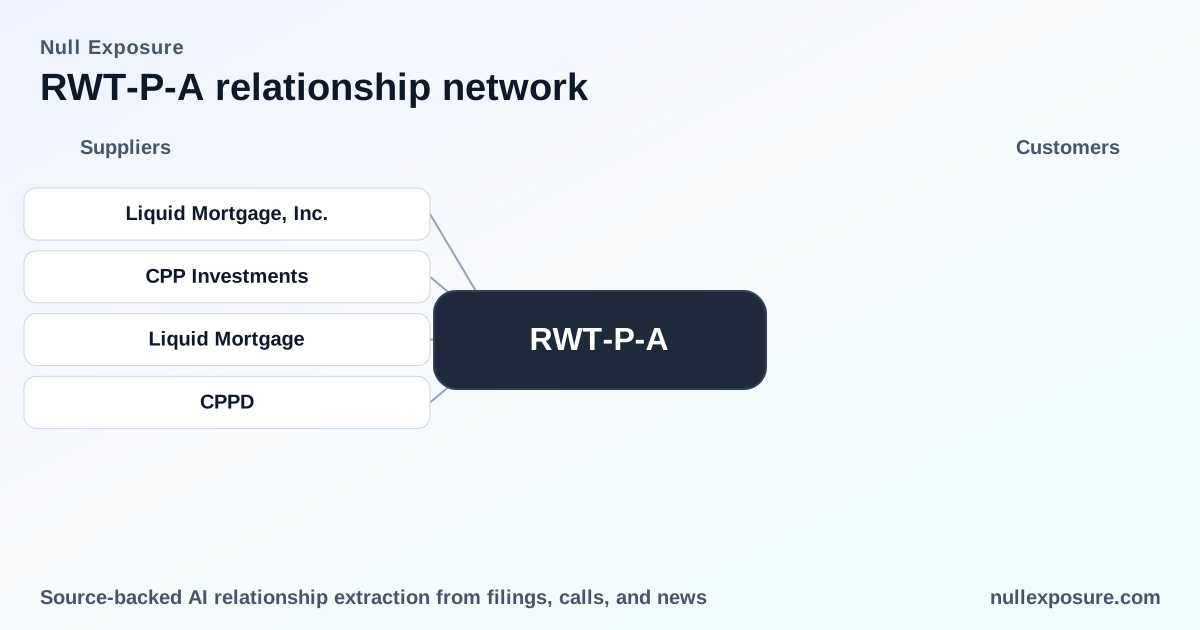
RWT-P-A: How Redwood Trust monetizes customer relationships through JV economics
Redwood Trust operates as a mortgage-focused REIT that originates, securitizes, and co-invests in residential mortgage loans and mortgage-backed securities, monetizing through loan sale margins, servicing fees, and equity stakes in structured vehicles. The company accelerates capital turnover and captures structured upside by placing originated loans into joint ventures with strategic partners while retaining minority stakes that participate in long-term performance. For investors evaluating RWT-P-A, the preferred stock holder perspective hinges on the stability of those financing flows, counterparty credit and operational partnerships, and how JV economics convert originations into recurring and contingent returns. Visit the NullExposure homepage for further research resources.
How Redwood’s operating model translates to cash and risk
Redwood’s model is transactional and partnership-driven. It originates or acquires mortgage assets, harvests near-term economics when loans are transferred into joint ventures or securitizations, and retains minority equity interests to capture residual upside over time. That dual revenue vector—immediate economics on placement plus longer-run equity participation—creates a hybrid return profile that mixes fee-like revenue with asset-based performance exposure.
Key business-model characteristics to monitor:
- Contracting posture: Redwood regularly structures contracts that transfer assets into third‑party vehicles while securing predictable placement fees and ongoing participation as a minority equity holder.
- Concentration and counterparty dependency: Reliance on a small set of JV partners concentrates execution and counterparty risk; partner performance directly affects long-term upside.
- Economic criticality: The JV placement mechanism is critical to Redwood’s capital-turnover strategy, making execution and legal terms materially important to cash generation.
- Maturity and predictability: Near-term economics from placements are relatively predictable; long-term upsides are path-dependent and tied to loan performance and servicing outcomes.
Every customer relationship disclosed in the results
Below is a concise coverage of each partner relationship identified in the available results.
CPP (inferred symbol: CPPD)
Redwood runs a joint venture with CPP where it earns a fixed stream of economics on loans placed into the JV and retains a 20% equity stake to participate in upside outcomes, enabling rapid capital turnover and continued performance exposure. This arrangement was discussed on Redwood’s Q4 2025 earnings call transcript published on Investing.com (May 3, 2026) which described the combination of reliable placement economics and minority stake upside. (Investing.com earnings call transcript, Q4 2025 / May 3, 2026: https://www.investing.com/news/transcripts/earnings-call-transcript-redwood-trust-q4-2025-misses-eps-forecast-revenue-beats-93CH-4501477)
Why the CPP JV matters to RWT-P-A holders
The CPP joint venture exemplifies Redwood’s core commercial playbook: turn originations into near-term cash while keeping exposure to upside through minority equity. For preferred holders, this structure has three direct implications:
- Cashflow support: Placement economics provide predictable fee-like cash that supports interest coverage and preferred dividends when paid from operating cash.
- Residual value upside: The 20% equity stake gives balance-sheet upside if underlying loans outperform, but that upside is subject to credit cycles and seasoning.
- Concentration risk: Heavy reliance on a few JVs concentrates counterparty risk; deterioration in a partner’s capital commitment or legal friction in JV terms could disrupt Redwood’s capital-turn cadence.
Risk and reward — what investors should watch next
Redwood’s JV strategy amplifies returns when originations and loan performance align with expectations, but it also creates concentrated operational and counterparty exposures. Evaluate these vectors closely:
- Partner stability: Confirm counterparty capital adequacy and alignment of incentive structures; a well-capitalized partner preserves Redwood’s ability to exit or scale placements.
- JV economics transparency: Monitor public commentary and call transcripts for explicit yield and fee metrics on placed loans; these determine how much margin converts to distributable cash.
- Asset performance: Track seasoning, default trends, and prepayment behavior in the underlying loan pools—these govern the long-run value of Redwood’s minority stakes.
- Funding and liquidity: Examine Redwood’s access to financing between placement events; the speed of capital turnover depends on both execution and short-term funding markets.
Key takeaway: the CPP JV provides both immediate, reliable economics and contingent upside via a minority stake; that combination improves return diversification but increases dependency on counterparties and asset performance.
Practical signals from the available constraints and disclosures
There are no explicit contractual constraints listed in the available relationship data, which itself is a company-level signal: no disclosed covenant excerpts or special contractual limitations were returned in the customer relationship results. Investors therefore should treat the absence of published constraints as an information gap to close through direct filings and call transcripts. In the interim, assume standard JV governance applies and prioritize primary-source documents (8‑Ks, proxy statements, and earnings call supplements) for definitive terms.
Bottom line for investors and operators
Redwood’s JV with CPP is a clear, repeatable execution of its business model: convert originated loans into near-term economic proceeds while maintaining minority stakes for upside participation. For RWT-P-A stakeholders, the critical evaluation points are partner credit and incentives, the consistency of placement economics, and the performance trajectory of retained equity interests. Validate these through ongoing earnings commentary and formal filings; for continuing coverage and structured summaries consult our research hub at the NullExposure homepage.
Bold, transparent JV economics are a structural advantage for Redwood when counterparties are strong and asset performance is stable; conversely, counterparty stress or adverse credit cycles will stress upside capture and capital-turn dynamics—factors that directly affect preferred security risk profiles and income coverage.