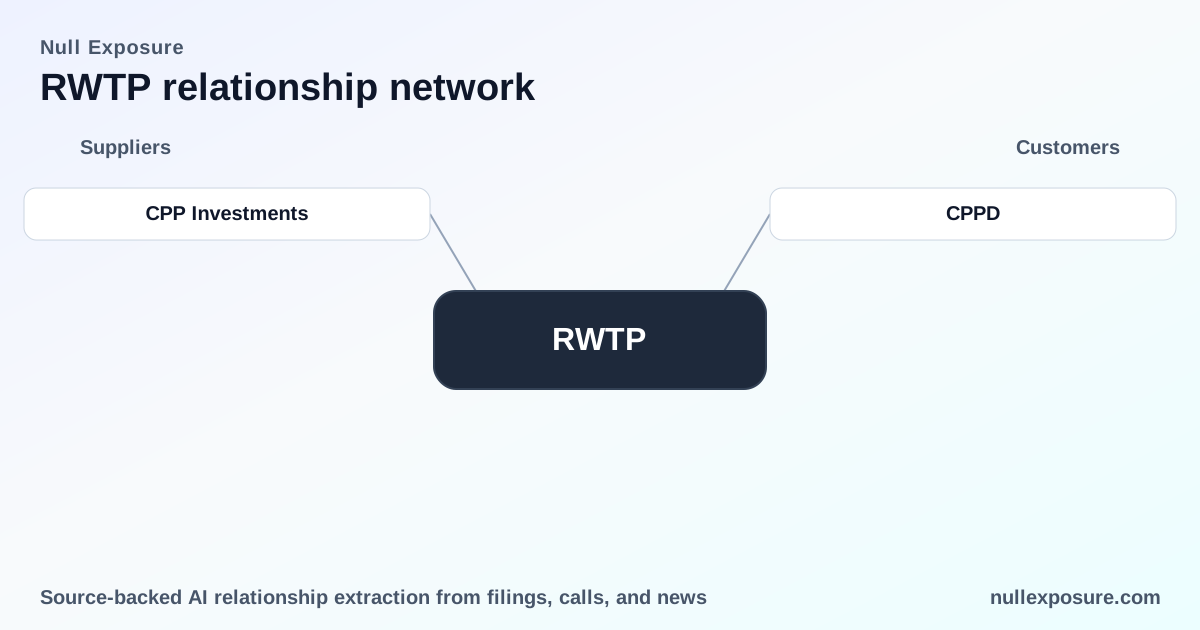
Redwood Trust (RWTP): Customer relationships that drive fee yield and capital velocity
Redwood Trust operates as a specialty mortgage finance company that acquires and originates residential investor loans, packages them into securitizations, sells whole loans, and manages an investments portfolio. The firm extracts income through loan-level economics on originated and acquired loans, securitization and distribution fees, and investment returns on retained portfolios and equity stakes in joint ventures — including a structured 20% stake in a joint venture that converts originated loans into distributable assets. For investors, Redwood’s core monetization is spread capture on mortgage assets plus recurring fee income from securitization and servicing activities, supported by strategic capital-allocation partnerships. Learn more at https://nullexposure.com/.
Executive summary: why the CPP JV matters to the P&L
Redwood’s disclosed joint venture with CPP is a clear operational lever: it accelerates capital turnover while locking in a fixed amount of economics on loans sold into the JV and preserving upside through its minority equity stake. That structure improves reported returns on capital and stabilizes fee revenue — a material behavioral change versus a pure hold-to-maturity investment book. According to management’s Q4 2025 earnings call transcript, Redwood is earning a “very certain amount of economics on loans going into the JV” and retains upside as a 20% stakeholder. (The Globe and Mail, Q4 2025 earnings call transcript, March 10, 2026.)
The CPP relationship — two documented mentions, one economic reality
CPP / CPPD — the same partnership described twice
Management described the partnership with CPP in the Q4 2025 earnings call as a joint-venture mechanism that both speeds capital recycling and provides predictable economics, while preserving participation in upside outcomes as a 20% owner. The comment was made in Redwood’s Q4 2025 earnings call transcript and reported by The Globe and Mail on March 10, 2026. (The Globe and Mail, Q4 2025 earnings call transcript, March 10, 2026.)
CPPD (duplicate entry) — consistent characterization
A second entry repeats the same disclosure: the joint venture structure delivers reliable economics on loans contributed to the JV and leaves Redwood with upside as the minority partner. The repeated mention in the same Q4 2025 call transcript underscores management’s strategic emphasis on the arrangement. (The Globe and Mail, Q4 2025 earnings call transcript, March 10, 2026.)
How customer and counterparty signals define Redwood’s operating posture
Redwood’s public disclosures and segment descriptions frame the company as both a buyer and seller of residential loans and as an originator/servicer network that supports securitization. Company-level signals from filings and investor materials show these characteristics:
- Contracting posture: Redwood acts as a large buyer of residential consumer loans from third-party originators and as a seller/contributor to securitizations and whole-loan purchasers. The firm also functions as a service provider via its Sequoia and CoreVest mortgage banking platforms that deliver securitization and distribution services.
- Concentration and geography: Redwood’s commercial focus is concentrated on the U.S. housing market — explicitly targeting segments underserved by government programs — which concentrates macro exposure to U.S. housing cycles and policy shifts.
- Criticality: The business model is highly dependent on access to third-party originations and capital partners to drive throughput into securitizations and JV structures; partnerships such as the CPP JV materially affect capital velocity and reported yields.
- Maturity and scalability: Redwood operates three named segments — Sequoia Mortgage Banking, CoreVest Mortgage Banking, and Redwood Investments — indicating a mature, multi-channel origination and distribution platform that combines recurring fee streams with portfolio risk-taking.
These signals derive from Redwood’s regulatory disclosures and investor communications describing the firm’s conduit activity, securitization programs, and acquisitions of origination platforms.
Operational risk vectors investors should price in
- Data and identity risk: Redwood’s loan acquisition activities entail possession of non-public borrower information, creating privacy and fraud exposure tied to servicing and loan transfers. Company disclosures acknowledge that borrower personal information could be leveraged by bad actors when Redwood acquires or services loans.
- Concentration in U.S. residential credit: The firm explicitly targets U.S. housing market niches that are not well served by government programs, increasing sensitivity to housing-market downturns and policy changes affecting private-label mortgage demand.
- Partner concentration and counterparty economics: Structures that rely on JVs and whole-loan buyers shift execution risk to counterparties and capital markets; however, the CPP JV demonstrates an ability to lock in predictable loan-level economics while retaining upside, which reduces reliance on immediate sale spreads but increases dependency on JV performance.
- Operational complexity from multi-segment operations: Running securitizations (Sequoia), investor-focused origination (CoreVest), and an investments portfolio requires integrated risk and funding management; execution flaws or market dislocations could compress margins across all channels.
What this means for valuation and monitoring
- Revenue quality has a strong fee-and-spread component. Redwood’s revenue comes from a mix of spread capture, securitization fees, distribution income, and investment portfolio returns (Revenue TTM reported in company metrics). Investors should value Redwood using a hybrid lens that combines spread-sensitive asset returns with fee annuities.
- JV economics improve capital efficiency. The CPP arrangement demonstrates a deliberate strategy to accelerate capital turnover while preserving economic upside as an investor; this increases return on deployed capital and reduces balance sheet duration risk when executed well.
- Watch four leading indicators: volume of loans acquired from third-party originators, securitization issuance and shelf activity, performance of JV partners and retained investments, and regulatory or policy shifts affecting non-agency mortgage demand.
Bottom line: concentrated execution with partnership leverage
Redwood Trust runs a capital-efficient mortgage platform that monetizes through loan economics, securitization services, and meaningful partnerships such as the 20% JV with CPP that converts loan originations into predictable economics and retained upside (The Globe and Mail, Q4 2025 earnings call transcript, March 10, 2026). Company-level disclosures also flag operational constraints — handling borrower personal information and a concentrated U.S. housing focus — that investors must price into risk-adjusted returns. For a deeper look at how these customer relationships influence portfolio construction and counterparty exposure, visit https://nullexposure.com/.
Bold takeaways:
- Joint ventures like the CPP deal materially increase capital turnover and stabilize economics.
- Redwood’s dual role as buyer, seller, and service provider creates diversified fee channels but concentrates macro exposure in U.S. housing.
- Data privacy and partner performance are primary operational risks for investors to monitor.