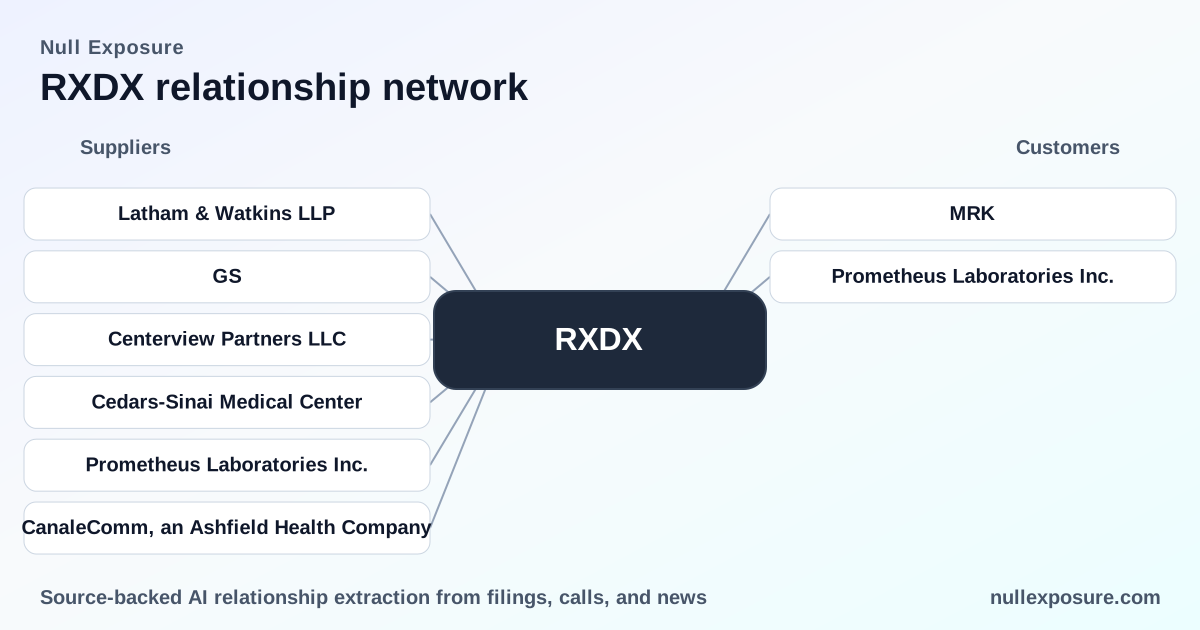
RXDX customer map: what the public record tells investors about partner risk and revenue cadence
RxDx operates as a clinical-stage biopharma partner whose commercial model is driven by collaborations, milestone and royalty arrangements, and short-term service reimbursements tied to development programs. The company’s revenue profile is therefore concentrated and event-driven: service fees and collaboration reimbursements fund near-term operations while milestone payments and corporate transactions drive outsized valuation inflection points. For a full relationship and signal map, visit https://nullexposure.com/.
The high-level investor thesis — why these relationships matter now
RXDX’s financial trajectory depends on a small set of large pharma interactions and a handful of development-stage collaborations. Revenue is lumpy and concentrated, with recurring service income limited and reimbursement mechanics creating timing volatility. Strategic value to investors derives from successful clinical advancement and the potential for licensing or acquisition events driven by partner validation.
- Drivers: collaboration milestones, big-pharma licensing or acquisition, and upfront payments tied to partnerships.
- Risks: concentration of partner exposure, revenue timing sensitivity from reimbursements, and early-stage maturity requiring external capital.
Company-level operating signals: RXDX contracts predominantly through development collaborations and transitional-service agreements; concentration risk is material because a handful of partners account for most documented revenue interactions; partnerships are critical to near-term cash flow and validation; the business is early-stage with revenue maturity tied to partner milestones and one-off transactions rather than stable product royalties.
For more context on how partner concentration affects valuation and cash runway, see our relationship maps at https://nullexposure.com/.
The public record on each customer relationship
Merck / MRK / Merck & Co.
Merck completed a strategic acquisition that directly affected Prometheus and related assets, signaling how large-cap pharma can both validate and consolidate smaller development-stage partners; Merck agreed to acquire Prometheus Biosciences for approximately $10.8–$11 billion at $200 per share, a transaction that reshaped partnership dynamics in the immunology space. According to BioSpectrum Asia and Investopedia (March 2026 reporting on the 2023 deal), the $200-per-share purchase price represented a substantial premium and demonstrates the potential exit value that large pharma can deliver to smaller collaborators.
Sources: BioSpectrum Asia (Mar 2026) and Investopedia (Mar 2026) reporting on Merck’s acquisition of Prometheus Biosciences in FY2023.
Merck / MRK (talent and follow-on ventures)
Former Prometheus executives who moved through the Merck transaction later seeded new ventures and raised capital, underscoring how corporate exits recycle talent into the therapeutic ecosystem and influence competitive dynamics; reporting shows ex-Prometheus leaders launched Mirador Therapeutics with significant funding after the Merck buyout. FierceBiotech and GEN Eng News covered these developments and the personnel movements into FY2024 narratives.
Sources: FierceBiotech (Mar 2026) and GEN Eng News (Mar 2026) on Prometheus veterans launching Mirador post-acquisition.
Takeda
Takeda invested in a collaboration with Prometheus in 2019 that included upfront consideration plus up to $420 million in milestone payments, an arrangement that illustrates how large pharmas structure staged commitments to precision-medicine partners. GeneOnline reported the Takeda deal terms in FY2025 context, highlighting the milestone-heavy nature of these alliances and the potential for sizeable contingent payouts.
Source: GeneOnline (reported May 2026 referencing the 2019 Takeda‑Prometheus pact and milestone structure).
Prometheus Laboratories Inc.
Prometheus Laboratories provided transitional services to Prometheus Biosciences under a spin-off arrangement, including facility subleasing and monthly service fees, which demonstrates a common early-stage operational pattern: transitional-service contracts generate modest, predictable cash inflows but are finite. A Marketscreener summary of the company spin-off (FY2020) documents the transitional-services arrangement and fee structure.
Source: Marketscreener summary of Prometheus Biosciences spin-off (FY2020).
Falk
RXDX disclosed that revenue from a Falk collaboration was $1.1 million for the quarter ended March 31, 2023, down from $3.9 million the prior year quarter, and attributed the decline to timing of collaboration development efforts subject to 25% reimbursement. The company filing (Exhibit 99.1 to an SEC submission) establishes that service-reimbursement mechanics can materially swing quarter-to-quarter revenue and that certain collaboration payments are explicitly subject to partial reimbursement.
Source: RXDX SEC filing (Exhibit 99.1, FY2023).
What these relationships mean for cash flow and valuation
Collectively, the public record defines a clear economic pattern: small-scale, recurring service and reimbursement revenue that smooths near-term funding needs, plus high-variance milestone and transaction events that create value spikes. Investors must underwrite two separate cash-flow regimes:
- Short-term: service fees and reimbursements, predictable but limited and susceptible to timing shifts (as RXDX’s Falk quarter demonstrates).
- Medium/long-term: milestone payments, licensing receipts, and acquisition value, driven by partner decisions and clinical progress, illustrated by the Prometheus–Merck transaction and Takeda milestone framework.
This hybrid model produces high operating leverage when clinical progress triggers partner payments, and substantial downside if the partnership pipeline stalls.
How to read partner disclosures as an investor
Focus on these five signals when evaluating RXDX’s partner set:
- Contract type: service/sublease vs milestone/licensing — service contracts support operations; milestone contracts drive upside.
- Concentration: how many partners account for material revenue; concentration implies idiosyncratic counterparty risk.
- Payment mechanics: reimbursement percentages and milestone timing that create quarter-level volatility.
- Strategic posture: whether partners are executing acquisitions or changes that could terminate, consolidate, or validate RXDX’s programs.
- Talent flows: executive movements post‑transaction can reshape competitive dynamics and future partnership opportunities.
Bottom line and action
RXDX is a partnership-dependent, event-driven biopharma, where revenue predictability is limited but upside from partner validation and corporate transactions is significant. The Merck acquisition of Prometheus and the Takeda milestone framework show the scale of what a successful partnership can deliver; the Falk filing demonstrates how reimbursement mechanics compress near-term revenue.
For a deeper, interactive view of RXDX’s partner web and to monitor changes in documented relationships, visit https://nullexposure.com/.