RXO Inc.: Customer Concentration, Contract Mix, and the Real-World Partners Behind the Numbers
RXO operates an asset-light, technology-driven freight brokerage and managed-transportation platform that monetizes by arranging truck capacity and charging customers for transportation services and value-added logistics. The company’s revenue mix combines spot brokerage and contractual managed-transportation and last-mile agreements, with scale coming from a relatively concentrated roster of large shippers alongside many small accounts; that structure creates volatile spot-driven top-line swings but also recurring revenue pockets that underpin margins when long-term mandates exist. For deeper diligence on counterparty footprints and relationship signals, see https://nullexposure.com/.
How RXO makes money and why customer relationships matter
RXO’s core product is truck brokerage supported by technology and an asset-light carrier pool, supplemented by managed transportation and last-mile services that generate longer-duration revenue. The company reported roughly $5.742 billion in trailing revenue and $941 million in gross profit, reflecting scale in brokerage volume while operating with limited owned assets. Company filings as of December 31, 2025 disclose a modest fixed-component remaining performance obligation (~$13 million) and state that approximately 94% of that amount will be recognized over the next three years, which signals some embedded contractual revenue amid a largely spot-exposed business.
Key economic drivers for investors:
- Volume and yield on brokerage contracts determine short-term cash flow; spot transactions amplify revenue volatility.
- Managed-transportation and last-mile mandates provide higher predictability and can compress customer concentration risk when at scale.
- Customer concentration is material: RXO’s largest customer generated about $653 million (11.4% of 2025 revenue), which concentrates counterparty risk at the top of the book.
RXO is primarily North America-focused, with the majority of sales generated in the U.S. and roughly 7% of revenue outside the U.S., supporting a thesis that macro U.S. freight volumes and industrial activity remain the dominant demand drivers (company filing, year-end 2025).
Constraints that shape the operating posture investors should model
Several company-level signals define how to model RXO’s customer economics and counterparty exposure:
- Contracting posture: RXO prices on both spot and contract bases, so cash flow models should layer a volatile spot bucket over a smaller but meaningful contractual book (filing language on pricing and remaining performance obligations).
- Concentration: The single-largest customer contribution (~11.4%) is material and requires scenario analysis for churn or renegotiation events.
- Geography and scale: RXO is North America-centric, limiting revenue diversification across geographies and tying growth to U.S. freight cycles (filing excerpts on geography and broker scale).
- Customer diversity: The company serves small businesses through Fortune 100 shippers, which reduces single-segment dependency but increases operational complexity in serving widely different account types.
- Segment mix: The core truck brokerage business is primary, while managed transportation and last-mile services supply strategic, higher-stability contracts that can offset brokerage volatility.
If you want a consolidated counterparty map and signal scoring for investor models, visit https://nullexposure.com/ for a structured view.
What the named relationships in the record reveal
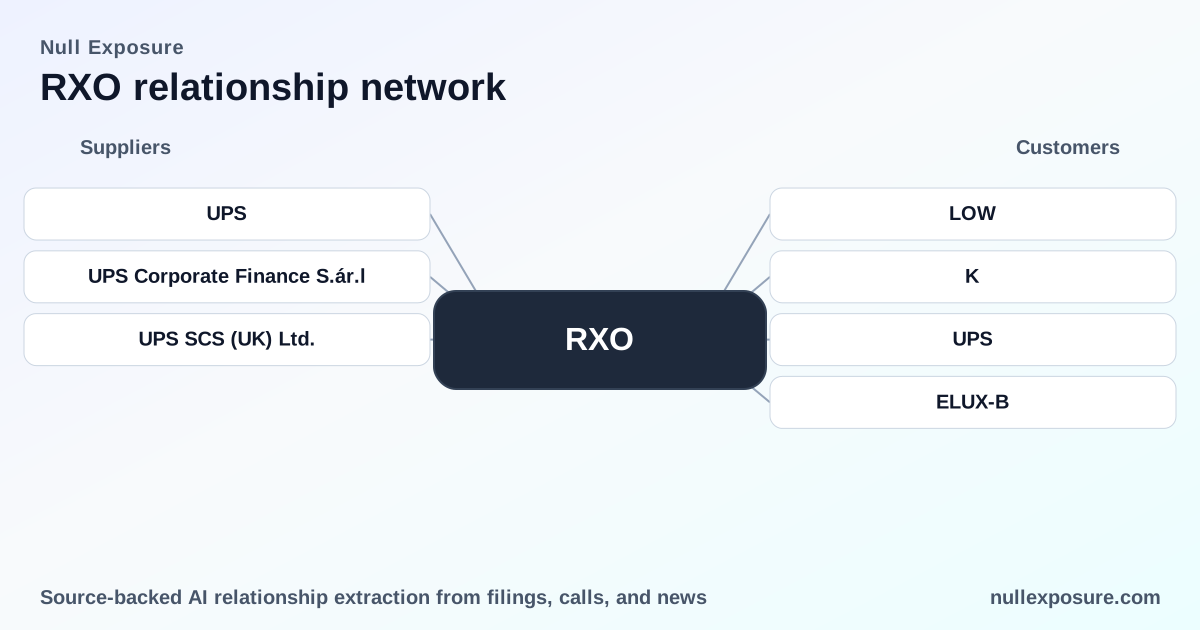
Below are the named counterparties extracted from recent public disclosures and press reporting; each entry includes a concise plain-English summary and its source.
Lowe’s
RXO cited Lowe’s as one of several “blue‑chip customers” that recently awarded business to the company, illustrating RXO’s success in winning large retail distribution mandates that drive truckload volumes. The mention comes from the Q4 2025 earnings call transcript published on InsiderMonkey (March 10, 2026).
Source: Q4 2025 earnings call transcript (InsiderMonkey), March 10, 2026.
K
An alternate match labeled “K” appears in the same Q4 2025 earnings call transcript and corresponds to the same “blue‑chip awards” language; this record is an inferred-name match tied to the company’s statement about new awards from several large shippers. The reference is drawn from the InsiderMonkey Q4 2025 transcript (March 10, 2026).
Source: Q4 2025 earnings call transcript (InsiderMonkey), March 10, 2026.
Kelanova
Kelanova is explicitly listed by RXO management among recent blue‑chip customer awards in the Q4 2025 call, confirming RXO’s penetration into consumer-packaged‑goods/logistics accounts that typically generate steady full‑truckload run rates. The citation is from the Q4 2025 earnings call transcript on InsiderMonkey (March 10, 2026).
Source: Q4 2025 earnings call transcript (InsiderMonkey), March 10, 2026.
Electrolux
RXO management named Electrolux as another blue‑chip customer award, signaling traction in durable-goods supply chains where reliable outbound and retail delivery are critical. This was disclosed in the Q4 2025 earnings call transcript reported by InsiderMonkey (March 10, 2026).
Source: Q4 2025 earnings call transcript (InsiderMonkey), March 10, 2026.
UPS
RXO agreed to acquire Coyote Logistics from UPS, and under the deal RXO will continue to serve UPS’s brokered transportation needs under a contract running through January 2030, embedding a long-term service relationship for a major network counterparty. The contractual runway with UPS provides a multi-year revenue stream linked to a strategic asset acquisition. Reported by MDM (March 10, 2026).
Source: MDM / Breaking News in Wholesale Distribution, March 10, 2026.
Bob’s Furniture (BOBS)
Bob’s Furniture formerly contracted with RXO (previously XPO Last Mile Inc.) to deliver products, and recent legal reporting indicates Bob’s has exited a delivery-driver wage lawsuit against RXO—this reflects a past customer relationship in the last‑mile segment and highlights operational and litigation risk vectors tied to contractor labor practices. Reported by Bloomberg Law’s Daily Labor Report (March 9, 2026).
Source: Bloomberg Law, Daily Labor Report, March 9, 2026.
Investment implications and risk checklist
- Concentration risk is real: With one customer at ~11.4% of revenue, underwrite downside scenarios where large mandates reduce volumes or shift to alternative providers.
- Dual contract posture influences volatility: Model a high‑variance spot bucket and a smaller, steadier contractual revenue stream informed by the $13 million fixed remaining performance obligation and the 94% near-term recognition schedule (company filing, Dec. 31, 2025).
- Asset-light scale is an advantage and exposure: Low capital intensity supports margin expansion in favourable markets but makes RXO dependent on carrier capacity and spot-market dynamics.
- Legal and operational execution risk: The Bob’s Furniture litigation history underscores exposure to labor and contractor disputes in last‑mile operations that can affect margins and reputational cost.
Bottom line
RXO’s mix of blue‑chip wins (Lowe’s, Kelanova, Electrolux), a strategic acquisition-driven relationship with UPS, and legacy last‑mile customers (e.g., Bob’s Furniture) constructs a business that is scale-driven but concentration-sensitive. Investors should model both spot volatility and the stability of managed‑transportation mandates, stress-testing scenarios where top-client volumes contract or contractual economics reset. For a structured counterparty analysis and layered signal scoring to support valuation work, visit https://nullexposure.com/.