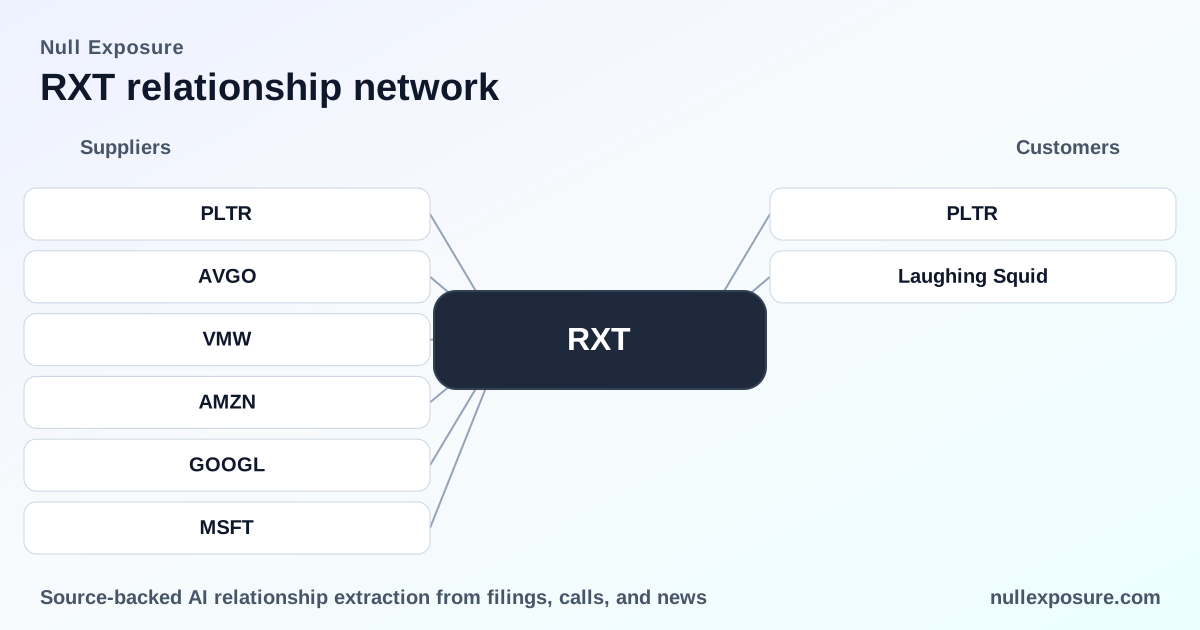
Rackspace Technology (RXT): Customer relationships driving a services-first multi‑cloud play
Rackspace monetizes by selling managed cloud services across public and private environments: recurring private‑cloud subscriptions and long‑term managed contracts, plus consumption‑based public cloud services and professional engagements. The business combines capital‑intensive infrastructure for private clouds with a capital‑light managed‑services arm, generating mixed revenue cadence and exposure to both durable contracts and volatile usage volumes. For a focused read on customer relationships and commercial risk, visit https://nullexposure.com/.
Why customers matter more than raw revenue figures
Rackspace’s commercial model blends predictable, contractually‑backed private cloud revenue with variable, usage‑driven public cloud billing. The company reported $2.6857 billion in trailing twelve‑month revenue and a negative profit margin of -8.41%, underscoring the importance of customer contract quality and the balance between fixed and consumption streams to restore margin expansion.
- Contracting posture: The company operates a hybrid mix—subscription and multi‑year private cloud contracts (12–36 months) alongside monthly, cancellable consumption contracts for public cloud and legacy OpenStack customers. This creates a layered revenue profile: base stability from private cloud plus upside/volatility from usage.
- Customer breadth and concentration: Rackspace serves over 81,000 customers in 120+ countries and reports no single customer accounted for 5% or more of 2024 revenue, a structural advantage for credit and revenue resilience.
- Role and criticality: Rackspace functions primarily as a service provider and reseller—designing, operating and sometimes reselling cloud infrastructure—which places it squarely in the mission‑critical path for customers’ IT operations.
- Geographic footprint: The revenue split shows meaningful presence across Americas, EMEA and APJ, and the firm explicitly operates global and UK sovereign capabilities—important for regulated workloads and AI sovereignty plays.
- Business segments: Public Cloud drives capital‑light, services revenue; Private Cloud is capital‑intensive but delivers recurring, longer‑term contracts. Investors should evaluate margin dynamics by segment rather than headline revenue alone.
If you want a deeper signal map of Rackspace customer relationships and commercial constraints, see more at https://nullexposure.com/.
The partnership matrix — relationship readouts investors need
Palantir Technologies (PLTR)
Rackspace will host and manage Palantir’s Foundry and AIP in its private cloud and UK sovereign data centers, and plans to expand a Palantir‑trained engineering team from about 30 to 250 within a year—an execution‑heavy, strategic managed‑services engagement that strengthens Rackspace’s sovereign and AI hosting credentials. (Reported by Simply Wall St and corroborated in March 2026 news coverage.)
Uniphore
Uniphore will move select enterprise inferencing workloads to Rackspace’s private cloud to deliver a Sovereign AI offering, positioning Rackspace as the managed host for latency‑sensitive, regulated AI workloads and reinforcing the company’s UK/sovereign capability narrative. (Reported via Yahoo Finance, May 2026.)
Reiter Affiliated Companies
Reiter selected Rackspace to modernize IT infrastructure with a VMware‑based private cloud, representing a classic private‑cloud, multi‑year managed‑services engagement focused on modernization and scalable migration. (Reported by TradersUnion, May 2026.)
Laughing Squid (customer reaction)
A longstanding Rackspace email customer, Laughing Squid reported a sudden 706% price increase for email service in a March 2026 blog post—an example of price‑sensitivity risk and potential brand/customer churn tied to contract reset decisions for commodity services. (Noted in TechRadar coverage of Laughing Squid’s post, March 2026.)
Rubrik (RBRK)
The collaboration with Rubrik integrates Rubrik Security Cloud into Rackspace’s services to keep sensitive data offline and bolster cyber‑resilience, a complementary security solution that supports Rackspace’s positioning for compliance‑sensitive hosting. (Reported by Sahm Capital, March 18, 2026.)
WORX / SCWorx (WORX)
SCWorx disclosed in its FY2024 10‑K that it hosts SaaS solutions in third‑party data centers including Rackspace, confirming Rackspace’s role as a third‑party hosting provider for SaaS vendors and evidencing the company’s reseller/host footprint in vendor supply chains. (Filed in SCWorx FY2024 10‑K.)
What these relationships mean for investors: upside and risk checklist
- Upside — differentiated AI and sovereign hosting: The Palantir and Uniphore agreements transform Rackspace into a managed host for enterprise AI stacks, a higher‑margin, high‑stickiness area if Rackspace executes on scale, compliance and performance SLAs.
- Revenue stability from multi‑year private contracts: The company’s disclosure of 12–36 month fixed‑term private cloud contracts creates a base of recurring revenue and provides predictability that offsets consumption volatility.
- Volatility from public cloud usage: The same filings state that public cloud revenue is invoiced monthly on a usage basis and is cancellable, which injects topline sensitivity to customer consumption patterns and cloud cost economics.
- Low counterparty concentration: No customer >5% of revenue is a meaningful structural credit strength; Rackspace’s risk is operational (service delivery, price resets) rather than concentrated client loss.
- Execution and margin pressure: With negative operating metrics and elevated EV/EBITDA multiple relative to profitability, execution risk on large strategic partnerships and containment of customer‑facing price conflicts (e.g., email price hikes) is the near‑term battleground for turning revenue into sustainable profits.
- Geographic and regulatory positioning: The company’s EMEA and UK sovereign posture is a competitive differentiator for regulated workloads; success depends on proving security, compliance and local engineering scale.
Bottom line
Rackspace is a services‑led multi‑cloud operator with a dual‑track revenue model: subscription/term‑backed private cloud contracts that anchor revenue, plus usage‑driven public cloud services that produce volatility and upside. Recent strategic customers and partnerships—particularly around hosted AI stacks—reposition Rackspace toward higher‑value managed services, but investor returns depend on disciplined contract economics, margin recovery, and smooth execution of the newly expanded delivery teams. For ongoing tracking of RXT customer developments and relationship risk, visit https://nullexposure.com/.