Ryanair Holdings (RYAAY): Distribution control is a revenue lever, not a footnote
Ryanair runs a low-cost, high-frequency airline business that monetizes through ticket sales and sizable ancillary fees, and it executes that model by channeling customers toward Ryanair-owned booking systems and price-transparent partners. The company enforces strict distribution rules—both commercially and legally—to protect fare integrity and ancillary economics, turning access to its Travel Agent Direct (TAD) booking platform into a strategic choke point for online travel agents (OTAs). For diligence and monitoring, see the detailed coverage at https://nullexposure.com/.
Why the March 2026 action matters for investors
Ryanair’s public move in early March 2026 is not an isolated PR event; it is a disclosure about how the company governs third-party access to its booking engine and how that governance translates into cash flow protection. Ryanair’s insistence on price transparency and its willingness to pursue court-ordered undertakings illustrate a contracting posture that is assertive and enforcement-capable, which directly supports its ancillary revenue streams (seat selection, baggage, priority boarding) by reducing opaque resale practices that compress Ryanair’s realised yield.
Key operating-model signals at the company level:
- Contracting posture: Ryanair enforces strict contractual limits on channel partners and is prepared to litigate to uphold distribution rules.
- Concentration and control: The airline prioritizes direct bookings and tightly controlled distribution; third-party access to TAD is a gatekeeping issue.
- Criticality: Access to Ryanair’s TAD is commercially critical for OTAs that aggregate and resell Ryanair inventory.
- Maturity: The company’s distribution standards and enforcement mechanisms are mature—Ryanair frames transparency as a non-negotiable commercial standard and secures legal remedies when necessary.
The relationships you need on your radar
Below are the partner relationships referenced in Ryanair’s March 4, 2026 corporate release; each relationship is summarized in plain English with the source cited.
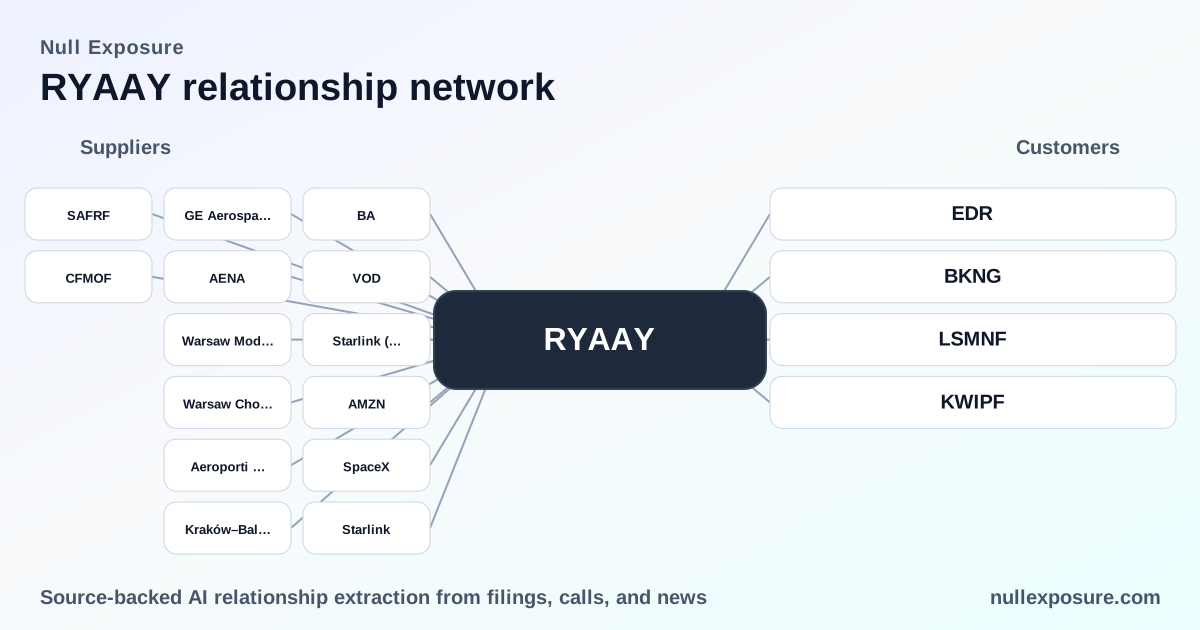
eDreams / EDR
Ryanair welcomed an Irish High Court order recording binding undertakings from eDreams that require the Spanish OTA to cease all direct and indirect access to Ryanair’s Travel Agent Direct (TAD) booking systems and to prevent any contractor from doing so. This is a direct enforcement outcome that severs a resale route for Ryanair inventory. (Ryanair corporate release, March 4, 2026: https://corporate.ryanair.com/news/?market=de)
EDR (alternate reference)
The same court action is described under the EDR ticker reference in Ryanair’s statement: eDreams has been legally restrained from using TAD, removing an OTA’s ability to trade Ryanair fares via direct system access. (Ryanair corporate release, March 4, 2026: https://corporate.ryanair.com/news/?market=de)
Booking.com / BKNG
Ryanair’s release notes that transparent OTAs such as Booking.com have adopted Ryanair’s price-transparency standards, positioning Booking.com as a channel partner that complies with Ryanair’s distribution rules rather than subverting them. That compliance preserves Ryanair’s fare architecture when inventory is listed externally. (Ryanair corporate release, March 4, 2026: https://corporate.ryanair.com/news/?market=de)
Lastminute
Ryanair identifies Lastminute as another OTA that has implemented Ryanair’s price-transparency standards, signaling an effective commercial alignment that allows Ryanair to maintain fare visibility and ancillary disclosures across that channel. (Ryanair corporate release, March 4, 2026: https://corporate.ryanair.com/news/?market=de)
Kiwi
Kiwi is cited alongside Booking.com and Lastminute as an OTA that adopted Ryanair’s transparency requirements, indicating that some marketplace partners accept the airline’s terms and preserve a consistent customer-facing pricing structure. (Ryanair corporate release, March 4, 2026: https://corporate.ryanair.com/news/?market=de)
What this means for revenue and risk profiles
Ryanair’s enforcement of distribution standards is a direct lever on two revenue drivers: ticket yield and ancillary spend per passenger. By limiting opaque reselling and forcing transparent price presentation, Ryanair preserves the customer’s pathway to ancillary options that are central to its unit economics.
Investment implications:
- Upside: Strong contract enforcement supports margin protection by reducing discounting and misleading fee presentation through third-party resellers; this reinforces Ryanair’s low-cost, high-ancillary-margin business model.
- Downside / regulatory risk: The same enforcement posture that protects economics can attract regulatory scrutiny in multiple jurisdictions concerned about competition and resale practices; investors should monitor regulatory filings and litigation developments.
- Channel concentration risk: Ryanair’s strategy increases reliance on its own distribution stack; while that preserves economics, it raises execution risk if the company mismanages customer acquisition outside third-party channels.
Selected near-term monitoring checklist:
- Legal filings related to the Irish High Court ruling and any appeals.
- OTA compliance trends—whether other resellers follow Booking.com/Lastminute/Kiwi’s lead or emulate eDreams.
- Ryanair’s commentary on direct-booking growth and ancillary revenue mix in quarterly results.
For a structured view of how distribution enforcement maps to financial outcomes, explore our coverage and signal tracking at https://nullexposure.com/.
Practical diligence takeaways for operators and investors
- Ryanair treats distribution access as a strategic asset; legal remedies are an extension of commercial negotiation, not a fallback.
- Compliant OTAs (Booking.com, Lastminute, Kiwi) act as amplifiers of Ryanair’s pricing discipline, which supports predictable ancillary capture.
- Non-compliant resellers (eDreams) face exclusion, directly cutting a channel that could otherwise undercut Ryanair’s fare/ancillary architecture.
- There are trade-offs between control and scale: enforcing strict distribution rules reduces leakage but concentrates customer acquisition risk in Ryanair’s own channels.
Bottom line
Ryanair’s March 2026 action is a clear, company-led enforcement of its distribution playbook: protect direct economics, require transparency from partners, and legally back commercial terms when necessary. For investors, that translates to a management team willing to defend margin drivers actively, with attendant regulatory and channel-concentration considerations that deserve ongoing surveillance.
If you want ongoing signals and relationship monitoring tied directly to corporate disclosures, visit https://nullexposure.com/ for subscription options and analyst briefings.