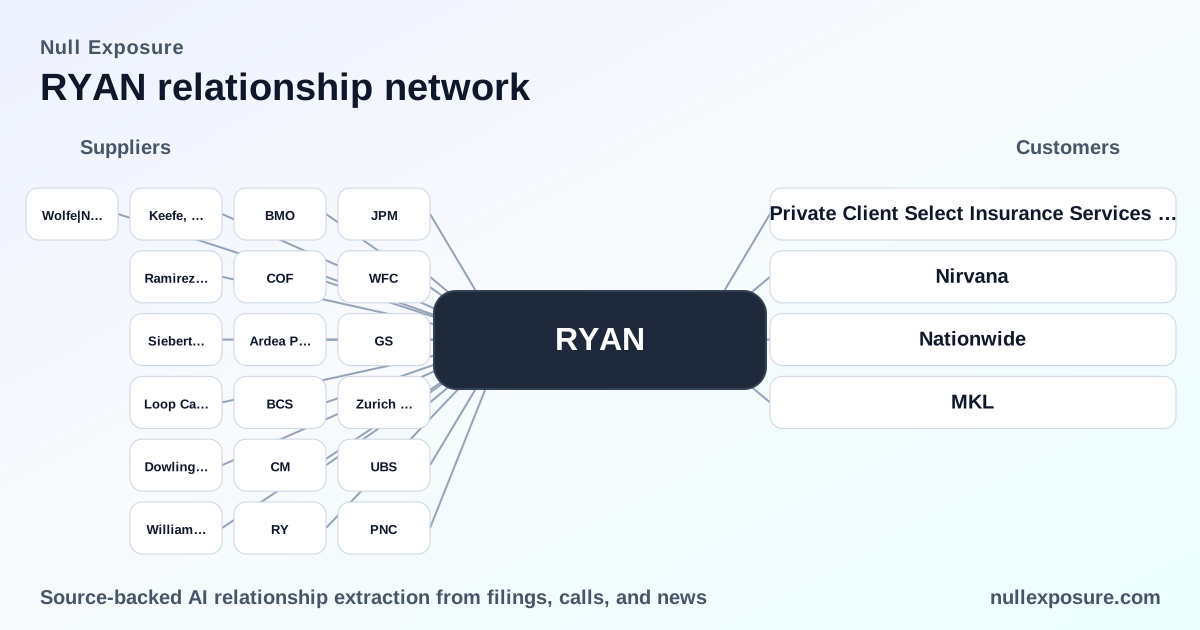
Ryan Specialty Group Holdings (RYAN): Relationship Map and Commercial Signals for Investors
Thesis — Ryan Specialty monetizes a highly scalable specialty-insurance services platform by selling underwriting, distribution and program-management capabilities to brokers and carriers and earning commissions, fees and delegated underwriting economics. The company converts underwriting authority into repeatable revenue through exclusive distribution agreements, delegated binding authority and collateralized reinsurance structures that increase fee capture and capital efficiency. For deeper relationship intelligence, visit Null Exposure: https://nullexposure.com/.
Overview: Ryan Specialty operates as a service-led specialty insurer and wholesale broker. Its business model is driven by delegated authority, program administration and strategic carrier partnerships that grant access to distribution and reinsurance capacity; the company collects revenue as commissions, fees and underwriting economics while expanding margins through scale and product innovation.
Key relationship highlights
- The relationships below are drawn from public reporting and news coverage; each entry includes a concise, plain-English take and the relevant source.
H2: Strategic carrier partnerships that enable delegated underwriting
Nationwide
Ryan describes an expanded, long-term relationship with Nationwide that underpins Ryan Re and new collateralized vehicles such as Rack Re; management positions the Nationwide tie-up as a large, strategic reinsurance and distribution anchor that helps Ryan secure delegated underwriting authority over structured reinsurance flows. According to Ryan’s Q4 2025 earnings transcript reported by The Globe and Mail and related press coverage, the company launched “Ryan Re’s expanded relationship with Nationwide” and cited a 10-year partnership as a key enabler for growth (Q4 2025 / 2026 reporting). Source: The Globe and Mail (Ryan Q4 2025 earnings transcript), 2026 — https://www.theglobeandmail.com/investing/markets/stocks/RYAN-N/pressreleases/196216/ryan-specialty-ryan-q4-2025-earnings-transcript/
Markel (MKL)
Ryan references a strategic relationship with Markel that complements the Nationwide cooperation; management highlighted execution on a Markel reinsurance book during recent calls, indicating material reinsurance and portfolio-management collaboration. Financial commentary and quarter notes cite Markel as a partner that enables Ryan to access reinsurance capacity and delegated authority in structured ways. Source: Sahm Capital write-up quoting management comments and The Globe and Mail earnings transcript, April–March 2026 — https://www.sahmcapital.com/news/content/a-look-at-ryan-specialty-holdings-ryan-valuation-as-analysts-trim-earnings-forecasts-but-keep-positive-ratings-2026-04-13/ and https://www.theglobeandmail.com/
H3: Distribution and wholesale brokerage relationships
Private Client Select Insurance Services (PCS)
Ryan was named as the exclusive wholesale broker for PCS in the U.S. high- and ultra-high-net-worth segment, giving Ryan preferential distribution into a profitable retail niche and likely improving fee capture on high-net-worth programs. Insurance Business reported the PCS distribution agreement and the exclusive-broker arrangement, dated in the reporting as FY2024 activity. Source: Insurance Business (PCS–Ryan partnership announcement), March 2026 — https://www.insurancebusinessmag.com/us/news/breaking-news/pcs-ryan-specialty-form-exclusive-distribution-partnership-499101.aspx
Nirvana
Nirvana, a specialty MGA, acquired Arena NV from Ryan Specialty, signalling selective portfolio rationalization and secondary-market activity in Ryan’s program businesses. This transaction reflects Ryan’s willingness to monetize non-core program assets and to reallocate capital to core underwriting and distribution priorities. Source: Insurance Journal (transaction report), December 2025 — https://www.insurancejournal.com/news/international/2025/12/05/850098.htm
USB‑P‑P
A regional development reference linking Ryan to a redevelopment project of a U.S. Bank building in Edina shows Ryan’s incidental exposure to real estate-related projects through local relationships and investments; this is a single reported mention that does not change Ryan’s core specialty-insurance profile but is worth noting for local operational context. Source: Minneapolis / Twin Cities Business Journal (project report), Sept 2020 — https://www.bizjournals.com/twincities/news/2020/09/01/mortenson-orion-redevelop-usbank-edina-france.html
Constraints and what they tell investors about the operating model Ryan’s corporate filings and public commentary reveal multiple operating constraints that are material to valuation and risk assessment. Presenting these as company-level signals clarifies how the firm structures commercial exposure and revenue capture:
-
Contracting posture: A mix of short-term and usage-based contracts. The company discloses practical expedients for contracts with renewal periods of one year or less and notes that some carrier contracts are terminable with minimal notice. Separately, Ryan’s Velocity Claims business is paid on a usage-based basis (1% of indemnity and expenses on claims it participates in), an explicit example of performance-linked compensation disclosed in filings. Source: Company filings (contract accounting and Velocity Claims disclosure), FY2025 filings.
-
Concentration and criticality: Retail-broker concentration is moderate and immaterial at the top-five level; the top five U.S. retail brokers account for roughly 23–25% of revenue, and no single retail broker exceeded ~8.8% in 2025, indicating diversified distribution while still depending on large broker relationships for scale. Source: FY2025 Form/Investor presentation (top-five broker disclosure).
-
Geography and expansion: North America is dominant, with growing EMEA/APAC presence. Roughly 94% of revenue is U.S.-based, but Ryan operates globally with 129 offices across North America, Europe, Asia and other regions, supporting international distribution and program growth. This mix gives Ryan scale in core U.S. markets while offering optionality in higher-growth international niches. Source: FY2025 revenue and office-count disclosures.
-
Relationship role and maturity: Ryan is principally a service provider and program manager—it provides distribution, underwriting, product development and delegated authority services and continues to run active, expanding relationships with carriers and MGAs. The company reports active access to 35,000+ retail firms and 350+ carriers, underlining the platform nature of its model. Source: Company disclosures and FY2025 investor materials.
-
Spend and contract economics: Most named partner flows are modest on a per-contract basis, but strategic partnerships scale. Example: revenue recognized from one agreement was $0.3m in 2025, while Ryan disclosed $1.6m of revenue from Geneva Re in 2025; these figures show both small-ticket program revenues and larger recurring reinsurance-administration flows. Source: FY2025 filings (revenue line items referencing agreement revenues and Geneva Re).
Investor implications — what to watch next
-
Positive: Delegated authority and collateralized reinsurance vehicles (e.g., Rack Re and Ryan Re) are high-leverage growth levers that expand fee pools and reduce reliance on broker-only economics. Management’s public commentary and press coverage list Nationwide and Markel partnerships as primary growth anchors. Source: Q4 2025 transcript and Sahm Capital analysis, March–April 2026.
-
Risk: Short-term, terminable carrier contracts and modest per-contract economics increase the importance of scale and renewal execution; any deterioration in broker relationships or execution on delegated authority could compress margins. Source: FY2025 contract disclosures.
-
Monitoring: Track renewal outcomes on the Nationwide and Markel arrangements, the performance and capital treatment of Ryan Re/Rack Re structures, and the pace of program monetizations or divestitures (for example, the Arena NV sale). These items will directly affect fee run-rate, underwriting leverage and capital efficiency.
If you want a consolidated, interactive map of Ryan’s counterparties and the constraint signals summarized above, explore Null Exposure’s relationship dashboard at https://nullexposure.com/.
Conclusion — Ryan’s core value proposition is platform-driven fee and underwriting capture via delegated authority and strategic carrier partnerships. The company shows disciplined top-five concentration, clear U.S. dominance, and active program and reinsurance initiatives that materially influence near-term earnings power; investors should focus on execution of the Nationwide/Markel arrangements and the margin impact of Ryan Re and collateralized sidecars as primary catalysts.