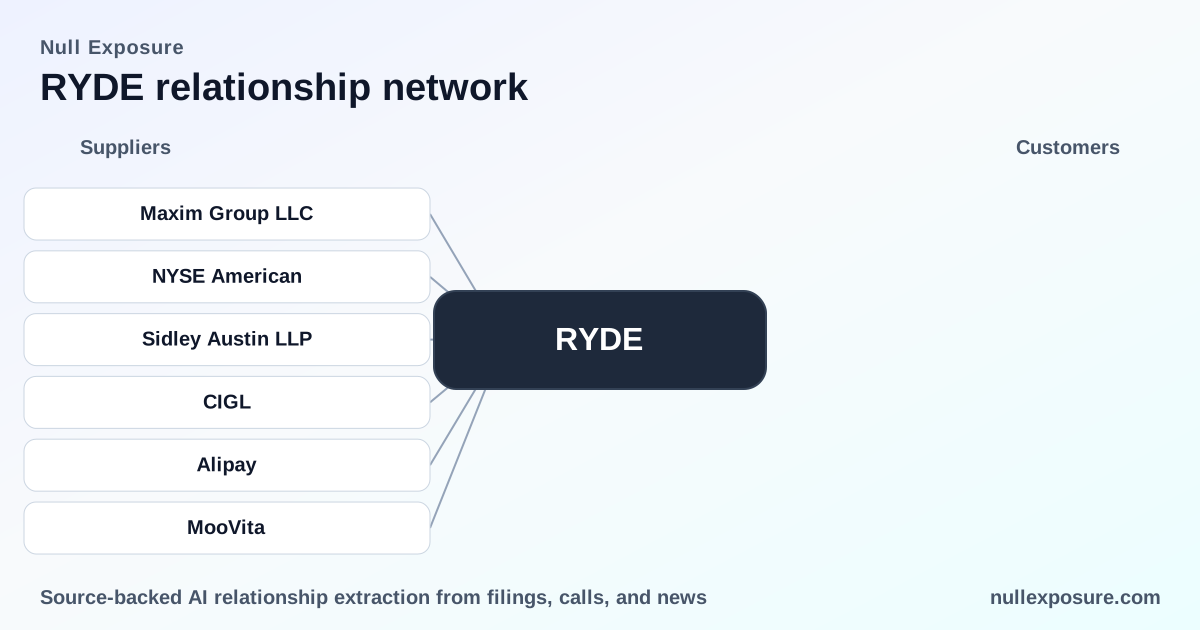
Ryde Group Ltd. (RYDE) — Customer relationships and what they signal for investors
Ryde Group Ltd. operates mobility and quick‑commerce services in Singapore and monetizes through ride fares and commissions, subscription passes and loyalty-credit mechanics (RydeCoins), and fees from quick‑commerce transactions. The group's revenue base is small but highly leverageable to unit economics improvements; investors should view Ryde as a high‑volatility, growth‑oriented operator whose customer partnerships are tactical levers for retention and incremental revenue rather than large legacy contracts.
For a concise view of Ryde’s customer-facing activity and deal flow, see Null Exposure’s customer intelligence homepage: https://nullexposure.com/
Why customer partnerships matter for Ryde: practical value, not scale yet
Ryde is a Singapore‑focused mobility operator with ancillary quick‑commerce operations. Partnerships that turn app users into higher‑frequency customers—via passes, credits, or co‑branded offers—directly affect average revenue per user and retention, the two variables fastest to move revenue in low‑scale mobility platforms. According to the company’s reported results through the quarter ended 2026‑03‑31, Ryde runs on a modest revenue base (TTM revenue ~$12.5M) with negative EBITDA and operating margins, so customer deals that improve per‑user monetization are strategically critical while the company climbs toward profitability.
If you want a panoramic view of Ryde’s customer relationships and how we track them, visit Null Exposure: https://nullexposure.com/
What the publicly visible customer relationships show
The public record for Ryde’s customer relationships in our review is concise but instructive—one named commercial tie surfaced in news coverage during 2026. Below I walk through the relationship and then translate the commercial signal for investors.
HelloRide — a product partnership to sell mobility perks
HelloRide and Ryde launched a partnership that bundles a 30‑day unlimited HelloRide pass plus S$20 in RydeCoins that customers can redeem for trips booked through Ryde in Singapore. This is an example of cross‑platform product bundling that uses prepaid passes and in‑app credit to drive short‑term usage and habituation. According to coverage by The Fly via TipRanks on May 3, 2026, the pass offering was publicized in that news item. (TipRanks/The Fly, 2026‑05‑03: https://www.tipranks.com/news/the-fly/ryde-group-helloride-partner-to-launch-mobility-perks-in-singapore-thefly)
- Why it matters: Bundled passes and platform credit are classic retention tools; here they are being used to convert HelloRide users into Ryde trips and to seed future paid usage with RydeCoins.
Interpreting Ryde’s contracting posture, concentration, criticality and maturity
There are no explicit constraint excerpts provided that name specific counterparties, so the following are company‑level signals drawn from Ryde’s public financial and ownership profile.
- Contracting posture: Ryde’s public profile and the HelloRide example indicate an opportunistic, promotional contracting posture—short, product‑level partnerships and co‑branded offers rather than long‑dated, revenue‑share contracts. This is consistent with a platform that needs near‑term transactional volume rather than guaranteed revenue streams.
- Customer concentration and criticality: With limited public relationships disclosed, customer concentration risk is higher at the company level because the business depends on broad consumer adoption across many small transactions. The HelloRide tie is important tactically but not a single large institutional customer that would dominate revenue.
- Maturity of commercial relationships: The type of partnership announced (30‑day passes and app credits) signals early to mid‑stage commercial sophistication—Ryde uses marketing partnerships and incentives rather than embedded enterprise contracts. For investors, this reflects high optionality but also revenue volatility until scale and repeat purchase patterns stabilize.
- Operational implication: Given TTM revenue of
$12.5M, negative EBITDA (‑$16.8M), and thin institutional ownership (~0.08%), Ryde operates from a growth‑funded posture where customer agreements are designed first for engagement and second for immediate top‑line lift.
Key financial and market context that shapes customer risk/reward
A few concise metrics anchor the partnership analysis:
- TTM Revenue: $12.5M; Gross Profit: $3.2M; EBITDA: ‑$16.8M (company filings through 2026‑03‑31).
- Valuation multiples are elevated relative to revenue: Price/Sales ~16.3x and EV/Revenue ~21.7x, reflecting market expectations for rapid revenue scaling.
- Market behavior: Beta ~3.46 and a wide 52‑week range ($0.16–$1.55) indicate pronounced share‑price sensitivity to news flow and execution.
- Ownership: Insiders ~7.7%, Institutions ~0.08%—public ownership leans retail, which influences liquidity and post‑announcement price moves.
These figures imply that customer partnerships such as HelloRide are high‑leverage events for sentiment and revenue growth: successful retention programs will move the needle on unit economics; underperformance will quickly pressure investor sentiment given the elevated multiples and low institutional buffer.
What investors should watch next
- Monitor the frequency and scale of similar partnerships: a steady stream of co‑branded passes or RydeCoin promotions indicates a repeatable customer‑acquisition channel; an absence suggests one‑off promotions.
- Track Q2–Q4 2026 revenue and margins for evidence that promotional spend translates to higher ARPU and lower churn. Short‑term increases in trips per user are the clearest early read‑outs.
- Watch ownership and funding events. With limited institutional ownership and negative EBITDA, Ryde’s path to scale relies on successful execution or additional capital; partnership economics will influence both.
Bottom line: tactical partnerships with strategic upside, but still early
HelloRide is a tactical—but meaningful—proof point that Ryde uses bundled products and in‑app credits to acquire and retain riders. For investors, these relationships are valuable indicators of go‑to‑market discipline and monetization experimentation, but Ryde’s small revenue base, negative margins, high valuation multiples, and retail‑heavy ownership profile mean partnerships must repeatedly deliver measurable lift before valuation re‑rating is credible.
For a structured feed of Ryde’s evolving customer relationships and to benchmark partnership signals across peers, visit Null Exposure: https://nullexposure.com/