RYET: Institutional Pilots and a Financing Backstop — what investors need to know
Ruanyun Edai Technology (NASDAQ: RYET) builds AI-driven Chinese language learning products for K–12 markets and is commercializing its HanLink platform through institutional pilots, licensing and service arrangements with schools and education centers; the company supplements cash needs with structured equity facilities. Revenue remains modest ($2.94M trailing twelve months) while the business is in early commercial scale-up, using grants and pilots to validate classroom efficacy and open international channels. For a focused view of customer relationships and strategic implications, see more at https://nullexposure.com/.
Institutional pilots that validate product-market fit — and how they convert to growth
Ruanyun has prioritized partnerships with recognized education institutions to demonstrate HanLink in live classrooms and to collect learning metrics such as homework accuracy and oral proficiency. These engagements are pilot- and grant-driven rather than long-term revenue contracts, which accelerates adoption signals but leaves near-term revenue visibility limited. The company’s financing flexibility through an equity purchase facility further supports execution while commercialization continues.
Relationship roll call — what every partnership means for RYET
Center on Chinese Education at Teachers College, Columbia University
Key takeaway: an academic validation and grant-funded pilot with U.S. institutional credibility. According to a GlobeNewswire press release (April 22, 2026), Ruanyun signed an award letter to provide a grant supporting an AI-assisted Chinese language and culture learning program implemented through Columbia University’s Center on Chinese Education. This engagement functions as a credibility-building pilot that positions HanLink for academic validation and research-backed evidence of learning outcomes.
Education & Skills International School (Riyadh)
Key takeaway: early international classroom exposure with meaningful user scale in a short pilot. Ruanyun launched a four-week HanLink pilot at Education & Skills International School in Riyadh in May 2025 involving 500 students across grades 1–12, with the company reporting metrics such as homework accuracy, oral proficiency and self-guided practice time, according to the GlobeNewswire announcement and subsequent press reposting in May 2026. The Riyadh pilot demonstrates RYET’s ability to deploy at scale quickly in overseas K–12 environments.
Confucius Institute at Prince Sultan University
Key takeaway: a cooperation agreement to scale HanLink within a regional educational network. The company announced a cooperation agreement in July 2025 with the Confucius Institute at Prince Sultan University to support further scaling of HanLink, as reported in the GlobeNewswire release and financial press coverage in May 2026. This partnership expands RYET’s institutional footprint in the Gulf region and offers a channel to local language education programs.
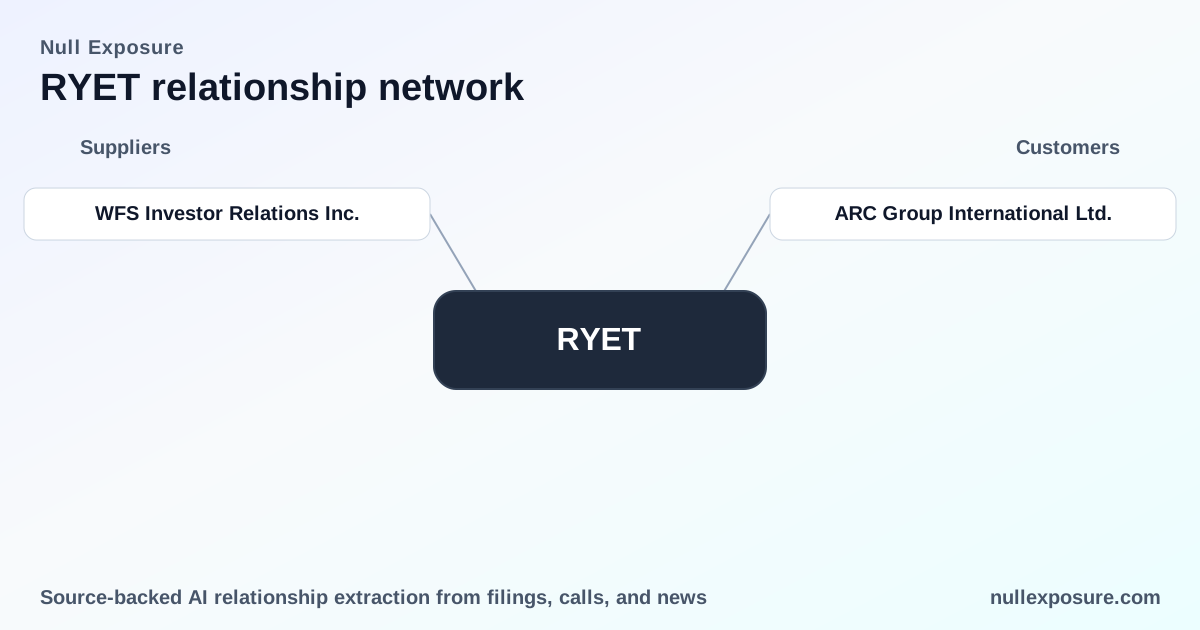
ARC Group International Ltd.
Key takeaway: a financing facility that provides optional liquidity through share purchase rights. In FY2025 Ruanyun established an equity purchase facility with ARC Group International Ltd., under which the company has the right, but not the obligation, to sell ordinary shares to ARC over a 36‑month period subject to customary conditions, including the effectiveness of a resale registration statement, according to an ARC Group announcement and corroborating coverage on Yahoo Finance (March 10, 2026). This arrangement is a financing mechanism rather than a customer relationship, and it supplies optional capital as RYET scales commercial deployments.
What these relationships reveal about RYET’s operating model and constraints
The relationship set is dominated by short-term pilots and institutional collaborations, not long-term judged contracts or recurring enterprise licenses. That pattern signals a contracting posture that is early-stage and validation-focused: Ruanyun is converting R&D into classroom pilots and academic studies to build evidence for a broader commercial roll‑out. The data sources analyzed did not surface long-duration service contracts or binding revenue guarantees, which is a company-level signal that revenue concentration is currently low and customer criticality is limited.
Financial context reinforces this operational reading: company filings and market data show $2.94M in trailing revenue, $2.16M gross profit, and operating margin at -10.12%, reflecting scale-up costs and investment in product validation. Insider ownership is high (≈59%) while institutional ownership is minimal (≈0.2%), indicating founder control and limited institutional analyst coverage at this stage.
Investment takeaways and principal risks
- Growth vector: Institutional pilots with Columbia University and regional partners position HanLink for adoption across academic and K–12 networks, offering a credible path from validation to licensing revenue.
- Commercialization risk: Current engagements are grant- and pilot-based, which accelerates evidence-gathering but does not guarantee conversion to recurring revenue; near-term topline growth will depend on converting pilots into paid contracts.
- Balance sheet / financing: The ARC equity purchase facility provides optional liquidity that reduces immediate cash pressure without committing future revenues; however, share issuance under such facilities dilutes existing holders when used.
- Concentration and scale: With a small roster of institutional partners and modest historical revenue, RYET remains an early-stage commercial operator in education technology rather than a mature platform provider.
For investors and operators tracking customer momentum, these partnerships are material signals of product validation and geographic expansion; they do not yet represent durable, high-concentration revenue streams. For more context on relationship roll-ups and customer signals, visit https://nullexposure.com/.
Bottom line
Ruanyun Edai Technology is executing a deliberate validation-first commercialization strategy: academic grants and school pilots build credibility for HanLink, while an equity purchase facility furnishes execution capital. The company’s near-term valuation will hinge on its ability to turn institutional pilots into recurring licensing or services revenue and to broaden institutional adoption beyond the current set of partners.