RYTHM, Inc.: Retail placements, licensing and the shift from equipment to branded beverages
RYTHM, Inc. monetizes through three distinct engines: hardware sales of extraction and cultivation equipment, recurring SaaS tied to each deployed VFU (Agrify Insights™ subscriptions), and consumer-facing revenue from the Señorita hemp-derived beverage brand (via direct distribution and licensing). Recent disclosures and press coverage show the company executing a deliberate repositioning toward beverage distribution and brand licensing while retaining a hardware/software legacy, creating a hybrid business with mixed revenue predictability and concentrated channel dependency. For a quick corporate signal summary, visit https://nullexposure.com/.
Retail distribution: where Señorita is being sold today
RYTHM’s Señorita beverage roll-out is anchored in a handful of national and regional liquor retailers.
- Total Wine: Señorita is listed in Total Wine stores across multiple states, supporting RYTHM’s initial retail footprint in the U.S. (MarketScreener, May 3, 2026: https://www.marketscreener.com/news/agrify-corporation-will-change-its-ticker-to-rym-from-agfy-ce7c50d3d98bff24).
- ABC Fine Wine & Spirits: ABC Fine Wine & Spirits is named among the top retailers carrying Señorita, positioning the brand in Florida and other ABC markets (MarketScreener, May 3, 2026: https://www.marketscreener.com/news/agrify-corporation-will-change-its-ticker-to-rym-from-agfy-ce7c50d3d98bff24).
- Binny’s: Binny’s (a Midwest retailer) is also carrying Señorita, extending distribution into regional specialty outlets in the company’s early commercialization phase (MarketScreener, May 3, 2026: https://www.marketscreener.com/news/agrify-corporation-will-change-its-ticker-to-rym-from-agfy-ce7c50d3d98bff24).
Key takeaway: retail placements with national chains accelerate reach quickly but create dependency on a small set of channel partners to execute nationwide expansion.
Asset transactions and customer counterparties
RYTHM’s footprint also reflects transactional activity with other industry players.
- CP Acquisitions, LLC: CP Acquisitions executed an asset purchase of a cultivation business formerly held by Agrify for approximately $7 million, reflecting the company’s ongoing asset rationalization and third-party counterparty activity (MarketScreener, May 3, 2026: https://www.marketscreener.com/quote/stock/RYTHM-INC-118077257/news/CP-Acquisitions-LLC-acquired-Cultivation-Business-from-Agrify-Corporation-for-approximately-7-mill-48687984/).
Key takeaway: disposals and sales to specialist buyers illustrate a move away from operator-facing verticals and toward a leaner product-and-brand posture.
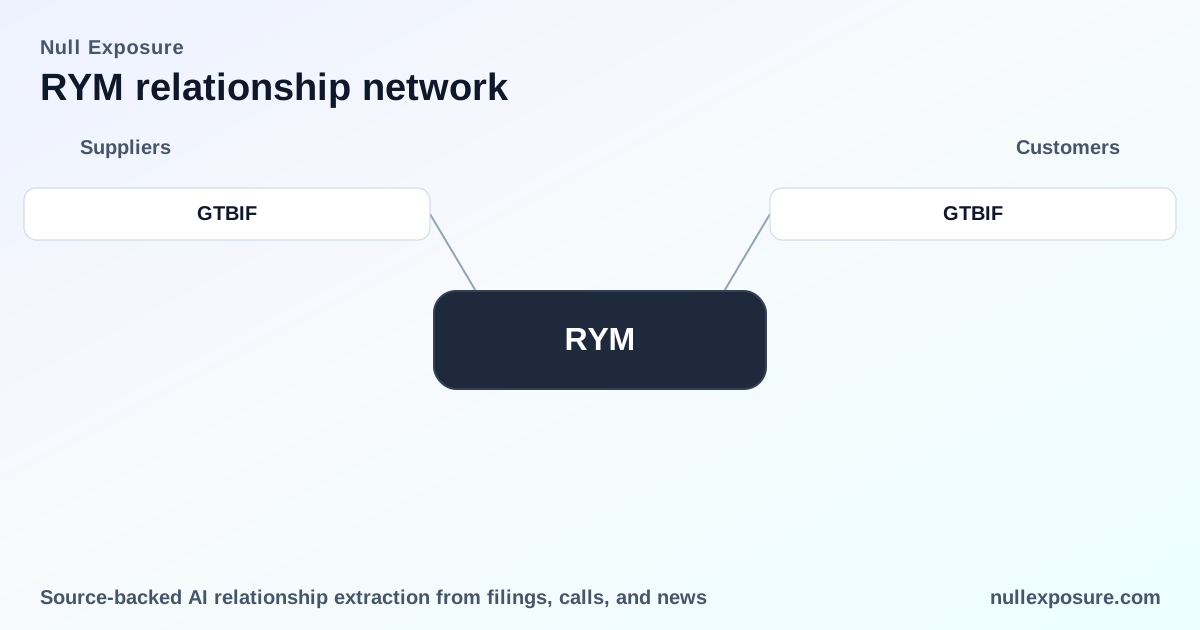
Licensing partner: Green Thumb Industries (GTBIF)
RYTHM is establishing third-party manufacturing and distribution relationships to scale Señorita.
- GTBIF (Green Thumb Industries): RYTHM entered into an agreement to license the Señorita brand to Green Thumb Industries for manufacture and distribution, effectively outsourcing consumer-packaged-goods scale-up to an experienced cannabis operator (MMJDaily and Yahoo Finance reporting, March 10, 2026: https://www.mmjdaily.com/article/9760351/us-agrify-corporation-changes-name-following-brand-portfolio-acquisition/; https://finance.yahoo.com/news/agrify-corporation-change-name-rythm-202000834.html).
- Green Thumb Industries (duplicate reporting): Multiple outlets confirmed the licensing arrangement naming Green Thumb Industries (GTBIF) as the manufacturing/distribution licensee, underscoring the strategic use of external scale partners rather than in-house manufacturing (MMJDaily and Yahoo Finance, March 10, 2026).
Key takeaway: licensing to GTBIF shifts capital intensity and operational execution to a large industry operator, accelerating distribution without equivalent capex from RYTHM.
What these customer signals tell investors about RYTHM’s operating model
The firm-level constraints disclosed in filings and reflected in the customer map translate into a clear operating posture:
- Contracting posture is hybrid and asymmetric. RYTHM combines long-term structured programs (the historical TTK solutions with multi-year commitments and extensive implementation services) with transactional, short-duration commercial arrangements (retail beverage placement and VFU hardware sales). The company also charges SaaS subscription fees tied to each VFU at roughly $1,500–$2,400 per VFU annually, creating a recurring revenue layer.
- Revenue concentration and channel criticality are elevated. Early Señorita distribution is concentrated in a few national and regional retailers; licensing to Green Thumb reduces manufacturing risk but transfers commercial execution dependency to a single large partner.
- Product mix creates cross-functional dependence. RYTHM remains both a seller of hardware (extraction and lab equipment) and a seller of branded consumer goods (Señorita), with software (Agrify Insights™) integrated into the hardware value proposition and critical to VFU operation, according to company disclosures.
- Maturity and stage heterogeneity. The portfolio contains mature retail placements and active brand deployments, alongside terminated elements—the TTK program is not being newly deployed, although legacy deployments exist—so management is shifting the growth engine from operator services to distribution and licensing.
Bold signal: Agrify Insights™ is presented as operationally critical to VFU customers, which increases stickiness for hardware buyers but concentrates recurring revenue into a modest per-unit subscription band.
Financial and operational risk considerations for investors
Linking customer relationships to the financial picture highlights several investor-relevant risks:
- Low absolute scale and negative profitability: RYTHM reports Revenue TTM of $17.3M and EBITDA of -$16.8M, indicating current operating losses while transitioning business lines.
- High market sensitivity: The company’s beta is 9.73 and market capitalization is small (approximately $60.2M), amplifying volatility around execution news such as retail rollouts or licensing announcements.
- Concentration risk in go-to-market: Early beverage revenue depends on a handful of retailers and on the Green Thumb licensing arrangement to scale manufacturing and distribution. Any failure to convert those channels into sustained sell-through would pressure cash flow.
- Mixed contract tenors: The coexistence of long-term implementation programs and short-term retail or licensing arrangements complicates revenue visibility and forecasting.
Conclusion — what to watch next
RYTHM has repositioned from a largely operator-facing equipment and services firm to a hybrid supplier/licensor and beverage distributor, monetizing via hardware sales, VFU-linked SaaS, direct beverage sales, and licensing to large alcohol/cannabis distributors. Investors should watch retail sell-through at Total Wine, ABC Fine Wine & Spirits, and Binny’s, and implementation progress under the Green Thumb license, as those metrics will determine whether the brand path can offset legacy hardware margin pressures.
For a concise, investor-focused briefing and ongoing relationship monitoring, see https://nullexposure.com/.