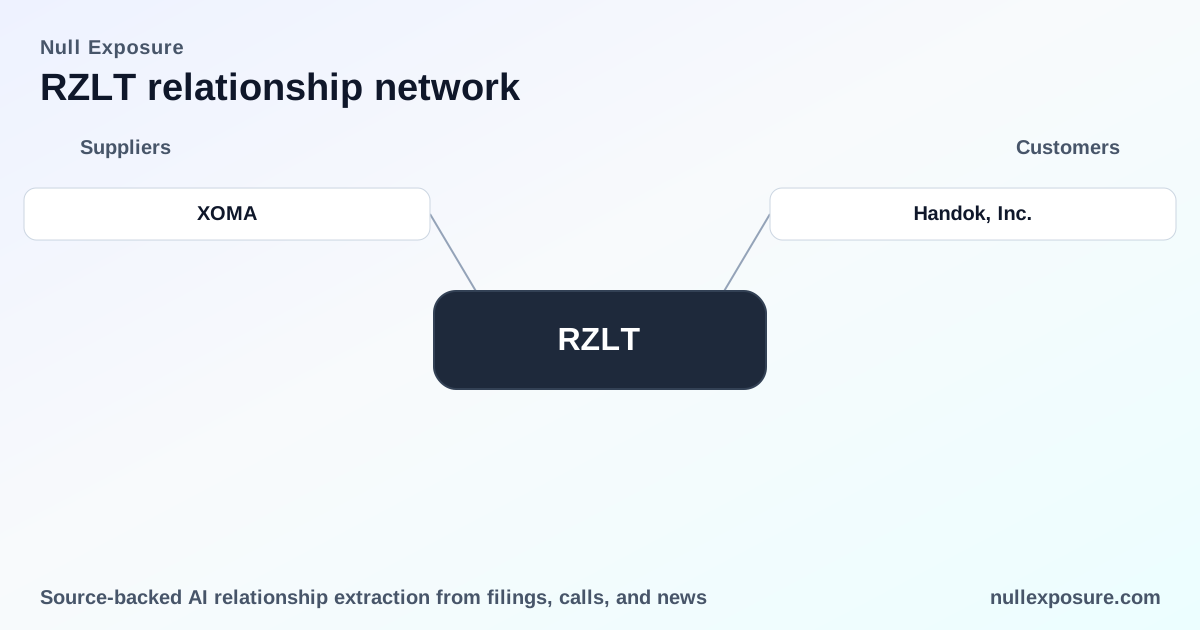
Rezolute (RZLT): Commercial relationships and what they mean for investors
Rezolute is a clinical-stage biopharma that monetizes through licensing and eventual commercialization of its lead asset, ersodetug, targeted at rare and metabolic disorders such as congenital hyperinsulinism. The company currently generates no product revenue, relies on strategic licensing arrangements to access geographies, and funds development through capital markets and partner agreements. Investors should view Rezolute as a lead-asset-centric developer whose valuation depends on clinical progress for ersodetug and the economics of a small number of commercial partnerships. For a consolidated view of Rezolute customer exposures and partner links, visit https://nullexposure.com/.
How Rezolute structures commercial reach today
Rezolute operates as a licensor and seller of clinical-stage IP rather than as a direct commercial-scale manufacturer. That operating posture manifests in two practical ways: licensing deals transfer regional commercialization rights to partners, and compassionate-use programs keep clinical access controlled by Rezolute while commercial upside remains concentrated in the lead asset.
- Licensing-first contracting posture. Rezolute executes exclusive territory licenses to third parties to obtain market access without building a global sales infrastructure.
- Concentration around a single core product. The company’s public filings identify ersodetug as the lead clinical asset, implying high revenue and execution concentration on a single program.
- Criticality of partners to market access. Where Rezolute licenses rights (territory or marketing), those partners are critical for local commercialization and distribution.
These features together define the company’s commercial risk profile: high program concentration, partner-dependent market access, and early-stage revenue timing driven by clinical milestones and future product launches.
One partnership matters today: Handok, Inc.
Handok, Inc. — exclusive license for Korea Rezolute’s FY2025 Form 10-K discloses an exclusive license agreement with Handok for the Republic of Korea, executed September 15, 2020, described as a related-party licensing agreement. This contract establishes Handok as the holder of Korean commercialization rights for Rezolute’s licensed technology. (Source: Rezolute FY2025 Form 10-K, fiscal year ended June 30, 2025.)
The disclosure is concise: the agreement is a strategic territorial license that transfers commercial responsibility for Korea to Handok while preserving Rezolute’s role as developer and licensor. (Source: Rezolute FY2025 Form 10-K.)
What the Handok relationship implies for investors
- Execution dependency in Korea. Rezolute’s market entry and any Korean revenue will rely on Handok’s ability to register, launch, and commercialize ersodetug under the terms of the license.
- Related-party governance signal. The disclosure labels the arrangement a related-party licensing agreement, which elevates the importance of transparency on contract economics and governance for minority investors.
Clinical programs and global footprint: evidence from filings
Rezolute’s public materials position ersodetug as a globally tested clinical asset. The company describes the sunRIZE study as a global, randomized trial covering patients three months and older with congenital hyperinsulinism, which signals an attempt to capture broad regulatory and payer jurisdictions rather than a single-market focus. This global trial posture supports the rationale for territorial licensing deals such as the Handok agreement, where local partners will execute commercialization in their respective markets. (Source: Rezolute FY2025 disclosures on sunRIZE.)
Operational constraints and business-model characteristics
The filing-derived signals point to a compact set of operational constraints that investors should incorporate into valuation and risk models:
- Contracting posture: primarily licensor/seller through exclusive territory agreements, minimizing the need for a global commercial organization but placing execution risk on partners.
- Concentration: high single-asset concentration around ersodetug; the company reports no product revenue and negative operating metrics consistent with clinical-stage biotechs (RevenueTTM = 0; negative EBITDA and EPS).
- Criticality: partners are mission-critical for regional launches and downstream royalties; a small number of partners implies single-point risks for each territory.
- Maturity: clinical-stage, with value tied to trial readouts, regulatory approvals, and future commercialization milestones rather than current product sales.
These constraints combine to produce a classic early-stage licensing profile: high upside from successful development and efficient capital allocation via regional partners, offset by partner execution risk and value concentration in a single program.
Risk implications for portfolio managers
- Partner concentration risk: A material portion of future revenue opportunity for a given geography is contingent on the Handok license and similar agreements; any deterioration in partner execution or disputes would directly delay market entry and milestones.
- R&D and regulatory risk: As a clinical-stage company, Rezolute’s market value will move with clinical readouts (e.g., sunRIZE) and regulatory progress; this underpins elevated volatility relative to established commercial peers.
- Governance and related-party scrutiny: The related-party label for the Handok agreement warrants monitoring of future disclosures on license economics, milestones, and governance safeguards.
Actionable takeaways for investors and operators
- Watch clinical milestones for ersodetug closely; positive sunRIZE outcomes materially de-risk the commercialization pathway and improve partner economics.
- Monitor partner disclosures and local regulatory filings in Korea from Handok to confirm timelines and launch readiness.
- Evaluate contractual economics when available: milestone timing, royalty rates, and exclusivity windows will determine realized upside for Rezolute shareholders.
For a consolidated, queryable view of Rezolute’s partner relationships and to track updates as filings arrive, visit https://nullexposure.com/.
Closing perspective
Rezolute’s commercial profile is unambiguous: a clinical-stage developer that leverages exclusive territorial licenses to scale without building a global commercial footprint. The Handok relationship illustrates that model—an exclusive, related-party license granting Korea rights while Rezolute focuses on clinical development and capital markets. Investors must price both the upside tied to ersodetug’s clinical trajectory and the execution dependency that territorial partners introduce into the revenue path.