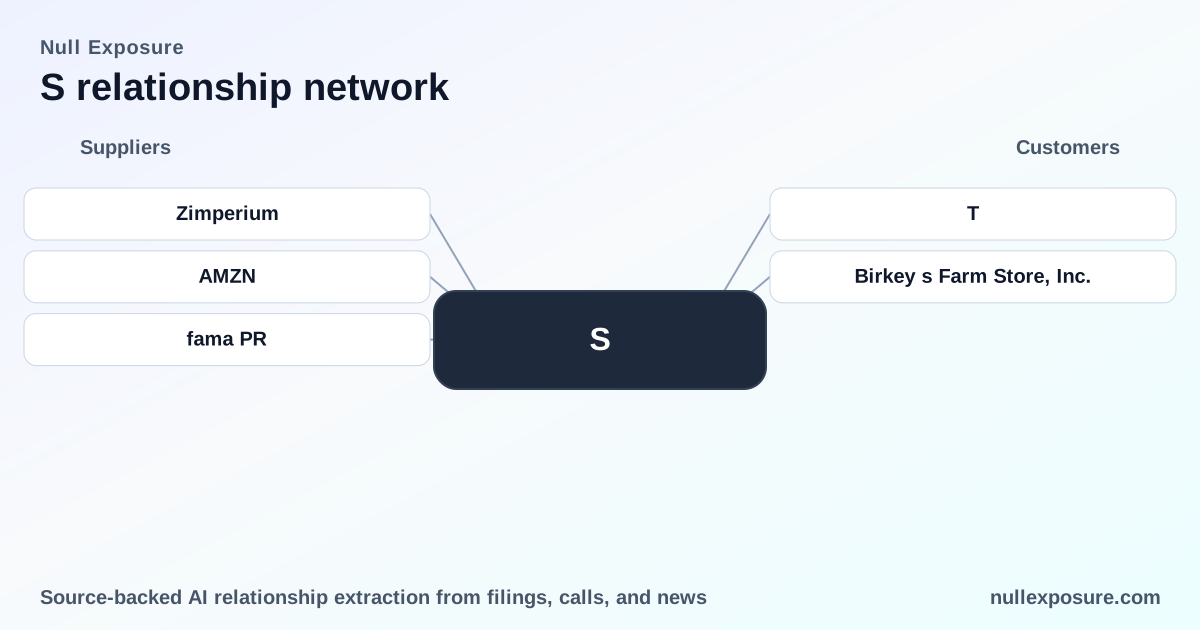
SentinelOne's Customer Web: Partnerships, channels and what they mean for owners
SentinelOne monetizes enterprise security primarily by selling subscriptions to its Singularity platform, supplemented by consumption or usage-based arrangements and professional services; the business scales through direct enterprise sales and a global network of channel and alliance partners that embed Singularity into managed services and third‑party platforms. For investors, the core read is simple: recurring subscription economics drive revenue visibility, while strategic partnerships expand addressable market and distribution without materially increasing single‑customer concentration. [Explore more on coverage and signals at https://nullexposure.com/]
How the customer signals synthesize into an operating model
SentinelOne’s commercial posture is subscription-first with usage-based wrinkles — contracts commonly run one to three years and include both ratable subscription revenue and consumption-linked components. The company reports meaningful remaining performance obligations (RPO), with a material portion recognizeable over the following 24 months, which supports short‑term revenue visibility. Customer composition is broad: SentinelOne serves small businesses through mid‑market accounts to very large enterprises and government entities, and the company explicitly supports managed security providers and incident response partners through its multi‑tenant platform.
- Contracting posture: Predominantly subscription, supplemented by usage‑based and non‑cancelable commitments that yield predictable recognition patterns.
- Concentration and criticality: No single end customer exceeded 3% of ARR as of January 31, 2025, signaling low customer concentration but high product criticality for individual buyers.
- Global reach and go‑to‑market: The Singularity platform is deployed globally; partnerships and alliances are a deliberate channel strategy to access new enterprise and managed‑services wallets.
- Stage and service role: Customer engagements are active and ongoing; SentinelOne functions as both seller and service provider where support, customization and incident response accelerate customer value capture.
These signals point to a growth profile driven by net retention and channel expansion rather than reliance on a small set of anchor accounts. The financial context: TTM revenue of roughly $1.0 billion and gross margin that supports operating leverage, though profitability remains a work in progress given negative EPS and EBITDA reported in the latest quarter ending January 31, 2026.
Relationship-by-relationship: the partners and customers investors should log
The following entries cover every relationship surfaced in recent monitoring. Each entry is a plain‑English take with the source cited for follow‑up.
NABL
NABL has deepened technology partnerships to integrate enterprise security capabilities into its platform, and this analysis notes a collaboration that includes SentinelOne integration as part of that push. Source: an Intellectia blog post referencing NABL’s FY2026 partnerships (May 3, 2026).
OPTU (Altice / Optimum)
Two Light Reading articles recount Altice USA’s launch of Optimum Mobile via MVNO agreements beginning in 2019; these items appear in the relationship set though they focus on Optimum’s MVNO history rather than a direct SentinelOne implementation. Source: Light Reading coverage of Altice USA / Optimum Mobile (FY2022 and FY2023).
AT&T
SentinelOne announced a managed endpoint security solution launched through an alliance with AT&T, positioning SentinelOne as the security engine for AT&T’s managed offering. Source: SentinelOne press release on the company site describing the AT&T alliance (press release, FY2021).
T (duplicate AT&T)
The same SentinelOne press release describing the AT&T managed endpoint security solution is listed again under the T ticker, underscoring the same commercial alliance with AT&T’s cybersecurity business. Source: SentinelOne press release on its website (FY2021).
FTI Consulting (FCN)
FTI Consulting selected SentinelOne’s Singularity XDR to strengthen its incident response and cyber readiness services for a global client portfolio, indicating adoption within professional services and advisory channels. Source: SentinelOne press release describing FTI Consulting’s selection (FY2026).
Cogent Communications (CCOI)
A TradingView summary cites Cogent’s acquisition of Sprint’s U.S. long‑haul fiber (May 1, 2023), an infrastructure move relevant to enterprise networking and service providers rather than a direct SentinelOne contract; the item is included in monitoring results. Source: TradingView coverage of Cogent’s SEC filing and network acquisition (FY2026 summary).
LevelBlue
Multiple reports document a global partnership between SentinelOne and LevelBlue, naming SentinelOne a preferred provider for managed detection, SIEM, and incident response—this expands SentinelOne’s route into managed and AI‑enabled security services. Source: Sahm Capital commentary and related coverage discussing the LevelBlue global partnership (FY2026).
Google Cloud
SentinelOne announced a multi‑year collaboration with Google Cloud and launched AI‑focused security offerings showcased at RSA Conference 2026; the Google Cloud tie strengthens cloud channel distribution and product integration for enterprise cloud customers. Source: Sahm Capital and industry writeups summarizing SentinelOne’s Google Cloud collaboration and RSA 2026 announcements (FY2026).
T‑Mobile (TMUS)
A TradingView article highlights T‑Mobile’s ongoing 5G deployments using spectrum from Sprint; this item appears in the relationship feed though the piece focuses on mobile network evolution rather than a SentinelOne customer contract. Source: TradingView summary of telecom industry activity (FY2026).
Birkey’s Farm Store, Inc.
A customer testimonial quoted in SentinelOne’s press materials describes Birkey’s Farm Store upgrading to SentinelOne from a competing product and praising improved protection and AT&T‑enabled support—an example of SMB adoption facilitated through channel alliances. Source: SentinelOne press release including Birkey’s customer quote (FY2021).
LevelBlue (second mention)
A second Sahm Capital piece reiterated the LevelBlue global partnership and SentinelOne’s positioning for managed detection and AI security services at RSA 2026; the repeated appearance reinforces LevelBlue as a strategic distribution partner. Source: Sahm Capital analysis of SentinelOne’s partnerships and RSA 2026 announcements (FY2026).
What investors should take away — opportunities and risks
- Opportunity: Partnerships with global cloud platforms (Google Cloud) and managed service alliances (LevelBlue, AT&T, FTI Consulting) meaningfully broaden go‑to‑market reach without grossly increasing single‑client concentration. This supports scalable revenue growth via channels while preserving subscription economics.
- Operational strength: High gross profit dollars and sizeable RPO give revenue visibility; the company’s product is positioned as mission‑critical for large enterprises and MSPs, supporting stickiness and renewal economics.
- Risk profile: Profitability remains negative on an EBITDA and EPS basis; continued investment in GTM and partnerships is necessary to convert revenue growth into operating leverage. Channel reliance requires careful contract management and co‑selling discipline.
- Capital markets view: Analysts maintain a range of ratings but the business model signals—subscription revenue, diverse customer base, and strategic partnerships—frame the investment thesis around growth and optionality from cloud and managed‑services expansion.
For a concise dashboard of partner signals and to track relationship changes over time, visit https://nullexposure.com/ — we summarize partner exposures and operating signals relevant for owners and operators evaluating SentinelOne.
Final read
SentinelOne runs a subscription‑centric commercial model augmented by usage elements and deep partner distribution. Investors should value the firm on recurring revenue momentum and the quality of its alliances while monitoring margin recovery and partner execution. The relationship set above maps the channels and endorsements that will determine how quickly Singularity captures incremental enterprise and managed‑service spend.