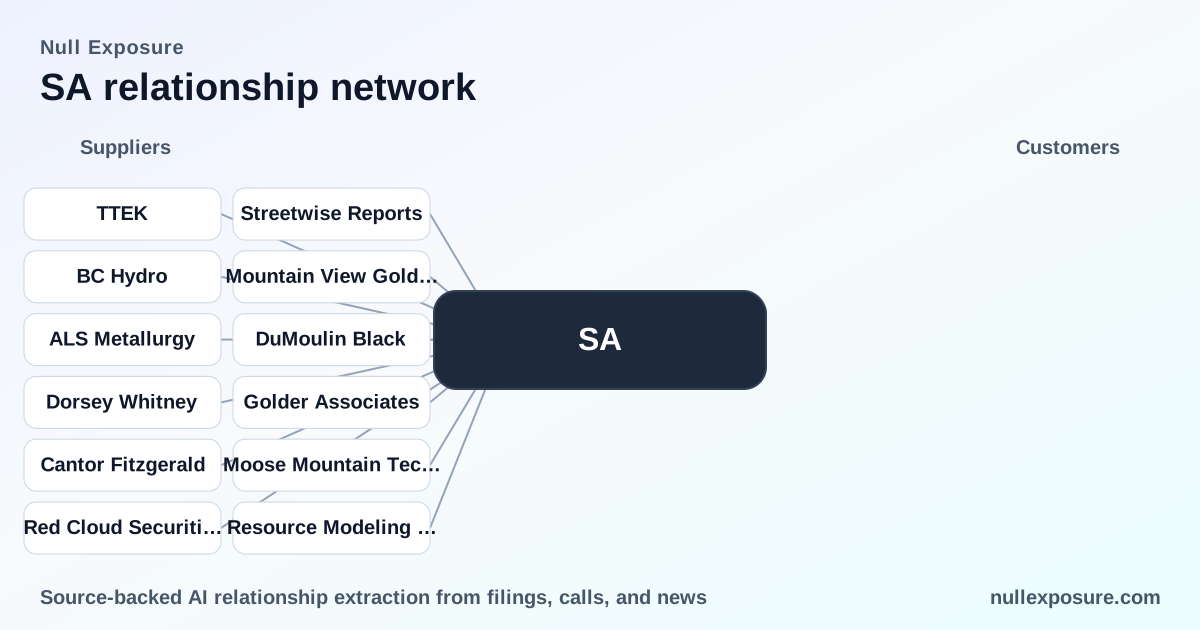
Seabridge Gold (SA): Streaming as Strategic Coverage — What the Valor Gold Tie Means for Investors
Seabridge Gold operates as an exploration and project-stage gold company that monetizes primarily through strategic asset-level arrangements rather than operating revenue. The company advances or acquires North American gold projects and converts value into liquidity and optionality via streaming agreements, royalties, joint ventures and selective asset transfers. For investors, Seabridge’s financial profile reads like an asset play: negative operating earnings and no reported revenue, balanced by large project optionality and market valuation that prices future resource realization.
For a targeted view of its customer/partner footprint and counterparty risk, this note synthesizes the single customer relationship disclosed in public coverage and places that tie into Seabridge’s operating model and investor-relevant constraints. For a fuller counterparty map, visit https://nullexposure.com/.
The headline relationship — a streaming right with Valor Gold
A recent market report documents a gold stream agreement between Seabridge and Valor Gold that grants Seabridge the right to purchase 10% of Valor’s quarterly gold production at a fixed price of US$4,000 per ounce, conditional on the quarterly average gold price exceeding US$4,000. This structure is a classic producer-stream arrangement: Seabridge pays a fixed low price per ounce in exchange for exposure to future production volumes and commodity upside beyond the threshold. A Streetwise Reports article covering analyst views on April 29, 2026, described the deal terms and the 10% purchase right.
Why this matters to investors
- Optional, low-cost exposure to production: The stream converts future physical ounces into a defined economic claim without the capital intensity of mine construction, improving optionality on Valor’s development timeline.
- Price-triggered economics: The conditional nature — activation only when the average quarterly gold price exceeds US$4,000 — pushes Seabridge toward a selective exposure profile that reduces payments during down cycles and captures upside when prices are high.
- Source: Streetwise Reports coverage of analyst commentary on April 29, 2026.
How this relationship fits Seabridge’s business model
Seabridge’s balance sheet and public metrics confirm its role as a project and exploration company rather than an operating gold producer: Revenue TTM is reported at zero and EPS is negative, so deals such as the Valor stream are meaningful because they provide an alternative route to realize value without immediate production or recurring operating cash flow. The Valor arrangement illustrates several consistent operational signals:
- Contracting posture: Seabridge uses structures that trade capital or contractual rights for future ounces — the company prefers streams/royalties and partnership positions over near-term production responsibilities.
- Concentration and counterparty exposure: With relatively few such arrangements disclosed publicly, each counterparty relationship is material to Seabridge’s strategy and valuation trajectory.
- Criticality to liquidity and valuation: Streaming rights are a channel to convert undeveloped resources into monetizable claims or finance, making these agreements strategically critical even if they do not generate immediate GAAP revenue.
- Maturity of the business model: The company remains exploration/development-focused; streaming relationships are a mature monetization tool for firms at this stage because they limit capital risk and accelerate value capture.
These are company-level signals drawn from Seabridge’s public profile and the nature of the Valor transaction; no contractual constraint excerpts in the reviewed materials explicitly assign operational limits to specific counterparties.
Relationship-by-relationship breakdown
Valor Gold — a conditional 10% gold stream
Seabridge secured the right to purchase 10% of Valor Gold’s quarterly gold production at a fixed price of US$4,000 per ounce, with the stream effective only when the quarterly average gold price exceeds US$4,000. This gives Seabridge cheap paid ounces when gold is strong and limited cash obligations when gold is weak, aligning Seabridge’s cash outflows with favorable price environments. Source: Streetwise Reports, April 29, 2026.
(That is the single customer/partner relationship disclosed in the public coverage we reviewed for Seabridge in this sweep.)
Investment implications and risk framing
For investors and operators evaluating Seabridge’s exposure, the Valor stream introduces both upside optionality and counterparty concentration risk:
- Upside: The capped purchase price combined with entitlement to a percentage of production provides leveraged upside to stronger gold prices while reducing capital deployment compared with direct mine ownership.
- Counterparty and execution risk: Seabridge’s returns from streaming depend on Valor’s ability to deliver production on schedule and at scale. With few disclosed streaming partners, execution failures or development slippage at a partner can have outsized impact on expected ounces and valuation accretion.
- Market sensitivity: Because Seabridge has no material operating revenue, its market valuation is sensitive to project milestones and the perceived collectibility of streaming claims — events that will re-price the company more than quarterly earnings.
Key takeaway: The Valor agreement is consistent with Seabridge’s asset-realization strategy: it purchases optional future production rather than producing directly, which conserves capital but concentrates execution risk on partners.
Constraints and operating signals investors should watch
No explicit contractual constraints were provided in the reviewed materials, which is itself an informative signal: there are no flagged disclosure excerpts restricting Seabridge’s ability to enter similar arrangements in the sources we checked. At the company level, investors should monitor these operating characteristics:
- Contracting posture: Expect more streaming, royalty and JV-like arrangements rather than direct production commitments.
- Concentration: A small number of counterparties will carry outsized impact on realized ounces — track each partner’s development schedules and capital needs.
- Criticality: Streams and royalties are central to converting Seabridge’s resource base into shareholder value; disruptions to these channels directly affect liquidity and upside.
- Maturity: Seabridge executes at a project-development maturity level where commercial arrangements drive valuation more than recurring earnings.
Bottom line for investors
Seabridge Gold’s tie to Valor Gold through a conditional 10% stream is an archetypal example of the company’s asset-light monetization strategy: it secures future ounces without taking on production capital, thus preserving optionality while introducing partner-execution risk. For active investors, the valuation case rests on three variables: the pace of partner development, realized gold prices relative to the $4,000 trigger, and the company’s ability to replicate value-capturing agreements across its portfolio.
For a deeper counterparty and relationship analysis relevant to portfolio decisions, visit https://nullexposure.com/.