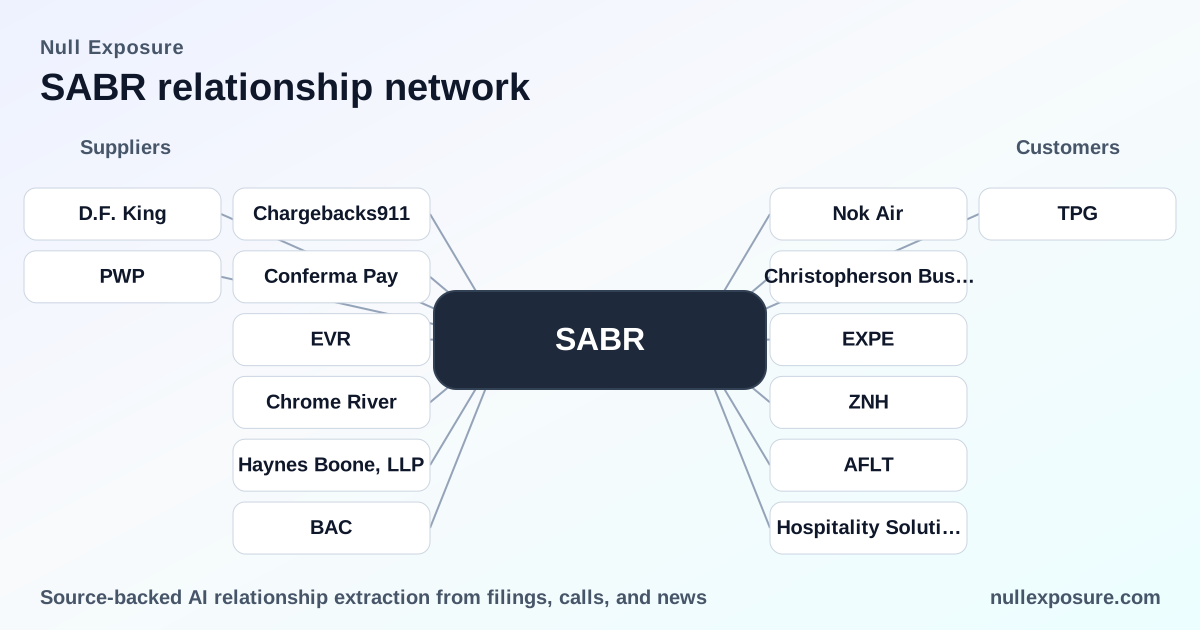
Sabre Corporation (SABR): Customer Relationships Drive a Transactional, Global Travel Franchise
Sabre operates a two-segment travel technology business that monetizes through a mix of transaction fees, recurring usage-based SaaS/hosted charges, software licensing and professional services, connecting airlines, hotels and travel buyers through a global distribution network and operational software. For investors, the core thesis is simple: Sabre is a transaction-led platform with recurring revenue characteristics from airlines and hoteliers, whose value depends on customer scale, renewal cadence and sensitivity to travel volumes — and whose recent strategic moves (including a divestiture of Hospitality Solutions) reframe capital allocation and risk exposure. Learn more at https://nullexposure.com/.
How Sabre actually makes money — the business model in plain English
Sabre drives revenue along two primary vectors. First, distribution: the Global Distribution System charges transaction fees on airline bookings and acts as a marketplace connecting travel buyers and suppliers. Second, software and services: Sabre sells airline operations, network-planning and hotel property-management software via SaaS/hosted subscriptions, usage-based fees, upfront implementation charges and professional services. Company disclosures indicate contract terms range from short (1–3 years) to long (3–10 years) depending on product and counterparty, which creates a blended mix of renewal-driven recurring revenue and volume-exposed transaction income. Geographic concentration is non-trivial — North America accounted for roughly 56% of direct billable bookings in the latest period — but the footprint is global, serving airlines and hotels across more than 175 countries.
Operating constraints that shape valuation and risk
- Contracting posture: Sabre’s revenue mix is a deliberate hybrid — long-term, multi-year contracts for major agencies and enterprise customers coexist with shorter travel-buyer agreements and highly variable transaction fees that fluctuate with travel demand. Capitalized implementation costs and multi-year amortization reflect that dynamic.
- Concentration and cyclicality: The business is materially tied to global travel volumes; transaction-based fees form a large portion of revenue and therefore Sabre’s topline correlates with industry travel cycles.
- Criticality to customers: Sabre’s products (GDS, SynXis CRS, airline operations and network planning) are mission-critical for distribution and operations, creating sticky relationships but also meaningful switching-cost considerations during contract renewals.
- Maturity and scale: With thousands of airline and hotel relationships and over 40,000 properties served, Sabre is a mature infrastructure provider — scale provides pricing leverage but also requires ongoing investment to retain parity with competitors.
Customer relationships: what the headlines report (roll call and implications)
Below I cover every relationship returned in the media feed, each with a concise takeaway and source reference.
Christopherson Business Travel
Sabre’s Q2 2025 commercial commentary highlighted new agency agreements including Christopherson Business Travel, reflecting continued traction in air distribution among corporate travel sellers. (TradingView news on Sabre Q2 2025 results, March 2026.)
Nok Air
Nok Air signed contracts with Sabre and Sabre’s Radixx unit to support airline IT and distribution, demonstrating Sabre’s role selling both distribution and airline systems in Southeast Asia. (AviTrader report, December 2021.)
Expedia
In a historical transaction, Expedia acquired Travelocity from Sabre in 2015 for $280 million — a reminder that Sabre has previously divested consumer-facing distribution assets while retaining core B2B infrastructure. (Wired coverage of Expedia/Travelocity deal, 2015.)
EXPE
The same Wired report documents the Expedia/Travelocity sale from Sabre’s previous portfolio; it underscores Sabre’s strategic willingness to restructure its asset mix to focus on infrastructure and enterprise software. (Wired, 2015.)
Hyatt Hotels Corporation
Starting in 2024, Sabre’s SynXis Central Reservation System became Hyatt’s main central reservation system, reinforcing Sabre’s position as a preferred CRS provider for large global hotel chains. (HotelTech/HotelDive reporting on Hyatt’s CRS transition, 2023–2024.)
WH (Wyndham Hotels / “WH” mention)
Wyndham’s public comments credit their technology stack — including providers such as Sabre — with improving brand efficiency and lowering operating cost, signaling Sabre’s strategic placement in franchise and branded hotel operations. (InsiderMonkey Q1 2026 transcript, referenced in 2026 commentary.)
Aeroflot
Sabre terminated its distribution agreement with Aeroflot in 2022, which reduced Aeroflot’s ability to sell tickets through Sabre’s GDS and illustrates political and regulatory tail risks that can disrupt distribution revenue. (FlyingMag report on GDS removal of Aeroflot, 2022.)
China Southern Airlines
China Southern renewed its GDS partnership with Sabre as it expands international routes, underlining Sabre’s role in carriers’ overseas distribution strategies. (TravelMole coverage of the China Southern renewal, 2022.)
ZNH
The duplicated feed entry for ZNH (China Southern) reiterates that renewals with national carriers are a repeated source of stability for Sabre’s GDS and distribution revenues. (TravelMole, 2022.)
Virgin Australia
Sabre announced commercial partnerships with Virgin Australia as part of its FY2025 commercial wins, reflecting wins in the Australasian market for both distribution and airline technology. (TradingView report on Sabre FY2025 highlights, May 2026.)
TPG
Sabre agreed to sell its Hospitality Solutions business to TPG for $1.1 billion, a material strategic divestiture that shifts Sabre’s exposure away from hotel software ownership while preserving transitional service revenue under a transition services agreement. (PR Newswire press release and Finviz coverage, March 2026.)
HAS (Hasbro)
A joint venture referenced between Hasbro and Sabre shows Sabre’s occasional cross-industry partnerships; the mention was in a corporate earnings call transcript noting a creative JV with Sabre on a game. (InsiderMonkey transcript, FY2026.)
Air India Express
Air India Express became the 100th airline to adopt Sabre’s network planning technology, evidence of product adoption momentum in airline operations and planning suites. (TravelMole coverage of the network-planning milestone, 2025.)
Hospitality Solutions
As part of the TPG transaction, Sabre will provide transition services following the sale of its Hospitality Solutions unit, indicating a temporary service-provider role post-close and an opportunity to shore up cash and simplify the business. (Sabre press release via PR Newswire, March 2026.)
VLRS (Volaris)
Volaris agreed to distribute content through SabreMosaic Travel Marketplace, demonstrating Sabre’s platform strategy to onboard low-cost and regional carriers into its distribution marketplace. (StockTitan report noting Volaris partnership, FY2026.)
Riyadh Air
Commercial partnerships announced with Riyadh Air (alongside Virgin Australia) reinforce Sabre’s play for expansion with emerging flag carriers and large new entrants. (TradingView coverage of FY2025 commercial partnerships, May 2026.)
Investment implications — what to watch next
- Revenue quality is mixed but constructive: the combination of usage-based transaction fees and recurring SaaS margins gives upside in travel recoveries while preserving recurring backbone revenue. Long-term contracts with major agencies and airlines improve revenue visibility, but transaction volume sensitivity keeps cyclicality in the model.
- Strategic simplification: the sale of Hospitality Solutions to TPG for $1.1 billion is a capital event that reduces product-line complexity and delivers cash; the announced transition services agreement creates short-term revenue plus execution risk during handoff. (PR Newswire, March 2026.)
- Customer wins and terminations both matter: new airline and hotel partnerships (Virgin Australia, Riyadh Air, China Southern, Hyatt) validate product competitiveness; conversely, the Aeroflot termination demonstrates geopolitical exposure and the operational impact that customer removals can have on distribution revenue.
For institutional readers wanting a deeper mapping of Sabre’s customer exposures and contract profiles, Null Exposure maintains a running intelligence feed and analysis of vendor-customer economics — see https://nullexposure.com/ for more.
Bottom line
Sabre is a mature travel-technology platform with transactional upside and recurring revenue durability, driven by distribution and enterprise software relationships across airlines and hotels. Investors should value Sabre on two axes: sensitivity to travel volumes and the stability provided by long-term software and agency contracts; the TPG divestiture materially resets both. Monitor renewals with large carriers and major hotel groups, execution of the Hospitality Solutions transition, and any additional moves that shift Sabre’s revenue mix away from volume-exposed GDS fees toward higher-margin SaaS contracts.