Sachem Capital (SACH): Customer Relationships, Deal Structure and What Investors Should Know
Sachem Capital is a mortgage REIT that originates and holds short‑term, collateralized real‑estate loans (often described as “hard money”) while also operating a small rental portfolio; it monetizes through interest income on loans, fees from loan origination and servicing, and modest rental cash flows, then returns capital to shareholders via dividends. This profile creates a mixed revenue stream driven by loan volume and portfolio turnover, with operating sensitivity to regional real‑estate cycles and capital markets access. For a rapid portfolio and counterparty read on how these relationships influence credit and liquidity dynamics, visit https://nullexposure.com/.
The simple commercial model behind the headlines
Sachem’s commercial model is straightforward: short-duration secured lending to small and mid‑market real‑estate players, supplemented by a limited rental property lease. Key operating drivers are:
- Fast, flexible underwriting to serve small and mid‑size developers and contractors.
- Short loan tenors (1–3 years) that generate recurring origination activity and recycling of capital.
- Concentration on northeastern and southeastern U.S. markets, which amplifies regional real‑estate cycle exposure.
- Dividend orientation: distributable income is a visible output of the strategy.
These attributes produce predictable interest income in benign markets and higher repricing frequency in stressed markets, so underwriting discipline and access to placement or equity capacity become strategic priorities.
What public sources disclose about counterparties and transactions
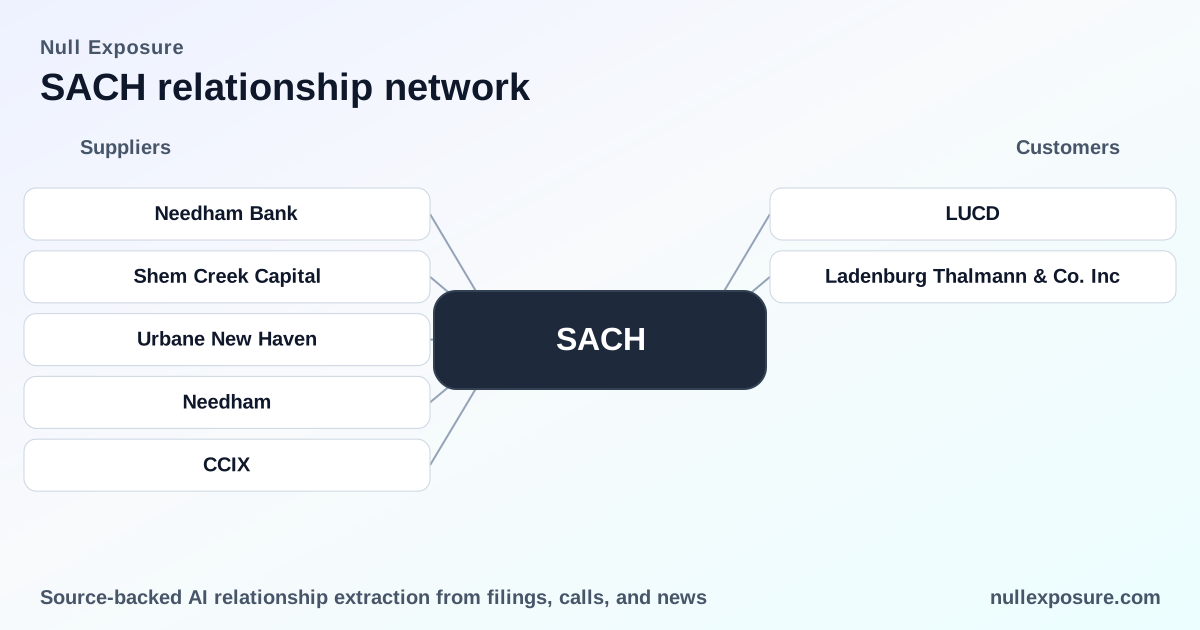
The public record for FY2026 contains a concise disclosure: Sachem executed a sales agreement referenced in SEC filings on November 14 with institutional placement and execution intermediaries. The press coverage cites two counterparties tied to that filing: Lucid (LUCD) and Ladenburg Thalmann & Co. Inc.
Lucid (listed as LUCD) — MarketScreener note (dividend article)
Sachem’s SEC filing on November 14 documents a sales agreement that names Lucid as a counterparty to placement activity; the transaction was reported alongside routine dividend and calendar disclosures. According to a MarketScreener article distributed in March 2026, the sales agreement was entered with Ladenburg Thalmann and Lucid. Source: MarketScreener, March 10, 2026 — https://www.marketscreener.com/news/sachem-capital-keeps-quarterly-dividend-at-0-05-per-share-payable-march-30-to-holders-of-record-ma-ce7e5fdadd8bff24
Lucid (listed as LUCD) — MarketScreener note (earnings-call announcement)
A separate MarketScreener release tied to Sachem’s fourth‑quarter and full‑year 2025 earnings schedule reiterates the November 14 sales agreement naming Lucid; the filing was disclosed in the company’s investor communications. Source: MarketScreener, March 10, 2026 — https://www.marketscreener.com/news/sachem-capital-sets-dates-for-fourth-quarter-and-full-year-2025-earning-release-and-conference-call-ce7e5cd9d188f024
Lucid (alternate name “Lucid”) — MarketScreener note (dividend article)
The same dividend announcement referenced Lucid under its trade name in connection with the November 14 sales agreement, confirming the counterparties named in the SEC filing. Source: MarketScreener, March 10, 2026 — https://www.marketscreener.com/news/sachem-capital-keeps-quarterly-dividend-at-0-05-per-share-payable-march-30-to-holders-of-record-ma-ce7e5fdadd8bff24
Lucid (alternate name “Lucid”) — MarketScreener note (earnings-call announcement)
The earnings‑release notice likewise lists Lucid in the November 14 sales agreement, reinforcing that placement or distribution capacity was engaged ahead of investor communications. Source: MarketScreener, March 10, 2026 — https://www.marketscreener.com/news/sachem-capital-sets-dates-for-fourth-quarter-and-full-year-2025-earning-release-and-conference-call-ce7e5cd9d188f024
Ladenburg Thalmann & Co. Inc — MarketScreener note (dividend article)
Sachem’s SEC filing of November 14 names Ladenburg Thalmann as a counterparty to a sales agreement, indicating the company used external broker‑dealer placement channels for capital or security distribution. MarketScreener’s March 2026 coverage references this filing in routine dividend and corporate notices. Source: MarketScreener, March 10, 2026 — https://www.marketscreener.com/news/sachem-capital-keeps-quarterly-dividend-at-0-05-per-share-payable-march-30-to-holders-of-record-ma-ce7e5fdadd8bff24
Ladenburg Thalmann & Co. Inc — MarketScreener note (earnings-call announcement)
The earnings‑release announcement also cites the November 14 sales agreement that included Ladenburg Thalmann, confirming the broker‑dealer’s role across multiple investor communications in FY2026. Source: MarketScreener, March 10, 2026 — https://www.marketscreener.com/news/sachem-capital-sets-dates-for-fourth-quarter-and-full-year-2025-earning-release-and-conference-call-ce7e5cd9d188f024
What the constraints tell investors about operating posture
The company’s disclosures and constraint signals provide a consistent operating narrative:
- Contracting posture: A dual posture — primarily short‑term, secured loans (1–3 years) combined with at least one longer‑term commercial lease (a 5‑year lease commenced August 1, 2021) — produces frequent roll or refinance events while maintaining a modest, stable rental cash flow.
- Counterparty mix and criticality: Borrower counterparty profile is concentrated in small and mid‑market real‑estate developers, owners and contractors, which makes underwriting flexibility and quick decision making critical to win repeat business.
- Geographic concentration: Lending is focused in the northeastern and southeastern United States, which concentrates market and regulatory risk regionally.
- Relationship maturity and dynamics: Relationships are active with a high degree of repeat business, indicating a pipeline driven by referrals and returning borrowers; operationally this reduces new origination cost but increases dependency on reputation and execution speed.
- Economic scale of deals: Documented unfunded construction loan balances and unfunded commitments show exposure bands from sub‑$100k leases to $1m–$100m loan commitments, signaling a loan book composed of many mid‑sized construction and rehab financings rather than a wholesale reliance on very large single credits.
Investment implications and portfolio risks
- Liquidity and placement capacity matter. The sales agreement with broker‑dealers such as Ladenburg Thalmann and Lucid signals that Sachem uses external capital markets channels to manage supply/demand imbalances; that distribution capacity is material to dividend sustainability and growth.
- Earnings are driven by loan origination cadence. The short tenor of loans means earnings reprice often, so underwriting discipline and secondary market access are persistent levers for margin control.
- Regional concentration is a double‑edged sword. Focus on the northeast and southeast increases expertise and sourcing efficiency but concentrates downside risk during localized market stress.
- Counterparty credit profile requires active monitoring. Small and mid‑market borrowers are relationship‑driven and less diversified; covenant design and collateral quality dictate realized loss experience.
For a concise market‑facing assessment and counterparty map tailored to institutional workflow, see our homepage: https://nullexposure.com/.
Final read
Sachem’s customer‑facing disclosures in FY2026 show a deploy‑and‑recycle lending model supported by outside distribution partners. The sales agreement naming Lucid and Ladenburg Thalmann demonstrates operational reliance on external placement channels, while constraint signals confirm a focused, repeatable business with geographic and borrower concentration. For investors and operators, the critical monitoring points are origination velocity, placement execution, and regional market indicators — these determine whether short‑term lending economics translate into reliable distributable cash flow.