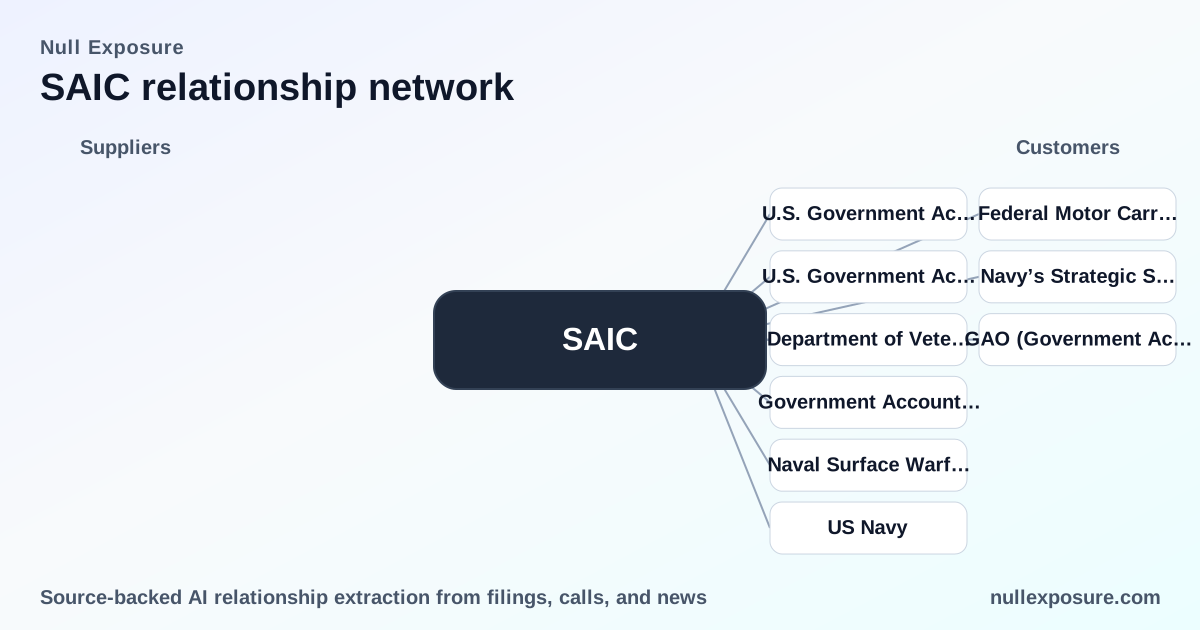
SAIC’s customer footprint: revenue stability powered by long-term U.S. government contracts
Thesis — Science Applications International Corporation (SAIC) operates as a services-led government contractor that monetizes technical, engineering and enterprise IT capabilities through long-term task orders, cost-reimbursable arrangements and IDIQ/framework vehicles with U.S. federal agencies. Its business model converts durable contracting relationships into predictable revenue and cash flow while concentrating risk in the U.S. government sector. Learn more analysis and customer intelligence at https://nullexposure.com/.
Why recent wins matter to investors: predictable revenue with concentrated exposure
SAIC’s recent contract awards reinforce a familiar revenue profile: large, mission-critical orders from federal agencies that plug into existing long-term frameworks and task-order vehicles. A $95 million GAO IT modernization award and a $75.2 million NAVAIR PRISM task order are additive near-term revenue drivers, but the more important signal is continuity — SAIC is consistently the service provider of record on multi-year programs. That operating posture supports stable margins from cost-reimbursable work and recurring task-order funding, while concentration in U.S. government customers is a clear structural risk to monitor.
Every customer relationship called out in public reporting
Below I summarize each relationship mentioned in the public signals and the primary source for that mention.
-
U.S. Government Accountability Office (GAO) — SAIC has been awarded a $95 million contract to modernize the GAO’s Technical Information Services program, delivering end-to-end IT services and a data-driven information environment. Source: GlobeNewswire press release (Feb 26, 2026) and Meritalk coverage (Mar 2026).
-
Naval Air Systems Command / NAVAIR — SAIC secured a $75.2 million PRISM task order to support NAVAIR capabilities in digital engineering and predictive analytics for aviation systems. Source: ASDNews reporting on the PRISM task order (Apr–May 2026).
-
NASA — SAIC served as NASA’s mission assurance partner for the Artemis II lunar mission, providing safety analysis, risk mitigation and real-time oversight across launch, spacecraft and crew systems. Source: SimplyWallSt coverage and press summaries of SAIC’s Artemis II role (May 2026).
-
Department of Veterans Affairs (VA) — The VA’s Technology Acquisition Center awarded SAIC a contract (reported as a $39.1 million award in a Federal Procurement Data System posting) for IT and telecommunications business application/application development support services. Source: GovConWire coverage of the Federal Procurement Data System posting (Mar 2026).
-
Naval Surface Warfare Center (NSWC Crane) — SAIC won a contract to develop testing capabilities and address gaps for advanced hypersonic concepts, supporting technology maturation and testing infrastructure at NSWC Crane. Source: Naval-Technology reporting on the hypersonics award (Jan–Mar 2026).
-
US Navy — SAIC was awarded a $63 million contract for advanced hypersonic weapon concepts and strategic mission solutions, reflecting multiple Navy taskings across RDT&E and systems engineering. Source: Naval-Technology news item (Jan 2026).
-
Navy’s Strategic Systems Programs (SSP) — The hypersonic work includes support to the Navy’s SSP and the Strategic Systems Hardware Divisions, indicating cross-organizational Navy demand for specialized engineering capabilities. Source: Naval-Technology coverage of the contract’s beneficiary organizations (Mar 2026).
-
Federal Motor Carrier Safety Administration (FMCSA) — SAIC partnered with Qualcomm on a $2 million FMCSA award to develop and field-test an untethered trailer asset management system for high-value or high-security loads. Source: TruckingInfo coverage of the FMCSA test contract (Mar 2026).
-
Department of Defense (DoD) — Public financial summaries and third‑party financial aggregators report that the DoD is the largest single contributor to SAIC’s top-line (listed as roughly 51.4% of sales in FY2026 commentary), underscoring SAIC’s exposure and strategic alignment with defense spending. Source: Intellectia financial commentary (FY2026 reporting).
What the contract signals say about SAIC’s operating model
Read as a whole, the public signals and SAIC’s own disclosures produce a consistent operational profile:
-
Contracting posture: framework + task-order execution. SAIC leverages IDIQs, GSA vehicles and long-term task orders; its remaining performance obligations exclude unexercised option periods, which is standard for this contracting posture.
-
Customer concentration: government-dominant. Almost all revenue is federal in nature; SAIC’s financial disclosures show prime and subcontracted U.S. government contracts drive the business.
-
Criticality: mission-essential services. The awards — IT modernization for GAO, mission assurance for NASA, hypersonics and naval aviation support — are mission-critical engagements that embed SAIC into operational workflows and testing pipelines.
-
Contract type and margin dynamics: mix leans toward cost-reimbursable with recurring task orders. A substantial proportion of revenue comes from cost-reimbursement contracts, which protect margins from certain inflationary pressures but require tight program control and timely billing.
-
Maturity and longevity: enduring relationships. SAIC reports decades-long customer relationships and operates roughly 1,700 active contracts and task orders, signaling institutionalized supplier status rather than one-off engagements.
Investment implications: upside drivers and concentrated risks
-
Upside: predictable backlog and repeat task orders support cash flow and make SAIC resilient to cyclical civilian IT downturns; specialized defense work (hypersonics, aviation) positions the company for program-cost escalation and scope expansion.
-
Risks: single-sector concentration and federal budget shifts are the dominant threats to valuation multiple expansion; adverse audit outcomes or compliance findings could be material given the government-focused revenue base.
Bottom line and next action
SAIC’s recent run of awards confirms its core proposition: a services-first government contractor that converts long-term contract vehicles into stable top-line and cash flow. However, investors must price the firm for concentrated government exposure and monitor program-level execution risk.
For deeper customer-level mapping and comparative supplier analytics, visit https://nullexposure.com/ for our proprietary briefs and relationship intelligence.