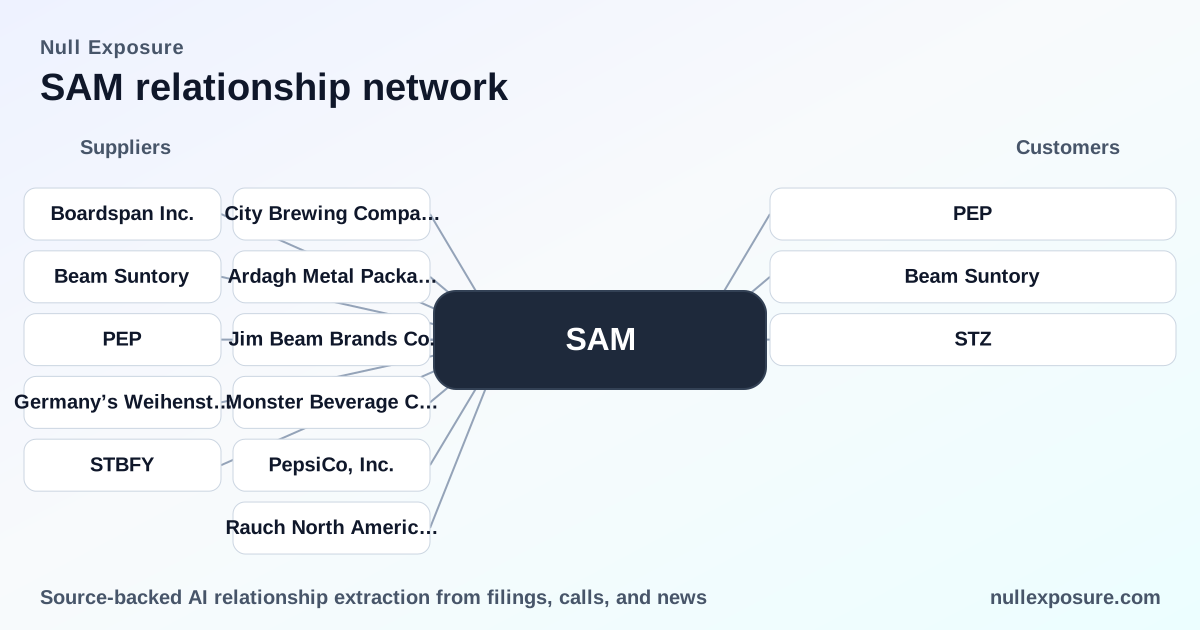
Boston Beer (SAM) — who buys the beer and what that means for investors
The Boston Beer Company generates revenue by producing and selling alcoholic beverages—primarily in the United States—through a network of independent distributors and strategic brand partnerships. The firm monetizes via branded ready-to-drink and craft beer products manufactured in-house and sold to wholesalers who place those products with retailers; selective co-brands and licensing deals extend reach without meaningfully increasing manufacturing capex. For investors assessing SAM’s customer relationships, the critical framers are distribution concentration, domestic revenue reliance, and the strategic partnerships that drive portfolio growth. For a deeper look at relationship intelligence, see NullExposure’s hub: https://nullexposure.com/.
How Boston Beer’s customer model actually works
Boston Beer operates as a branded beverage manufacturer and seller with the following commercial characteristics:
- Distribution-first contracting posture — the company sells almost exclusively to independent wholesalers (Distributors) who then service retailers across channels (grocery, on‑premise, club, convenience).
- High domestic concentration — roughly 94–95% of revenue is domestic, making U.S. distributor relationships far more material than any international account.
- Moderate counterparty concentration — the top three Distributors account for about 7% of gross sales, and the largest single Distributor is roughly 3%, which reduces single-counterparty failure risk while leaving the company exposed to channel dynamics rather than single customers.
These characteristics create predictable cash flow from scale brands while leaving Boston Beer exposed to category competition and distributor economics documented in its filings. For more on how we source and validate relationships, visit https://nullexposure.com/.
The relationship map investors should read (each entry covered)
Below I list every relationship surfaced in the recent crawl with a plain-English investment-oriented summary and source reference.
USGA — Sun Cruiser partnership
Boston Beer’s Sun Cruiser has been named the Official Ready‑to‑Drink Cocktail of the U.S. Open and U.S. Women’s Open, signaling a multi-year sports marketing partnership intended to increase national brand awareness for the RTD line. According to a Sahm Capital news release (March 2026), this agreement places Sun Cruiser in high‑visibility event distribution and co‑marketing programs. Key takeaway: accelerated consumer trial for Sun Cruiser via premium sports venues.
Source: Sahm Capital press release on the Sun Cruiser–USGA partnership (March 10, 2026).
PEP — PepsiCo distribution/co‑brand arrangement (Boston Beer release)
Boston Beer developed and produced the U.S. launch of HARD MTN DEW while PepsiCo created an entity to sell, deliver, and merchandise the product, reflecting a split where Boston Beer handles production and PepsiCo handles retail execution. The company described this arrangement in a Boston Beer press release (August 2021). Key takeaway: Boston Beer leverages partner scale for go‑to‑market while preserving manufacturing economics.
Source: Boston Beer Company press release (Aug 2021).
PepsiCo — same commercial arrangement (duplicate capture)
The August 2021 release likewise identifies PepsiCo as the retailing and merchandising partner for the HARD MTN DEW launch, which places Boston Beer in a supplier role to a global CPG powerhouse with superior shelf and logistics capabilities. This is the same business arrangement described in Boston Beer’s announcement (Aug 2021). Key takeaway: delegating retail execution reduces Boston Beer’s channel risk for a high-volume launch.
Source: Boston Beer Company press release (Aug 2021).
Beam Suntory — RTD manufacturing and distribution collaboration
Boston Beer entered a strategic collaboration to bring Sauza tequila RTD formats to market by contributing production capabilities and distribution reach, while Beam Suntory contributes brand and category expertise. Boston Beer’s announcement (July 2021) and trade coverage (Brewbound, July 2021) outline a partnership built on complementary strengths. Key takeaway: partnerships with spirits companies expand Boston Beer’s RTD footprint without incremental brand risk.
Source: Boston Beer press release (July 2021) and Brewbound coverage (July 2021).
Beam Suntory (Brewbound capture) — press and trade confirmation
Brewbound’s reporting reiterated that Boston Beer’s “expertise, production capabilities and distribution footprint” are central to bringing Sauza’s RTD to market, confirming the operational role Boston Beer will play. This second item duplicates the same collaboration but from a trade press perspective. Key takeaway: trade press corroboration reduces execution uncertainty for the partnership.
Source: Brewbound article on the Boston Beer–Beam Suntory strategic partnership (July 2021).
Constellation Brands — competitive mention in 10‑K
Boston Beer’s FY2024 10‑K lists Constellation Brands among competitors that have significantly greater marketing and distribution resources in the U.S. beer market—an explicit competitive pressure rather than a customer relationship. The filing identifies imported brands controlled by Constellation as meaningful share competitors. Key takeaway: Constellation’s scale is a competitive constraint on Boston Beer’s growth, particularly in segments where imported brands expand.
Source: Boston Beer 10‑K (FY2024).
STZ — ticker call‑out in the 10‑K (duplicate competitive reference)
The FY2024 10‑K also calls out STZ (Constellation Brands) by ticker when describing competitive dynamics with imported beers such as Modelo and Corona. This is a duplicate capture of the same competitive context in the 10‑K. Key takeaway: the filing explicitly frames STZ as a major competitor with distribution and financial advantages.
Source: Boston Beer 10‑K (FY2024).
What the filing‑level constraints tell investors about SAM’s operating model
The constraints in Boston Beer’s filings are informative company‑level signals:
- Geographic concentration (NA): Approximately 94–95% of shipments are domestic, concentrating revenue exposure to U.S. consumer spending patterns and channel dynamics rather than diversified international demand.
- Distributor role as the primary customer: The company sells predominantly to a network of over 300 independent wholesalers; this is the contractual backbone of revenue generation and indicates a seller‑to‑distributor contracting posture rather than direct retail sales.
- Spend bands and concentration: The top three Distributors together represent about 7% of gross sales, and the single largest Distributor is ~3%, implying moderate counterparty concentration that constrains credit risk but leaves channel risk (category mix, trade spends) as the principal execution risk.
- Relationship maturity and stage: Distributor relationships are active and operationally mature, forming the routine conduit for product flow to retailers.
These constraints together define a business that is strong in branded manufacturing and marketing but exposed to U.S. channel economics and competitive activity from deeper-pocketed global brewers.
Investment implications and risk framing
- Growth lever: Strategic partnerships (PepsiCo, Beam Suntory) are the primary route to rapid national scale for new RTD and co‑branded products while keeping CAPEX light. Partnership execution is therefore a material growth driver.
- Risk vector: U.S.-centric revenue and competition from Constellation, AB InBev, and Heineken create persistent margin pressure and require sustained marketing investment to defend share. Distributor economics—not a single customer—are the operational risk to monitor.
- Valuation context: With negative trailing EPS but positive operating margins and FY2024 EBITDA of roughly $229 million, the company trades with growth expectations priced into forward multiples; investors should watch whether partnerships convert into durable retail listings and margin expansion.
Bottom line for investors
Boston Beer runs a distributor‑centric commercial model with high domestic concentration, moderate distributor concentration, and a clear playbook of using brand partnerships to scale new RTD launches quickly. Monitor execution on partnership rollouts (HARD MTN DEW, Sauza RTD, Sun Cruiser), distributor trade economics, and competitive moves from larger brewers. For ongoing relationship monitoring and actionable signals on SAM, explore our coverage at https://nullexposure.com/.