Silvercrest Asset Management Group (SAMG): client relationships and what the CBUS seed means for concentration and growth
Silvercrest Asset Management Group operates as a fee‑based wealth manager and family‑office service provider, monetizing primarily through investment management fees tied to assets under management and bespoke advisory services for ultra‑high‑net‑worth individuals and institutions. The firm reports $125.3 million in trailing revenue and a market capitalization near $101 million (latest quarter ended 2025‑12‑31), and it grows profit through concentrated, high‑value client relationships and occasional institutional seed mandates that bring scale quickly. For a compact but material profile of client risk and opportunity, see https://nullexposure.com/.
How Silvercrest wins business and gets paid
Silvercrest runs a services‑led, AUM fee model: the company provides investment management and family office services to wealthy individuals, families, endowments, foundations and institutional investors, and collects revenue via management fees on assets. The firm discloses domestic revenue concentration and a client base skewed toward large relationships: as of year‑end 2024, the top 50 relationships averaged $472 million each and represented about 65% of AUM, while third‑party distribution channels accounted for roughly $5.5 billion, or 15% of total AUM, according to company filings (FY2024/FY2025). These structural facts drive both scale upside and concentration risk.
Key financial context: trailing revenue $125.3M, EBITDA ~$11.7M, and a modest profit margin (3.9% trailing). The firm’s business model is sensitive to AUM flows and client retention dynamics rather than product sales volume.
Client relationships recorded in the coverage
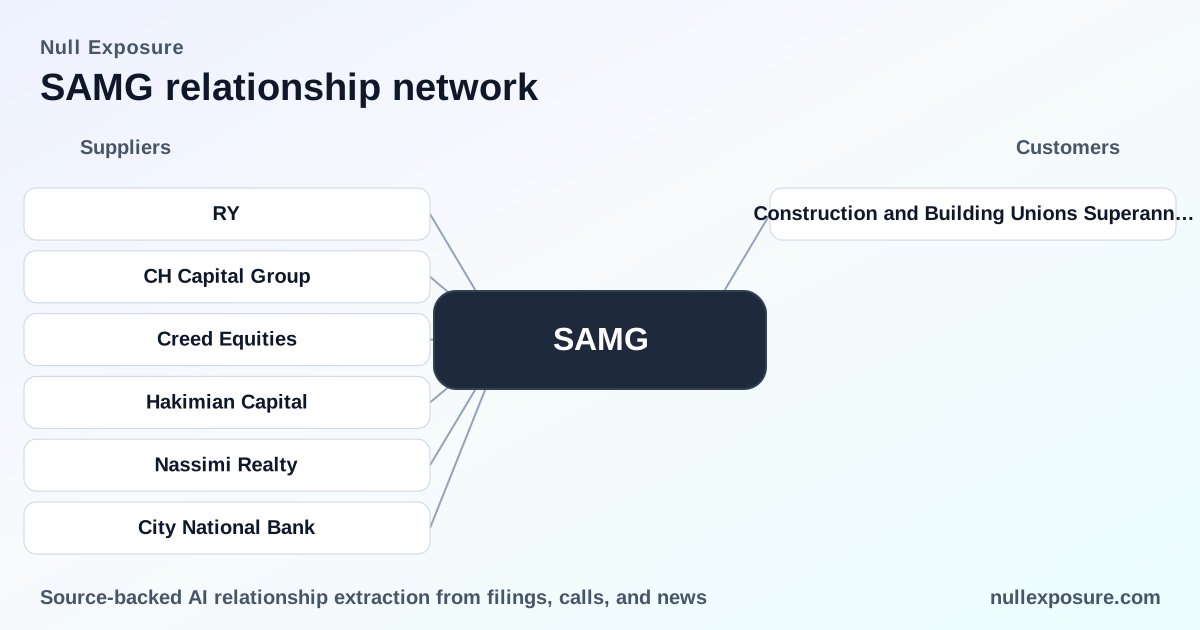
The public record contains two near‑identical items documenting a significant institutional seed relationship with Australia’s Construction and Building Unions Superannuation Fund (CBUS). Both items reference the same $1.3 billion USD initial seed investment into Silvercrest’s new Global Value Equity strategy.
-
Silvercrest announced winning a $1.3 billion USD seed investment from CBUS to launch its Global Value Equity strategy; this placement is presented as a primary driver of seed inflows in the quarter. A news report summarized the quarter as “primarily bolstered by winning a successful seed investment ... $1.3 billion USD ($2.0 billion AUD) in partnership with CBUS.” (Advfn report, May 3, 2026.)
-
A separate press item also records the $1.3 billion USD initial seed from Australia’s Construction and Building Unions Superannuation Fund (CBUS) as the seed investor for the Global Value Opportunity Equity strategy. (QuiverQuant coverage of the company announcement, March 10, 2026.)
Both items together confirm a single, sizeable institutional placement that immediately scales an active strategy and brings a non‑US institutional relationship onto Silvercrest’s platform.
Operating model constraints and company‑level signals
Company disclosures and the relationship evidence establish a concise set of operating characteristics investors must weigh:
-
Contracting posture: short‑term termination risk. Silvercrest states that substantially all revenue‑generating contracts and relationships can be terminated on no notice, which elevates the turnover sensitivity of its revenue base (company filing language).
-
High concentration and material clients. The top 50 relationships average $472 million and represent ~65% of AUM; the firm reports 832 client relationships averaging $43 million that account for 99% of assets under management, signaling high client concentration and the business impact if a single large relationship exits.
-
Client mix leans to large enterprises, institutions and wealthy individuals. Filings emphasize relationships with ultra‑high‑net‑worth individuals, institutional investors, public and corporate pension funds, endowments and foundations — a blend that produces larger average account sizes and institutional sales opportunities.
-
Domestic revenue base. The company discloses that currently all revenue is domestic; international business exists for some clients but the firm does not actively market outside the United States.
-
Mature relationships with high retention. Annual client retention has averaged 98% since 2006, indicating a stable core book that offsets some short‑term contract fragility.
-
Role and segment clarity. Silvercrest positions itself as a service provider and seller of wealth management and family office services, not as a product manufacturer; the company’s segment focus is services.
Taken together, these signals describe a services business that gains scale through a small number of large relationships, is operationally mature and sticky, but retains material vulnerability to individual client exits given short‑notice termination rights and high concentration.
Strategic implications of the CBUS seed investment
The CBUS placement is both a growth vector and a structural test of the firm’s model.
-
Scale acceleration: A $1.3 billion seed instantly moves a retail or institutional strategy from launch to institutional scale, increasing fee revenue potential without incremental client acquisition cost for that mandate. The March–May 2026 disclosures confirm that this single institutional placement was a primary source of seed flows for the quarter.
-
Concentration amplification: While the seed boosts AUM and revenue opportunity, it also increases concentration in a firm already reporting that top accounts drive AUM. Investors should treat the seed as beneficial from a growth standpoint but monitor how much of Silvercrest’s new inflows concentrate in a handful of mandates.
-
Distribution proof point: Securing CBUS — a major Australian superannuation fund — validates Silvercrest’s ability to win large institutional relationships beyond its traditional ultra‑high‑net‑worth and US institutional base. The deal constitutes a commercial reference that can be marketed to other institutional prospects.
What this means for revenue stability and valuation
Silvercrest’s revenue is directly tied to AUM and client tenure. The company’s high retention rate (98% historical) cushions short‑term termination exposure, but the firm’s explicit contractual exposure to immediate termination and its top‑heavy client roster create an asymmetry: large wins can rapidly lift revenue, yet an exit by a major client would have outsized downside.
From a valuation lens, the market has priced the firm with a modest multiple (trailing P/E ~23.5; forward P/E 11.8) and a small market cap ($101M). The CBUS seed reduces execution risk on the new strategy and can justify multiple expansion if the firm converts seed capital into a durable fee base; conversely, sustained reliance on a small set of large relationships constrains the multiple investors are willing to pay.
What investors should watch next
- Quarterly AUM disclosures and the net flow impact of the CBUS seed on total AUM and management fees.
- Any change to the top‑50 concentration metric and disclosures about client diversification or loss‑protection clauses.
- New institutional placements that follow CBUS, which would demonstrate repeatability of the institutional sales channel.
- Fee compression or restructuring tied to seeded strategies and how seed economics convert to run‑rate fees reported in future quarters.
For a concise overview and tracking of Silvercrest relationship signals visit https://nullexposure.com/.
Bottom line
Silvercrest is a services‑driven wealth manager whose economics hinge on a concentrated, high‑value client book and the firm’s ability to convert institutional seed placements into lasting fee revenue. The $1.3 billion CBUS seed is a meaningful validation and a material influx of capital — positive for growth but also increasing concentration risk in an already top‑heavy AUM profile. Investors should balance the upside from scaled strategies against the structural exposure that comes from short‑notice contract termination and domestic concentration.