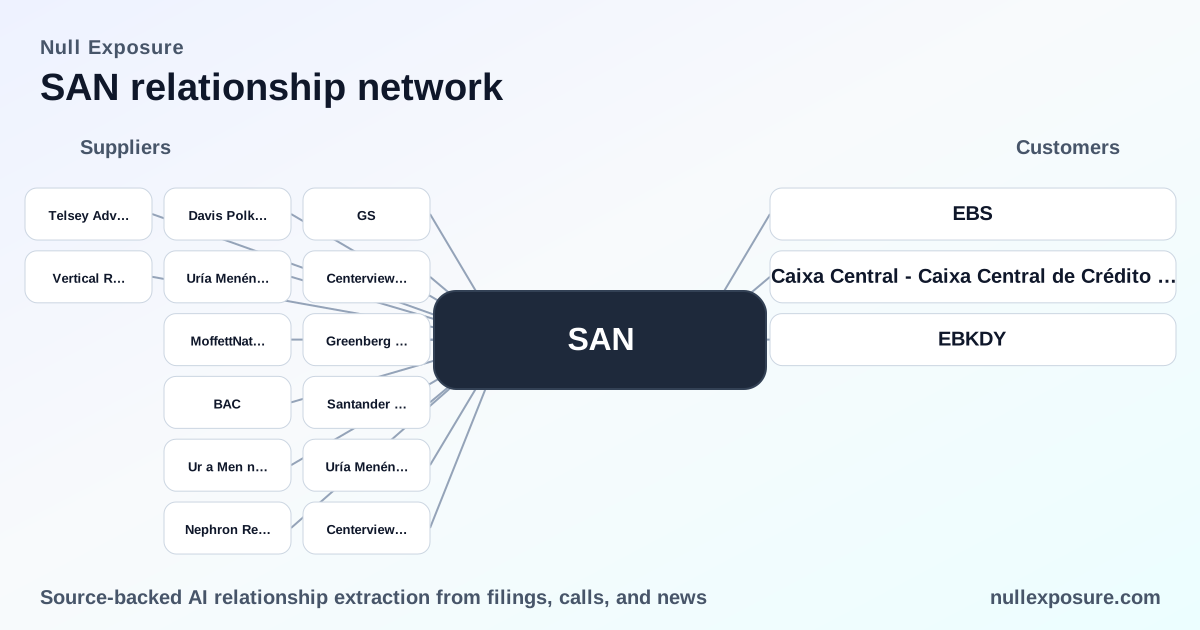
Banco Santander (SAN) — Customer Relationships that Drive Capital‑Markets and Transactional Revenue
Banco Santander operates as a global diversified bank, monetizing through retail and commercial deposit spreads, fee income from capital‑markets underwriting and advisory, trade finance and supplier‑finance services, and occasional portfolio dispositions. Santander’s customer footprint in this dataset underscores two core revenue franchises: capital‑markets origination and structured transaction banking (reverse factoring, repo and lending) — activities that generate recurring fees and transactional interest income. Visit https://nullexposure.com/ for additional relationship analytics and signal sourcing.
What these relationships tell investors about Santander’s operating model
Santander functions as both a distribution engine for equity and debt issuances and a balance‑sheet counterparty for corporate financing. Across the visible relationships the bank is consistently the book‑running manager or sole underwriter, the provider of reverse factoring and receivables financing, and the lender/agent in repo and loan facilities. This combination gives Santander high revenue optionality (fees + interest) and exposes it to transactional concentration risk when large underwriting or loan exposures cluster in single deals or sectors.
- Contracting posture: Active lead arranger / sole book‑runner in numerous IPOs and offerings, and counterparty in supplier‑finance agreements — Santander takes front‑office placement and balance‑sheet risk.
- Concentration and criticality: Counterparties span SPACs, corporates, and financial sponsors; capital markets engagements are episodic but high value, while reverse factoring relationships are operationally critical for corporate suppliers.
- Maturity and stability: Many interactions reflect mature capital‑markets roles (underwriting, buybacks) and recurring transactional products (reverse factoring, repo), supporting steady fee flow and interest income.
No explicit relationship constraints were supplied in the dataset, so there are no flagged contractual caveats to attribute at the relationship level.
Relationship map — counterparties, role and source
Below I enumerate every counterparty captured in the results and summarize Santander’s role in plain English with a concise source citation.
-
JENA‑U — Santander US Capital Markets LLC is listed as the contact for prospectus copies for Jena Acquisition Corporation II’s IPO, signaling an underwriting/syndicate administrative role. Source: Chronicle Journal reporting on the FY2025 offering (prospectus contact information).
-
AEXA (American Exceptionalism Acquisition Corp A) — Santander served as sole book‑running manager for AEXA’s upsized $300m IPO and held a 45‑day option to purchase additional shares to cover over‑allotments. Source: MLQ.ai and StockTitan coverage of the FY2025 IPO pricing.
-
TBBB — The company disclosed a reverse‑factoring arrangement with Banco Santander Mexico that finances supplier receivables; Santander’s liability under the agreement is contractually capped and the sponsor pays Santander the invoice amounts on a 60‑day cycle. Source: SEC filing excerpt in FY2026 (company 6‑K/MD&A).
-
LOKV — Santander US Capital Markets acted as sole underwriter for Live Oak Acquisition Corp V’s $200m offering, reflecting continued SPAC underwriting activity. Source: Investing.com report on the FY2025 offering.
-
LCAA (Lotus Tech and L Catterton Asia Acquisition Corp) — Santander US Capital Markets acted as equity capital markets advisor and financial advisor to LCAA in a proposed combination. Source: CityBiz article describing FY2024 advisory work.
-
EBS / Erste Group Bank AG — Santander completed the sale of a 49% stake in Santander Bank Polska to Erste Group for approximately €7bn; the transaction also transferred a 50% stake in the Polish asset management business. Source: Banco Santander press release and CrowdfundInsider reporting in FY2026.
-
DESP (Despegar.com) — The company launched a co‑branded credit card with Banco Santander in Brazil, indicating partnership on consumer payments and card origination. Source: Company earnings call transcript cited by The Motley Fool (FY2020 reference in dataset).
-
PAC (Grupo Aeroportuario del Pacífico) — Proceeds from recent issuances were earmarked to repay a bank loan with Banco Santander for Ps.1,500.0 million, indicating Santander held corporate debt that was refinanced. Source: GlobeNewswire results release (FY2025).
-
TE (T1 Energy) — Santander acted alongside J.P. Morgan as lead book‑running manager for T1 Energy’s upsized offering of convertible senior notes due 2031, demonstrating joint lead manager roles in debt capital markets. Source: Santander/J.P. Morgan placement coverage via GlobeNewswire and Investing.com (FY2026).
-
CRH plc — CRH executed NYSE share repurchases through Santander US Capital Markets as the executing broker for a $300m repurchase program; Santander handled execution of buyback trades. Source: The Globe and Mail press release and Tikr commentary on FY2026 repurchases.
-
Market Financial Solutions Ltd — Multiple law firms initiated investigations tied to the collapse of this UK mortgage provider to which Santander was a lender, indicating potential credit and litigation exposure. Source: TradingKey article on market movers (FY2026).
-
Caixa Central de Crédito Agrícola (Caixa Central) — Caixa Central mandated Banco Santander to conduct open‑market purchases or privately negotiated transactions for its callable senior preferred notes due 2027, showing Santander acting as an agency or trading counterparty. Source: Reuters/Euronext Dublin notice republished on TradingView (FY2026).
-
BSAC (Banco Santander Chile / related entities) — Internal group consulting services and a contract for a digital trade‑services platform (“Global Trade Services”) were recorded between Banco Santander‑Chile and Santander Global Trade Platform Solutions S.L., indicating intra‑group product and platform provisioning. Source: Chilean reporting and SEC 6‑K excerpts (FY2020 and FY2026 items).
-
CBU (Community Bank System, Inc.) — CBU acquired seven Santander Bank branches in Allentown, PA; Santander was the divesting party in a branch sale, reflecting retail footprint rationalization in the U.S. Source: TradingView, CityBiz and company SEC filings (FY2025/FY2026 coverage).
-
BTI (British American Tobacco) — BAT repurchased ordinary shares from Banco Santander as part of its buyback program, with Santander acting as a seller/executing broker in share cancellation transactions. Source: TradersUnion report on FY2026 buyback execution.
-
YPF — Santander sealed a strategic alliance to integrate banking and payments services into the YPF app, showing product partnership and embedded banking distribution in Argentina. Source: BNamericas and MobilityPlaza coverage (FY2026).
-
ARI (Apollo Commercial Real Estate Finance) — The company executed a master repurchase agreement with Banco Santander, S.A. New York Branch, indicating Santander’s role as repo counterparty for securitized or financing facilities. Source: CityBiz reporting on FY2023 facilities.
-
RDI (Reading International) — Reading extended the maturity of a Santander loan against live theater assets in NYC, demonstrating Santander’s role as a secured lender to real‑asset operators. Source: Earnings call transcript republished by Investing.com (FY2025).
-
ORC (Orchid Island Capital) — Portfolio listings show Banco Santander SA as a held issuer in ORC’s RMBS/portfolio disclosures, indicating Santander paper appears in third‑party investor holdings. Source: The Globe and Mail/Quiver Quant portfolio updates (FY2025–FY2026).
Investment implications and risk checklist
- Revenue mix benefit: Underwriting and advisory work generates high‑margin fees; reverse factoring and loan facilities generate fee and net interest income. These relationships show diversified revenue channels beyond classic retail banking.
- Balance‑sheet exposure: Acting as sole underwriter or lender concentrates episodic underwriting risk and persistent credit exposure; the Market Financial Solutions matter highlights litigation and credit re‑risking. Monitor credit provisioning and contingent liabilities.
- Strategic distribution: Partnerships with consumer platforms (YPF) and intra‑group platform sales (GTS) expand low‑cost deposit and fee distribution. Distribution diversification supports cross‑sell and fee growth.
For actionable relationship intelligence and continuous monitoring of Santander’s counterparty exposures, visit https://nullexposure.com/ — the platform integrates signal aggregation and timelines for institutional workflows.
Bottom line
Santander’s customer relationships in this snapshot reinforce its dual role as a capital‑markets originator and a transactional bank that uses its balance sheet for supplier and corporate finance. That combination creates steady fee streams and recurring interest income but imposes episodic concentration and credit risk tied to large underwriting deals and loan portfolios. Investors should track underwriting pipelines, portfolio dispositions, and any open litigation tied to funded counterparties for a clear view of near‑term earnings sensitivity.