Sangoma (SANG): Taking Share from Legacy UC Vendors — What the Q4 2025 Call Means for Investors
Sangoma Technologies develops hardware and software for voice and data connectivity and monetizes through a mix of product sales, recurring software subscriptions, and support contracts for enterprise communications systems. The company competes as a replacement and upgrade path for legacy PBX and unified-communications vendors, and management highlighted customer wins against incumbents on the Q4 2025 earnings call, signalling tactical market-share gains that could accelerate recurring revenue growth. For deeper company-wide intelligence and customer visibility, visit https://nullexposure.com/.
How Sangoma actually makes money — the operating model in plain terms
Sangoma sells both physical communications hardware and software-based communications platforms, then sells ongoing support and subscription services around those platforms. That dual revenue stream produces a mix of one-time product revenue and higher-margin recurring revenue, which defines its contracting posture: customers typically buy hardware or software and then sign multi-year support or license agreements that create revenue stickiness.
Key financial context: Revenue TTM $219.7M, Gross Profit TTM $155.1M, and an enterprise valuation that implies bargain multiples—EV/Revenue ~0.76 and EV/EBITDA ~4.2. Profitability is still under pressure: TTM diluted EPS -$0.17 and operating margin -3.34%, reflecting reinvestment and integration costs. Insider ownership is material at ~26.7%, and institutional holders make up ~28.0%, a shareholder base that typically supports strategic consolidation and M&A activity.
What management named on the Q4 2025 call — the customer relationships
The Q4 2025 earnings call included a concise competitive positioning line that explicitly referenced incumbents from whom Sangoma is winning business. The transcript was first surfaced on March 7, 2026.
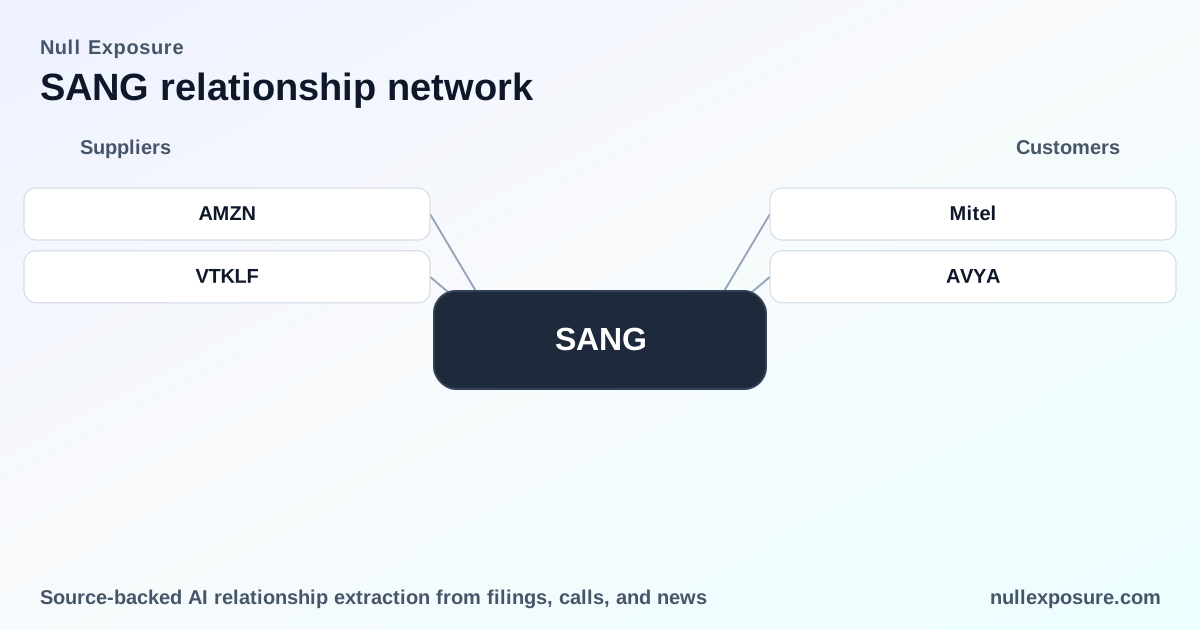
Mitel
Sangoma stated it is "capturing share from ... Mitel," indicating active customer conversions away from Mitel’s legacy platforms toward Sangoma’s solutions; this is a direct competitive win in the enterprise telephony replacement market. Source: Q4 2025 earnings call (transcript published March 7, 2026).
Avaya
Management said it is “capturing share from Avaya,” confirming Avaya is a named incumbent whose customers Sangoma is displacing, which supports the company narrative of growth driven by migrations off older PBX infrastructure. Source: Q4 2025 earnings call (transcript published March 7, 2026).
AVYA (duplicate mention)
The call transcript includes a duplicate reference rendered as AVYA (same entity as Avaya), reinforcing the emphasis on Avaya displacement as a near-term source of customer wins; the repetition in the transcript underlines the strategic importance of that competitor conversion. Source: Q4 2025 earnings call (transcript published March 7, 2026).
Why these customer signals matter — commercial and investment implications
These explicit name-checks of Mitel and Avaya are tactical evidence that Sangoma is executing on a displacement strategy that targets large installed bases running ageing equipment. That operating posture has several implications for investors:
- Contracting posture: Sangoma wins customers through migrations and replacement projects that typically convert into multi-year support contracts, increasing recurring revenue over time and lowering churn risk on migrated accounts.
- Concentration and disclosure: The customer-scope feed lists a narrow set of named incumbents; this is a company-level signal that Sangoma publicly highlights competitive wins more than large single-customer concentration, and public disclosures do not enumerate a broad roster of anchor customers.
- Criticality: Replacing core voice infrastructure is a mission-critical procurement for enterprise customers, so successful migrations create higher switching costs post-deployment and a path to upsell services.
- Maturity of market: The market Sangoma targets is mature and cyclical—the opportunity is defined by ongoing refresh cycles and vendor rationalization among enterprises moving off legacy PBXs.
For a focused view on customers and counterparties, see additional resources at https://nullexposure.com/.
Risk profile and upside case tied to customer relationships
The upside from converting Avaya and Mitel customers is clear: successful conversions can accelerate recurring revenue and improve margins as installed bases migrate to Sangoma’s subscription-supported platforms. The transcript language confirms Sangoma is actively harvesting that opportunity.
Key risks remain: quarterly revenue growth is negative year-over-year (-13% in the latest quarter), EPS is negative, and operating margins are compressed, so wins against legacy vendors must scale quickly to materially improve unit economics. Market valuation reflects both the opportunity and the execution risk—analyst consensus target price sits at $9, while the current market environment prices the stock conservatively.
Constraints and disclosures relevant to customer analysis
The customer-scoped feed returned no explicit contractual constraints for Sangoma in the period covered. That is a company-level signal: there were no public contract limitations, exclusivity clauses, or customer-specific constraints identified in the customer exposure data. The absence of explicit constraints reduces visibility into counterparty concentration risk and contract renewal timing, which investors should consider when modelling revenue stickiness and downside scenarios.
Bottom line: what investors should watch next
- Conversion cadence from Avaya and Mitel customers. Quarterly disclosure that quantifies migrated seats or recurring revenue uplift will convert the qualitative call language into measurable growth.
- Recurring revenue trajectory and margin expansion. The key value inflection for Sangoma is the shift from hardware-driven revenue to higher-margin subscription and support income.
- Disclosure of major customer contracts or renewals. Given the lack of explicit contractual constraints in public customer-scoped data, any future filings that name anchor customers or large multi-year agreements will materially change the risk/reward profile.
For ongoing monitoring of customer relationships and counterparty exposure relevant to Sangoma and comparable communications-platform companies, visit https://nullexposure.com/ for structured insight and updates.