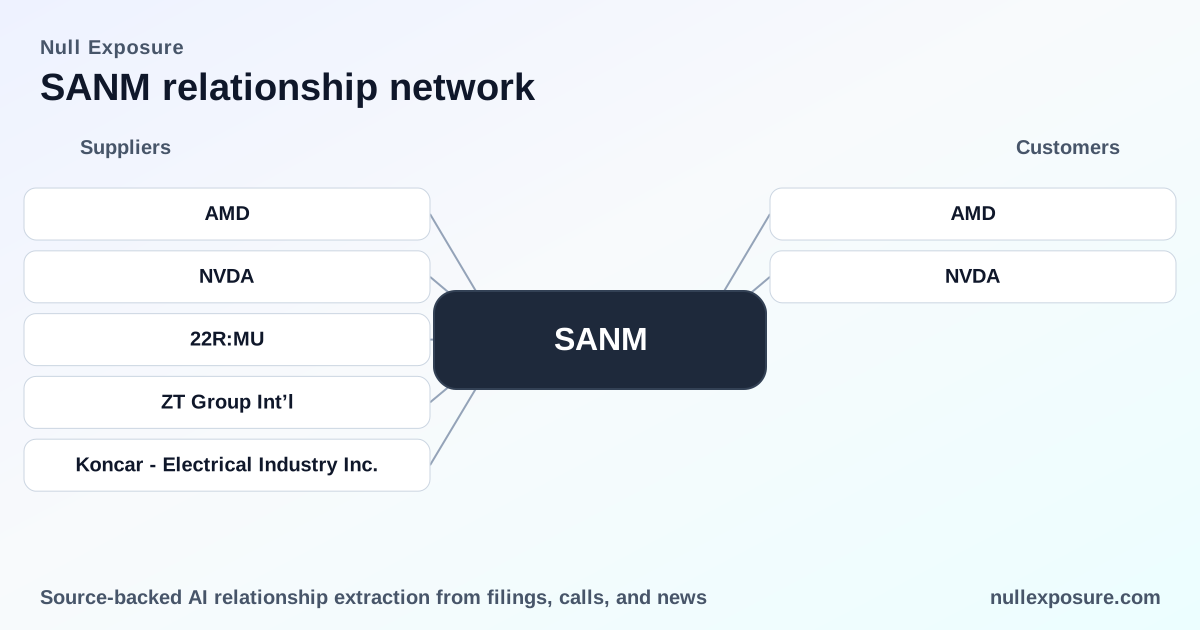
Sanmina (SANM): Manufacturing the AI Rack Opportunity — Customer Signals and Investor Takeaways
Sanmina builds revenue by selling integrated manufacturing and after‑sales services to OEMs and cloud infrastructure customers, with a concentrated portfolio of large accounts and a focus on advanced electronics manufacturing. The company monetizes through contract manufacturing, new‑product introduction support and regional logistics, and its 2025 profile shows an industrially mature supplier transitioning to higher‑margin AI and rack‑scale work. For a deeper look at Sanmina’s commercial footprint and client-level evidence, visit https://nullexposure.com/.
The short investment thesis up front
Sanmina is a global electronics manufacturer that generates the bulk of its revenue from a small set of large OEMs and is actively repositioning to capture AI rack and accelerated‑compute demand. The company’s material customer concentration creates both upside (rapid revenue lift if large AI programs ramp) and downside (single‑customer shocks), while a mix of multi‑year supply agreements and annual performance obligations produces a hybrid revenue profile that is predictable at scale but exposed to cycle timing.
How Sanmina sells, and what that means for revenue durability
Sanmina operates as a supplier to original equipment manufacturers across industrial, medical, defense, automotive, communications and cloud infrastructure markets. The firm reports a single reportable segment (IMS) that accounted for roughly 80% of revenue in 2025, underscoring that manufacturing is the core commercial engine. Public disclosures indicate Sanmina signs both multi‑year supply agreements (three to five years) and contracts where performance obligations are typically one year or less, so its contracting posture mixes longer strategic relationships with near‑term program variability. Sales to the top ten customers represented 52% of net sales in 2025, a concentration level that is a defining balance‑sheet risk and a lever for rapid growth when one of those customers ramps work.
- Key business model drivers: concentrated customer base, global regional footprint to meet time‑to‑market and local content needs, and a strategic emphasis on new product introductions for growth industries.
- Operating constraints signal: global reach, material customer concentration, dominant manufacturing segment, and an active portfolio of relationships that the company seeks to make long‑term.
Learn more about Sanmina’s commercial mapping at https://nullexposure.com/.
What the public evidence says about customer relationships
Below I summarize every customer relationship instance surfaced in the record set. Each entry is concise and tied directly to the cited source.
Finviz — Sanmina named an AMD manufacturing partner for AI racks (May 3, 2026)
Finviz reported that AMD selected Sanmina as a manufacturing partner for AI rack‑scale solutions, a move positioned to accelerate cloud AI infrastructure deployment. This coverage frames Sanmina as a strategic supplier for AMD’s rack programs (Finviz, May 3, 2026).
AMD earnings call — ZT Systems sale and strategic partnership (2025 Q3)
In AMD’s 2025 Q3 earnings call, AMD confirmed it completed the sale of the ZT manufacturing business to Sanmina and designated Sanmina as its lead manufacturing partner for Helios, formalizing Sanmina’s role on a named AMD platform (AMD 2025 Q3 earnings call, Mar 2026).
TradingView (Zacks) — reiteration of AMD manufacturing tie (May 3, 2026)
A TradingView/Zacks post reiterated that AMD selected Sanmina for AI rack‑scale manufacturing, emphasizing the same market narrative that Sanmina is positioning to supply AMD rack systems (TradingView/Zacks, May 3, 2026).
Investing.com — JPMorgan notes preferred NPI partnership with AMD (May 3, 2026)
An Investing.com summary of JPMorgan’s initiation highlighted that Sanmina maintains a preferred new‑product‑introduction (NPI) partnership with AMD for accelerated compute, showing investor research recognizes Sanmina’s strategic role in product launches (Investing.com reporting of JPMorgan initiation, May 3, 2026).
Intellectia.ai — investor questions on AMD ramp vs Nvidia decline (earnings notice, Jan 26, 2026)
A pre‑earnings notice cited investor concern about how quickly Sanmina/ZT can grow revenues from AMD rack builds as Nvidia rack work declines, flagging a near‑term transition risk in revenue mix (Intellectia.ai, Jan 26, 2026).
Intellectia.ai (separate NVidia mention) — same investor framing with Nvidia label
The same Intellectia.ai piece was also filed under Nvidia news, noting the same question about the pace of transition from Nvidia racks to AMD rack production and the associated revenue timing risk (Intellectia.ai, Jan 26, 2026).
The Globe and Mail — management expects AMD projects to ramp later in the year (Mar 2026)
Coverage of Sanmina’s quarterly call quoted management (Faust) explaining that legacy platforms rolled off and that AMD‑driven accelerated compute projects are expected to ramp toward year‑end, indicating a timing profile for anticipated revenue (The Globe and Mail, Mar 2026).
The Globe and Mail — analyst inquiry on the NVIDIA → AMD transition (Bank of America)
The Globe and Mail reported that a Bank of America analyst asked about the transition from NVIDIA partnerships to AMD partnerships, reflecting investor focus on the supplier mix shift and its implications for top‑line growth (The Globe and Mail, Mar 2026).
The Globe and Mail — duplicate NVDA ticker reference from the same call coverage
The same earnings coverage also referenced the NVDA ticker explicitly in analyst questions, underlining that the market is tracking both NVIDIA and AMD exposure in Sanmina’s cloud‑infrastructure business (The Globe and Mail, Mar 2026).
Intellectia.ai — market note on exposure risk amid post‑earnings surge (May 3, 2026)
Following a strong quarter, Intellectia.ai noted that the market flagged Sanmina’s exposure to the AMD rack manufacturing business as a potential limiter on growth opportunities should that exposure remain concentrated (Intellectia.ai, May 3, 2026).
LFWD 10‑K — LFWD outsources manufacturing to Sanmina (FY2024)
LFWD’s FY2024 10‑K discloses that some LFWD products are outsourced to Sanmina, providing a direct example of Sanmina’s OEM customer relationships documented in a counterparty filing (LFWD 10‑K, FY2024).
Finviz deep dive — AMD partnerships expected to drive H2 results (Mar 10, 2026)
A Finviz deep‑dive on Q4 commentary explicitly stated that new projects and partnerships—particularly with AMD—are anticipated to drive results in the second half of the year and beyond, reinforcing management’s ramp‑timing message (Finviz, Mar 10, 2026).
Investor implications — concentrated upside and timing risk
- Concentration is the single dominant risk/return lever. With 52% of sales from the top ten customers, a ramp by AMD‑related rack programs can meaningfully lift revenue and margins; conversely, delays or re‑allocation of volume create acute downside.
- Contracting posture is mixed and strategic. Multi‑year supply agreements provide runway for scale, but many performance obligations are annual, so quarter‑to‑quarter volatility is possible.
- The ZT acquisition is material for capability and control. AMD’s transfer of ZT to Sanmina converts a supplier relationship into a direct operational asset for rack‑scale production, increasing Sanmina’s capture of downstream value.
- Valuation and fundamentals. Sanmina’s market cap (
$11.9B) and FY‑TTM revenue ($11.34B) show scale; profitability is modest (profit margin ~2.3%, operating margin ~5.7%), so meaningful margin expansion depends on successful transition to higher‑value AI/accelerated compute work.
For investors and operators tracking commercial exposure, Sanmina is a bet on execution and customer concentration, not a diversified growth story. For ongoing customer exposure monitoring and relationship signals, see Sanmina’s profile at https://nullexposure.com/.
Bold takeaways: Sanmina is now a named manufacturing partner for AMD’s AI racks; concentration amplifies both the upside of a successful ramp and the downside of timing slips.