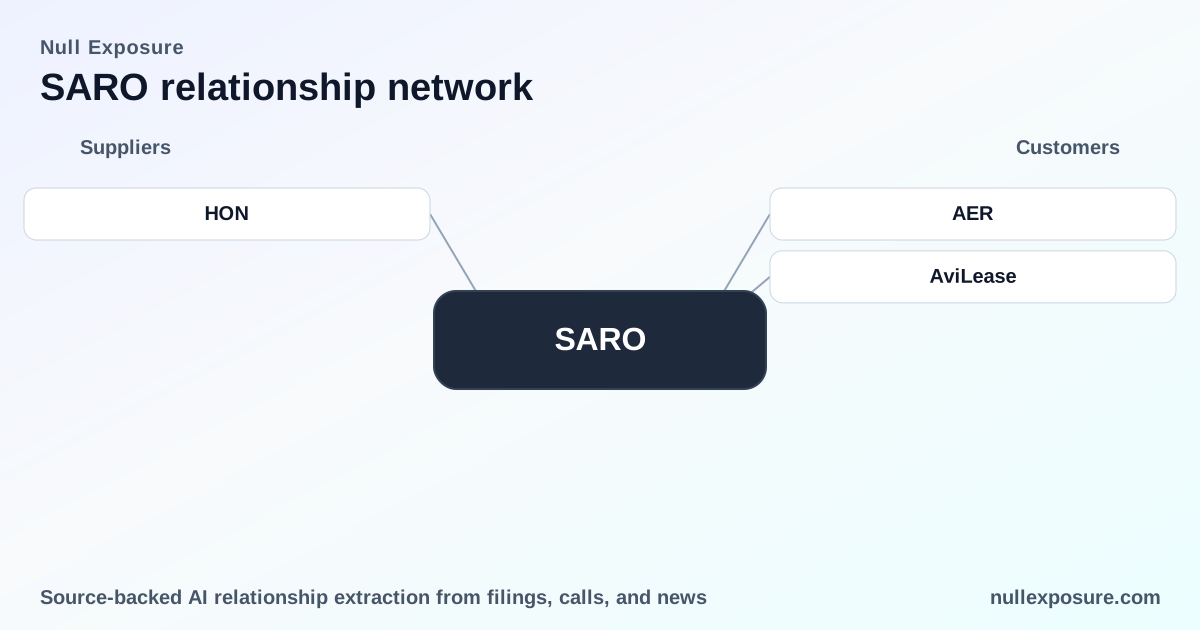
How StandardAero Monetizes Aftermarket Engine Services and Where its Customers Sit
StandardAero (NYSE: SARO) is a pure-play aerospace aftermarket services company that monetizes through multi-year service agreements, usage-based engine programs and shorter-term rental/lease offerings, selling maintenance, repair and overhaul (MRO), component repair and field support to commercial lessors, airlines, OEMs and military end-users. The business model blends high-margin long-term program revenues with recurring, flight-hour–linked cash flows and cyclical spot work, producing predictable annuity-like streams alongside episodic shop visits that drive working-capital variability.
For a deeper, transaction-level view of customer relationships and commercial drivers, visit the NullExposure home page: https://nullexposure.com/
Business model characteristics and contracting posture
- Contracting posture: Predominantly long-term and programmatic; the company reports that roughly 77% of revenue in 2024 derived from customers with long-term agreements, while a meaningful portion of commercial relationships are usage-based (monthly payments tied to flight hours).
- Revenue concentration: Material concentration exists—when subsidiaries are aggregated, the top four OEM customers accounted for ~41% of revenue in 2024—so large counterparty exposure is a structural feature.
- Criticality and maturity: StandardAero provides mission-critical aftermarket services across commercial, military and business aviation, positioning it as an essential provider rather than a discretionary supplier. The services segment structure and long-term agreements point to a mature, service-led revenue base.
- Geographic footprint: Global reach with significant North American exposure (U.S. customers generated the largest share) plus EMEA and APAC revenues that support diversified demand patterns.
- Contract tenor mix: Alongside long-term programs, usage-based engine contracts and short-term engine leases (1–12 months) provide flexibility to capture spot demand while preserving recurring revenue.
Collectively, these constraints indicate a firm with high program stability, flight-hour–linked cash flow, material customer concentration, and global operational scale—characteristics investors must weigh when modeling revenue durability and counterparty credit risk.
Key customer relationship evidence — what transactions say about commercial positioning
AER (news item via AviTrader, Feb 6, 2026)
StandardAero completed delivery of its first CFM LEAP engine for a performance restoration shop visit; the engine was a LEAP-1A owned by AerCap and powers an Airbus A320neo-family aircraft. Source: AviTrader, February 6, 2026 (https://avitrader.com/2026/02/06/standardaero-completes-first-leap-engine-performance-restoration-shop-visit/).
AerCap (news item via AviTrader, Feb 6, 2026)
AerCap is the owner of the LEAP-1A engine that entered StandardAero’s performance restoration shop visit, demonstrating StandardAero’s access to large lessor-owned assets for shop-cycle revenue. Source: AviTrader, February 6, 2026 (https://avitrader.com/2026/02/06/standardaero-completes-first-leap-engine-performance-restoration-shop-visit/).
AviLease (transaction announcement via AviTrader, Feb 6, 2026)
StandardAero signed an agreement enabling it to provide MRO services to AviLease for LEAP-1A, LEAP-1B and CFM56-7B engines, broadening its coverage across both new-generation and legacy narrowbody powerplants. Source: AviTrader, February 6, 2026 (https://avitrader.com/2026/02/06/standardaero-completes-first-leap-engine-performance-restoration-shop-visit/).
AviLease (analyst/news summary via Finviz, Mar 2026)
Analyst and news coverage repeats the signing of a general terms agreement between StandardAero and AviLease for LEAP and CFM56-7B MRO services, indicating market recognition of the commercial arrangement. Source: Finviz news roundup, March 10, 2026 (https://finviz.com/news/329039/ubs-raises-its-price-target-on-standardaero-inc-saro-to-35-and-maintains-a-neutral-rating).
Rolls‑Royce (commercial support agreement reported, Apr 2026)
StandardAero announced a long-term agreement with Rolls‑Royce to provide repair and overhaul support for the MT7 marine gas turbine at its Maryville, Tennessee facility, expanding the company’s OEM-backed service scope into naval marine powertrains. Source: InsiderMonkey reporting StandardAero announcement, April 22 / May 3, 2026 (https://www.insidermonkey.com/blog/standardaero-inc-saro-10-most-undervalued-defense-stocks-to-buy-according-to-analysts-1748163/?amp=1).
AviLease (earnings/preview coverage citing the agreement, Mar 2026)
Earnings previews and coverage reiterated the AviLease general terms agreement, underscoring the deal’s prominence across multiple market communications. Source: Finviz news, March 10, 2026 (https://finviz.com/news/314518/standardaero-inc-saro-earnings-expected-to-grow-what-to-know-ahead-of-next-weeks-release).
AviLease (historical/earnings context cited in broader corporate news, Mar 2026)
Corporate announcements that reference StandardAero’s buyback program or analyst notes also cite the AviLease MRO agreement, demonstrating the transaction’s investor-significance in FY2025–FY2026 coverage. Source: Finviz news, March 10, 2026 (https://finviz.com/news/259459/standardaero-inc-saro-approves-450m-buyback-program-as-bernstein-socgen-affirms-outperform-stance).
Rolls Royce (valuation and market reaction coverage after MT7 support agreement, Apr 2026)
Market commentary and valuation notes connected the new Rolls Royce MT7 support agreement to StandardAero’s strategic positioning, highlighting the MT7 deal as a driver of durable aftermarket revenue in marine and defense-adjacent niches. Source: MarketBeat/Yahoo Finance roundups, May 2026 (https://www.marketbeat.com/instant-alerts/standardaero-inc-nysesaro-given-consensus-rating-of-moderate-buy-by-analysts-2026-03-21/).
Interpretation and investment implications
- Revenue durability: Long-term agreements and flight-hour–based contracts create stable, recurring cash flows that support valuation multiples typical of service franchises; StandardAero’s FY2024 disclosure that ~77% of revenue is from long-term customers is central to cash-flow forecasts.
- Concentration risk: The top-four OEM customer concentration (~41% of revenue) requires active counterparty monitoring and scenario analysis—loss or renegotiation of a major OEM program would materially affect throughput and margin.
- Customer mix and contract flexibility: The combination of usage-based (flight-hour) contracts, fixed-price short-term leases, and spot shop visits gives StandardAero the ability to capture both predictable and opportunistic revenue, smoothing cyclicality while retaining upside in recovery periods.
- Strategic OEM relationships: Deals like the Rolls‑Royce MT7 contract and multiple lessor agreements (AviLease, AerCap) illustrate a two-track commercial strategy: secure OEM-authorized work and partner with global lessors for volume-driven shop activity—both are structural earnings drivers.
Bold takeaways for investors
- StandardAero is a service-led, program-driven cash-flow business with embedded flight-hour annuities and significant OEM/lessor relationships.
- Monitor customer concentration and OEM program renewals closely; these are the primary near-term risk levers for revenue and margin.
- Recent wins with AviLease and Rolls‑Royce validate both the company’s narrowbody LEAP/CFM coverage and strategic expansion into marine/defense powertrains.
For a comprehensive view of SARO’s customer flows and to model counterparty credit exposure, consider the company-level relationship signals and public transaction coverage at NullExposure: https://nullexposure.com/
Disclosure: This commentary synthesizes public news coverage and company disclosures through FY2026 for investment research purposes.