Sigma Additive Solutions (SASI): customer relationships, revenue posture, and what investors should know
Sigma Additive Solutions develops quality assurance software for industrial 3D printing and has historically monetized through software licensing, integrations with hardware partners, and strategic IP transactions. Recent public disclosures and press coverage depict a company that combines partnership-led go-to-market with opportunistic intellectual property monetization, including a material sale of QA assets to a strategic buyer. For deeper research and ongoing tracking of these customer and partner ties, visit https://nullexposure.com/.
Quick read: what the relationships indicate about SASI's commercial model
Sigma operates as a small-cap specialist that sells software solutions into the additive manufacturing value chain and leverages partnerships and academic collaborations to distribute capability rather than relying solely on an enterprise direct-sales engine. The company’s commercial approach is increasingly characterized by asset-level exits and strategic licensing, which transforms recurring software economics into one-time monetization events when executed.
Customer and partner rundown — the relationships investors should track
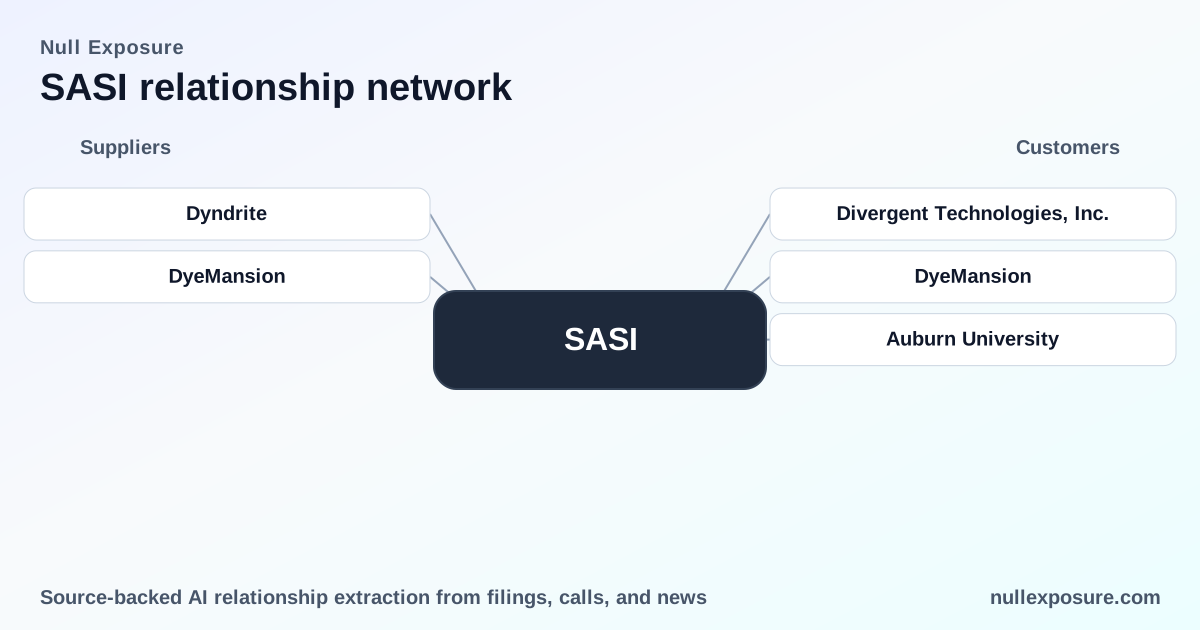
Divergent Technologies, Inc.
Sigma completed a transaction transferring intellectual property related to its additive quality assurance product to Divergent, following an earlier announced agreement to sell its in‑process QA technology suite. According to PR Newswire, the original purchase agreement was announced in FY2023, and subsequent press coverage (FinancialContent/Yahoo/TipRanks) confirms the sale and closing activity reported in FY2024. These disclosures indicate a tangible monetization of Sigma’s core QA software IP through a strategic buyer. (Sources: PR Newswire FY2023; FinancialContent, Yahoo Finance, TipRanks FY2024–FY2026.)
Honeywell
Industry coverage notes that Sigma worked with large aerospace players such as Honeywell through commercialization programs and industry consortia, positioning Sigma’s offerings within aerospace supply chains. A 3DPrint analysis highlighted Sigma’s historic connections to aerospace firms via programs like America Makes, signaling industry validation and channel access into high-value manufacturing customers. (Source: 3DPrint.com, FY2023.)
DyeMansion
Sigma announced a partnership to integrate its QA analytics with DyeMansion post-processing hardware (DM60, Powershot Performance, Powerfuse S), creating an integrated hardware/software offering for polymer 3D printing post-processing. The market notice (FinancialContent/BizWire) framed the arrangement as an expansion into post-processing channels, demonstrating Sigma’s strategy of embedding software into partner ecosystems to drive adoption. (Source: FinancialContent/BizWire, FY2023.)
Auburn University
Sigma’s engagement with Auburn University was described as part of the AcGovDustrial program, reflecting an academic and government-industry collaboration aimed at product development and validation. The Auburn relationship suggests Sigma has pursued academic partnerships to support R&D, pilot projects, and industry adoption in applied manufacturing contexts. (Source: FinancialContent markets posting, FY2022.)
What these relationships collectively reveal about operating posture and business model
- Contracting posture: Sigma’s public record shows a preference for partnerships, embedded integrations, and IP transactions over only pursuing large perpetual licensing contracts. The Divergent IP sale is a clear example of converting technology ownership into cash consideration.
- Concentration and customer mix: The prominence of a single strategic transaction with Divergent and named engagements with large OEMs and academic partners suggests moderate concentration risk—large buyers and strategic partners can materially influence revenue trajectories when they acquire IP or incorporate Sigma technology into integrated solutions.
- Criticality of product: Relationships with aerospace firms and post-processing OEMs indicate Sigma’s QA software addresses high-value, mission-critical use cases in additive manufacturing quality control rather than superficial monitoring, enhancing the strategic value of its IP to industrial buyers.
- Maturity and commercialization path: The mix of academic collaborations and corporate partnerships points to a company that has progressed from research/validation toward commercialization, yet relies on partners to scale deployment, and is willing to monetize technology assets when strategic alignment or capital needs favor that route.
Note: The records reviewed do not include discrete contract clauses or constraint excerpts; therefore these statements reflect company-level commercial signals sourced from public press coverage and filings.
Key investor risk considerations
- Revenue volatility from IP sales: Converting software IP into one-time sale proceeds can boost near-term cash but reduces recurring revenue potential unless replaced with new licensing deals or services.
- Dependency on partners for scale: Sigma’s go-to-market is partner-heavy; success depends on partners like DyeMansion and adoption within OEM supply chains such as aerospace — a partner’s strategic change could materially affect growth.
- Concentration around strategic buyers: The Divergent transaction demonstrates both strategic validation and concentration risk: when a single buyer absorbs prime assets, Sigma’s future revenue base can shift materially.
- Visibility into contractual terms: Public disclosures provide transaction headlines but limited detail on long-term licensing, revenue-sharing, or support obligations; that reduces forward visibility for revenue modeling.
Tactical implications for investors and operators
- For investors, track subsequent licensing deals, recurring revenue replacement, and any disclosed earn-outs or royalties associated with the Divergent sale to assess the durability of Sigma’s revenue base.
- For operators or potential partners, Sigma offers integrable QA capabilities with demonstrated acceptance in post-processing and aerospace channels, making it a candidate for embedded software partnerships or licensing discussions.
Bottom line — focused takeaways
- Sigma’s business model blends partner-led distribution with opportunistic IP monetization, demonstrated by the Divergent asset sale and partnerships with DyeMansion and aerospace players.
- Strategic partnerships and academic collaborations drive validation and go-to-market, but they also create concentration and execution risks if recurring revenue replaces one-time asset monetization insufficiently.
- Investors should monitor follow-on licensing, partnership expansions, and any disclosures about recurring revenue substitution to evaluate long-term cash-flow stability.
For ongoing monitoring, research support, and a consolidated view of SASI’s customer and partner links, explore https://nullexposure.com/.