Saratoga Investment Corp (SAT): Credit Intermediation, Collateral Services, and What Investors Should Know
Saratoga Investment Corp (SAT) operates as a closed-end specialty finance vehicle that generates income and total return by originating, acquiring, and managing middle‑market loans and equity interests, monetizing through interest and fee income plus realized gains and recurring dividends (current stated yield 6.00%). The portfolio is actively managed, with exposure concentrated in U.S. middle‑market borrowers and structured credit arrangements that rely on third‑party custodians and collateral agents for operational execution. For a deeper read on counterparty footprints and relationship risk, visit https://nullexposure.com/.
The short takeaway for investors
Saratoga runs a levered, active lending portfolio with long‑dated loan structures and formalized security arrangements; its operating model depends on custodial and collateral administration relationships that are material to deal settlement and risk control. The company’s FY2025 disclosures show an asset base above $1.1 billion and a diversified set of portfolio companies, but its business model concentrates on mid‑market U.S. credits and long‑term loan contracts—factors that define liquidity, counterparty dependency, and operational complexity.
What the Live Oak Credit Agreement actually establishes
On March 27, 2024, Saratoga and its special purpose subsidiary SIF III executed a credit and security agreement (Live Oak Credit Agreement) that formalizes the Live Oak Credit Facility and allocates operational roles among counterparties. U.S. Bank National Association is named in the 10‑K as the custodian, and U.S. Bank Trust Company, National Association is identified as the collateral administrator for the facility, which positions U.S. Bank to hold and administer the facility’s secured assets. According to the FY2025 10‑K filing, this structure delegates custody and collateral administration to the U.S. Bank entities while Saratoga retains the collateral manager role for SIF III (10‑K, FY2025).
Counterparty relationships — the full list and what each does
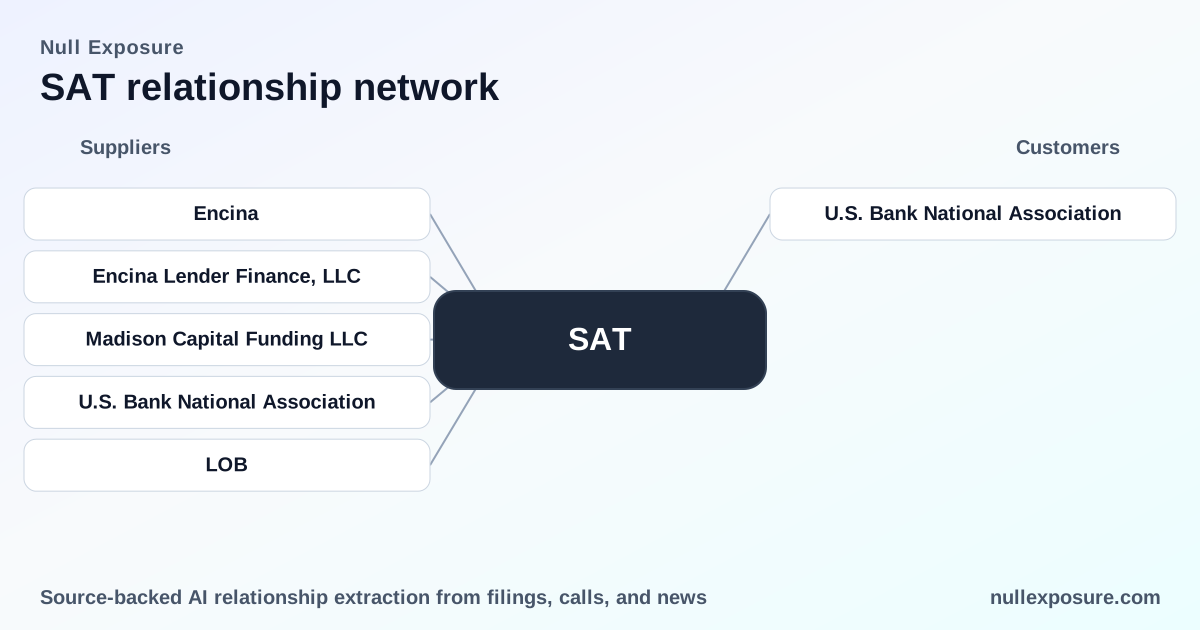
Below is the single customer‑scope relationship disclosed in the results and the role it plays in Saratoga’s operating model.
U.S. Bank National Association — custodian and collateral services
U.S. Bank National Association serves as the custodian under the Live Oak Credit Agreement supporting Saratoga’s SIF III vehicle, a role that places U.S. Bank in charge of holding the facility’s cash and securities and supporting settlement and safekeeping functions. The FY2025 10‑K documents the March 27, 2024 agreement and names U.S. Bank as custodian (10‑K, sat‑2025‑02‑28, FY2025).
Why this relationship matters: custodial appointment concentrates operational and settlement risk outside Saratoga’s internal controls; any interruption in custodial services would directly affect loan servicing and collateral management timelines.
Company‑level signals drawn from constraints and filings
The company’s disclosure set and extracted constraints establish several company‑level operating characteristics that are consequential for investors evaluating relationship exposure and business durability:
- Long‑term contracting posture. Filings reference loan maturities and amortization schedules out to 2033 and commonly five‑to‑seven year term loans, indicating Saratoga uses durable contract structures that lock capital and create long‑duration credit exposure. This produces steadier yield but increases sensitivity to credit cycles and interest rate paths (company filings, FY2025).
- Mid‑market counterparty focus. Saratoga explicitly targets U.S. middle‑market enterprises for customized financing solutions; that market niche drives higher underwriting intensity and a need for active portfolio management, which in turn elevates the importance of reliable custody and collateral administration services (company disclosure).
- North America geographic concentration. Business activity is concentrated in U.S. middle‑market credits, channeling regional macro and credit‑cycle risk into portfolio performance.
- Active portfolio stage and scale. The company reports total assets of $1,191.5 million and investments in 48 portfolio companies as of February 28, 2025, signaling an active investment program with meaningful diversification across issuers but concentrated exposure by strategy (FY2025 10‑K).
- Dual buyer/seller posture in transactions. Language in the filings positions Saratoga alternatively as a buyer (investor) and seller (originator/structured lender), reflecting the hybrid role of a collateral manager and sponsor in securitizations and credit facilities; this multiplies operational touchpoints and counterparty interfaces.
- Services segment orientation. The company operates as a specialty finance and services provider rather than a traditional banking franchise, meaning revenue is driven by interest, fees, and portfolio dispositions rather than deposit gathering.
These signals together imply an operational model that is contract‑intensive, custody‑dependent, and mid‑market concentrated, requiring high quality external service providers and robust internal underwriting to sustain returns.
Key risks and upside drivers for investors
- Risk — counterparty operational concentration. The named custodian role for U.S. Bank centralizes settlement and safekeeping risk; disruptions, legal disputes, or operational failure at the custodian would have an outsized near‑term impact on transaction flows.
- Risk — long contract duration and rate exposure. Long‑dated term loans and structured facilities lock in credit risk over extended horizons, increasing sensitivity to credit migration and liquidity dynamics in stressed markets.
- Upside — fee and yield capture from middle‑market specialties. Saratoga’s focus on bespoke financing to middle‑market borrowers creates opportunities for higher spreads and structuring fees relative to broadly syndicated markets, supporting the stated dividend yield where underwriting discipline holds.
- Upside — active collateral and portfolio management. As collateral manager and equityholder for SIF III, Saratoga retains value capture through both interest income and equity upside when portfolio companies are realized.
Bottom line: what to watch next
Investors should monitor three primary vectors: counterparty performance of custodians and collateral agents, quarterly portfolio credit performance and realized loss metrics, and liquidity metrics tied to long‑dated facilities. The FY2025 10‑K establishes the framework and counterparties (including U.S. Bank) that support Saratoga’s operational model; these relationships are essential to the firm’s ability to execute and monetize its middle‑market strategy (10‑K, FY2025).
For an operational deep dive and ongoing monitoring of Saratoga’s counterparty map and contractual footprint, visit https://nullexposure.com/.
Final recommendation: treat custodial and collateral relationships as first‑order operational risks for SAT, and weight allocations to the stock accordingly while tracking portfolio credit trends and service provider performance documented in future filings.