Satellogic (SATLW) — Customer relationships and what they imply for revenue durability
Satellogic builds and operates nanosatellites and monetizes through three primary channels: Constellation-as-a-Service (CaaS) long-term contracts with governments and institutions, point-in-time image sales for asset monitoring, and sale or licensing of satellites and related hardware. The company’s economic model combines recurring, contract-backed CaaS revenue with transactional imagery and periodic hardware sales, a mix that creates both predictable revenue corridors and episodic upside tied to satellite deliveries and large government awards. For a concise, structured view of these customer relationships and operational constraints, see NullExposure for additional context: https://nullexposure.com/.
Quick investor take: Albania contract signals government CaaS traction
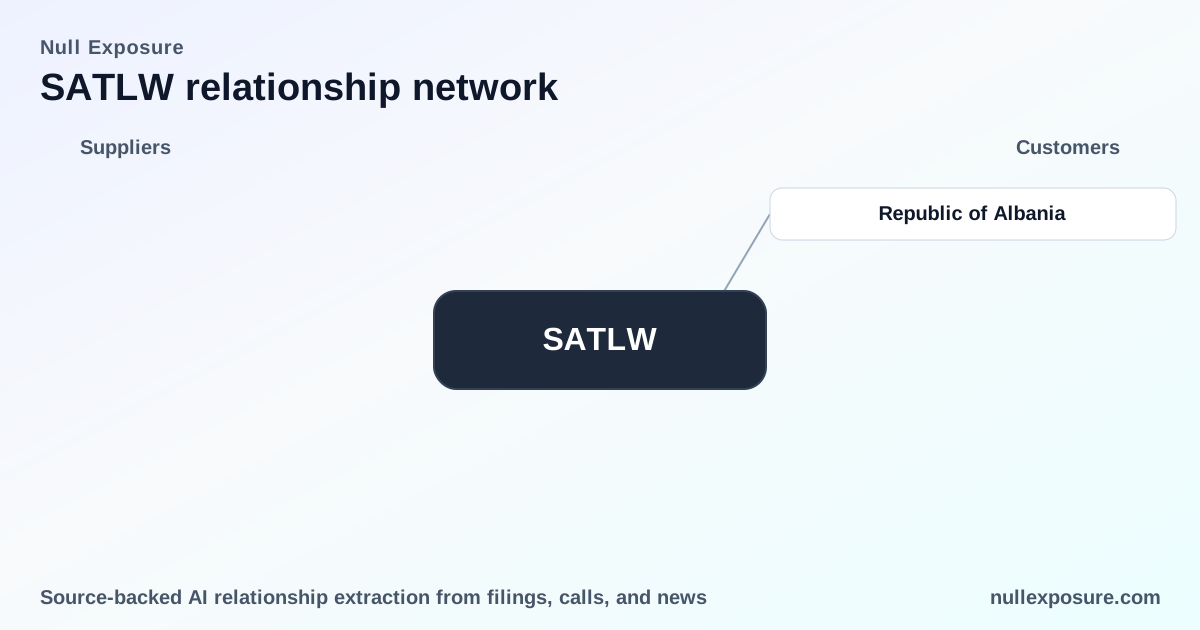
Satellogic disclosed a three‑year, $6 million Constellation‑as‑a‑Service contract with the Republic of Albania, an explicit example of the firm’s strategy to lock governments into multi‑year CaaS agreements that deliver recurring service revenue over time. According to the company’s FY2024 10‑K, that contract is part of its broader effort to build a government customer base for CaaS.
Relationship inventory: every customer relationship the filing lists
Republic of Albania — three‑year CaaS contract (FY2024)
Satellogic entered a three‑year, $6 million Constellation‑as‑a‑Service engagement with the Republic of Albania to provide satellite tasking and imagery services under a multi‑year arrangement. This contract is explicitly disclosed in the company’s FY2024 10‑K and represents a government CaaS win. (Source: company FY2024 10‑K filing.)
If you require a structured feed of relationships and contract attributes for model input, explore NullExposure’s coverage: https://nullexposure.com/.
Company-level operating model and contract posture — reading between the lines of the filings
Satellogic’s public disclosures establish a mixed contracting posture that investors must translate into revenue predictability and operational risk:
- Long‑term, subscription‑style CaaS: The company explicitly frames CaaS as a stand‑ready commitment where revenue is recognized over time. The Albania agreement is a concrete example of this posture; the filing also references other multi‑year arrangements and a prior five‑year noncancellable agreement that provided annual image credits, indicating institutional use of multi‑year structures.
- Spot, point‑in‑time sales for asset monitoring: The business continues to sell imagery on a single‑task basis and recognizes revenue at point of delivery. This transactional channel supplements recurring CaaS receipts but increases quarter‑to‑quarter volatility.
- Licensing and hardware sales: Satellogic both licenses imagery and sells or licenses satellites via its Space Systems product line; satellite sales are recognized at point in time, creating episodic revenue swings tied to manufacturing and delivery cadence.
- Counterparty mix tilting to governments: The company identifies governments and governmental agencies as a material and strategic customer set — supported by selection to NASA’s Commercial SmallSat Data Acquisition (CSDA) On‑Ramp1 program in September 2024 — which positions Satellogic for larger program awards and multi‑year awards with higher contract criticality.
These signals combine to create a business model that is part subscription/recurring services and part transactional hardware sales, with the proportion shifting as government CaaS wins scale.
Geography, scale and concentration — where revenue actually comes from
Satellogic’s revenue distribution in FY2024 shows North America as the largest geography, followed by Europe and Asia Pacific:
- North America: $7,904 (thousands) in FY2024.
- Europe: $2,631 (thousands) in FY2024.
- Asia Pacific: $2,322 (thousands) in FY2024.
- South America: $13 (thousands) in FY2024.
(Source: FY2024 10‑K revenue by geography table.) These figures indicate that growth and customer concentration are presently North America‑centric, an important consideration for investors modeling commercialization risk and expansion runway.
Revenue scale, unit economics and business maturity
- Satellogic reported Revenue TTM of $17.7 million and Gross Profit TTM of $12.8 million, with negative operating metrics (EBITDA and EPS are negative). (Source: company consolidated metrics and latest filings.)
- The company emphasizes a vertically integrated satellite manufacturing capability as critical to achieving lower unit economics and delivering competitive pricing for CaaS and asset monitoring customers. Vertical integration is a maturity signal: it reduces third‑party supply dependence but concentrates operational execution risk inside Satellogic.
Contract size and spend profile
Filings indicate customer spend typically ranges in the $1 million–$10 million band for material engagements, consistent with the $6 million Albania contract and disclosure that the company recognized $5.3 million of revenue from a single customer in FY2024 (the latter referenced at the company level, not tied to a named counterparty in the public excerpt). (Source: FY2024 10‑K disclosures.)
Risk profile for investors and operators — what to monitor closely
- Concentration risk: Early‑stage satellite companies often show a handful of large government customers; Satellogic’s geographic and customer mix implies similar concentration. High customer concentration amplifies revenue volatility if a large contract is delayed or not renewed.
- Revenue mix volatility: The combination of recurring CaaS and point‑in‑time hardware sales produces lumpy revenue recognition; investors must separate baseline recurring revenue from one‑off satellite sales when forecasting.
- Government program dependency: Government awards, including NASA CSDA On‑Ramp1 participation, increase addressable market but add program delivery and compliance risk. Governments are strategic but demand rigorous performance and security adherence.
- Unit economics hinge on manufacturing execution: The company’s stated path towards better unit economics depends on delivering satellites at scale and on schedule; any manufacturing slips will affect both revenue timing and margin outcomes.
- Profitability and capital needs: Current reported negative EBITDA and deeply negative EPS indicate the firm remains in a capital‑intensive growth phase; watch cash flows, funding cadence, and contract prepayment or credit terms.
Bottom line — what this relationship set implies for valuation and operations
The Republic of Albania contract is a clear validation of Satellogic’s CaaS product and government sales motion: multi‑year, multi‑million-dollar deals are achievable and fit the company’s stated strategy. At the same time, the firm’s hybrid model—recurring CaaS plus transactional hardware and spot sales—creates both a baseline of recurring value and episodic upside, necessitating careful distinction between recurring revenue and one‑time satellite transactions when valuing future cash flows.
Key investor takeaways:
- Government CaaS contracts provide revenue durability and strategic credibility; the Albania engagement is illustrative of that pathway.
- North America dominates current revenue, so international expansion or additional government wins will be critical to diversify concentration.
- Operational execution on manufacturing and delivery drives margin improvement; unit economics will determine whether current revenue growth translates into sustainable profitability.
For ongoing tracking of Satellogic’s customer wins, contract structure, and revenue attribution, NullExposure maintains structured coverage and model inputs: https://nullexposure.com/.