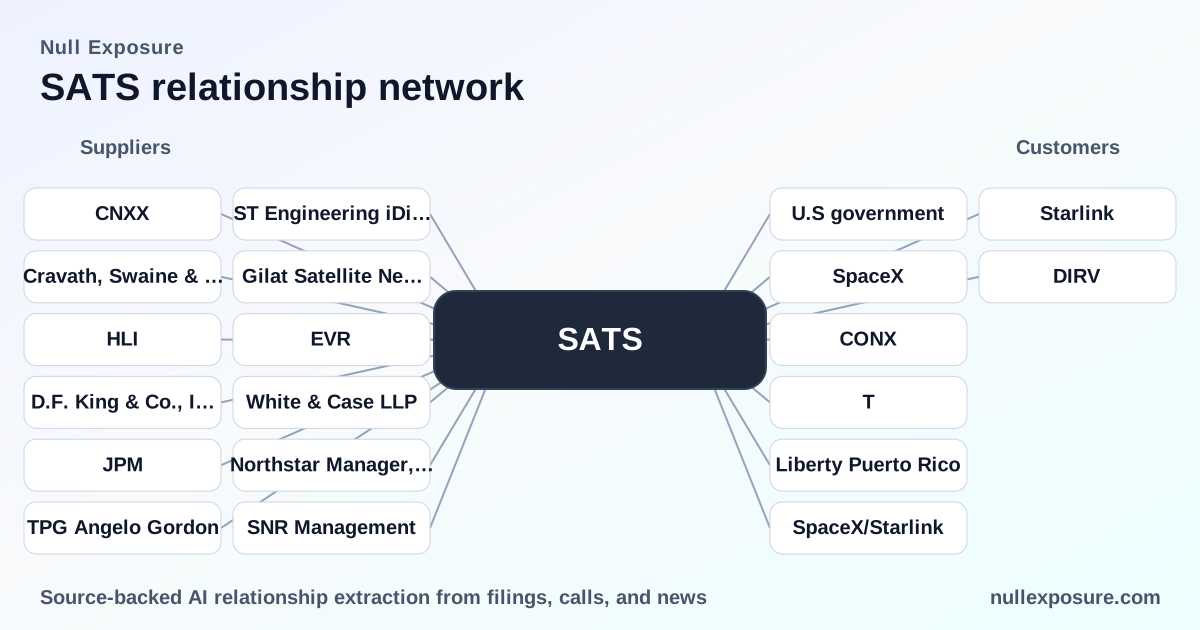
EchoStar (SATS) — customer relationships that underwrite a strategic pivot
EchoStar operates as a diversified broadband and satellite communications company that monetizes through three principal channels: Pay‑TV subscriber fees (DISH and SLING brands), wireless services and device sales, and broadband & satellite services including enterprise managed networks and equipment leases. Recent transactions that realize spectrum value and reassign customer flows materially de‑risk the balance sheet while shifting the company’s revenue mix away from capital‑intensive spectrum ownership toward service partnerships and referrals. For primary documentation and analytics, see EchoStar’s filings and market coverage linked on our site: https://nullexposure.com/.
Business model in plain language — what pays the bills today
EchoStar collects recurring subscription revenue from millions of Pay‑TV and broadband subscribers, sells wireless devices and service, and contracts with enterprise and government customers for managed network solutions and satellite capacity. The company reports roughly $15.0 billion in trailing twelve‑month revenue and a $1.6 billion contracted revenue backlog in Broadband & Satellite Services, which demonstrates both scale and material committed future cash flow from long‑term enterprise contracts (EchoStar 2024 10‑K, FY2024). These characteristics create a hybrid cash flow profile: a high‑frequency consumer subscription base plus fewer, larger enterprise contracts that drive multi‑year visibility.
- Key monetization drivers: subscription churn and ARPU in Pay‑TV/Wireless; enterprise contract backlog and equipment leases in Broadband & Satellite Services; one‑time proceeds from spectrum sales and asset disposals.
Constraints and operational posture that investors must factor
Several company‑level signals in filings and disclosures define EchoStar’s contracting posture and risk profile:
- Subscription + short billing cycles for consumer video: residential video contracts are billed monthly, delivering predictable, recurring cash flow but requiring constant retention efforts.
- Long‑term, non‑cancelable enterprise contracts: the Broadband & Satellite Services segment explicitly records a roughly $1.6 billion contracted revenue backlog (Dec 31, 2024), indicating material concentration of future revenue in multi‑year agreements.
- Customer mix is broad but North America‑heavy: EchoStar reports the overwhelming share of revenue from North America, with defined operations across the Americas; enterprise/government customers are an important portion of the book.
- Counterparty diversity: the company serves individuals, small and mid‑market businesses, large enterprises and government entities — a deliberate diversification that balances consumer churn risk with large, lower‑frequency contract dollars.
- Capital redeployment and balance‑sheet de‑risking: realized and announced spectrum sales materially reduce balance‑sheet leverage and convert optionality into cash or equity stakes, changing the company’s strategic priorities away from spectrum build‑out.
- Spend concentration signal: the backlog and disclosed asset sales place certain transactions well into the $100m+ spend band, reflecting enterprise‑scale counterparties.
These constraints collectively indicate an operator that runs subscriber‑driven revenue at scale while preserving growth optionality and de‑leveraging through selective asset monetization.
Every named customer and counterparty — line by line
U.S government
EchoStar lists the U.S. government among its enterprise customers, supplying broadband network technologies, managed services and hardware to civilian and defense entities as part of its enterprise book (EchoStar 10‑K, FY2024). This establishes government contracts as a meaningful portion of the long‑term services backlog.
T (AT&T) — FY2026 report
Market reports note AT&T struck a roughly $23 billion deal with EchoStar to acquire a batch of wireless spectrum licenses, a transaction that realizes spectrum value and reduces EchoStar’s wireless roll‑out obligations (news coverage, TS2.Tech, FY2026). This sale accelerates cash conversion of spectrum assets.
SpaceX — Benzinga report (FY2025)
EchoStar announced a sale of AWS‑4 and H‑block spectrum licenses to SpaceX in a deal valued at about $17 billion, converting spectrum into immediate value for shareholders (Benzinga coverage, FY2025). The deal includes cash and equity elements that materially change EchoStar’s capital structure.
CONX / CONXF — DISH press release and Finviz (FY2025/FY2026)
EchoStar disclosed asset sales to CONX as part of its transformation, with line items showing proceeds in filings and investor communications (EchoStar/DISH press release, Feb 27, 2025; Finviz summary, FY2026). These disposals are part of the company’s strategy to streamline operations and reduce leverage.
SpaceX — amended AWS‑3 sale (SahmCapital, FY2025)
An amended definitive agreement transferred EchoStar’s unpaired AWS‑3 licenses to SpaceX for approximately $2.6 billion in SpaceX stock (as of Sep 2025), further realizing spectrum value and establishing an equity relationship with SpaceX (SahmCapital report, FY2025).
AT&T / T — Morningstar analysis (FY2026)
Morningstar commentary synthesizes that the sales of spectrum to AT&T and SpaceX immediately realize shareholder value and materially reduce balance‑sheet risk, reframing EchoStar away from spectrum deployment to a services and partnership focus (Morningstar company report, FY2026).
SpaceX — TradingKey (FY2026)
Independent market commentary identifies the SpaceX spectrum sale — a near $17 billion transaction combining cash and an equity stake — as the chief catalyst for EchoStar’s recent rerating and strategic repositioning (TradingKey analysis, FY2026).
TBB — 2025 Q4 earnings call
A quarter‑end earnings call transcript notes agreements for other parties to acquire spectrum licenses from EchoStar, confirming the commercial disposition of spectrum assets referenced in public filings and investor calls (TBB earnings call, 2025 Q4).
Starlink — SahmCapital (FY2025)
EchoStar’s HughesNet business agreed to refer existing HughesNet customers and new customers to Starlink under a fee‑based referral program, creating a commercial flow of subscribers to SpaceX’s consumer satellite service (SahmCapital report, Nov 2025).
SpaceX/Starlink — TradingView summary (FY2023 entry referenced)
Trading and news summaries highlight the $17 billion deal with SpaceX/Starlink to sell spectrum licenses, underscoring market perception of the transaction’s scale and strategic importance (TradingView/press release summary).
Liberty Puerto Rico — DISH press release and Finviz (FY2025/FY2026)
EchoStar disclosed an asset sale to Liberty Puerto Rico, recorded in corporate results and financial summaries, as part of its asset rationalization program (DISH investor release, Feb 27, 2025; Finviz, FY2026).
DIRECTV / DIRV — PR Newswire (FY2024)
Under an equity purchase agreement announced in PR filings, DIRECTV will acquire EchoStar’s video distribution businesses (DISH and Sling TV) in exchange for assumption of DBS debt and other consideration, representing a material reallocation of operating responsibilities and liabilities (PR Newswire release, FY2024).
Investment implications and risks
- Positive: spectrum monetizations convert latent asset value into liquid proceeds and equity stakes, reducing leverage and shortening debt maturities while retaining recurring service revenues from consumer and enterprise contracts.
- Negative: selling core spectrum reduces optional upside from a proprietary wireless network build, and the referral model shifts revenue from direct subscription capture to fee and referral economics, which are typically lower margin and dependent on partner execution.
- Operational watch: monitor retention and ARPU trends in Pay‑TV and HughesNet, the pace of recognized backlog revenue, and how proceeds from asset sales are deployed against debt and growth.
For primary filings, transaction press releases, and curated analysis, visit our hub at https://nullexposure.com/. If you want a tailored relationship map or a one‑page risk brief on EchoStar’s partner agreements, schedule a deeper review through our site.