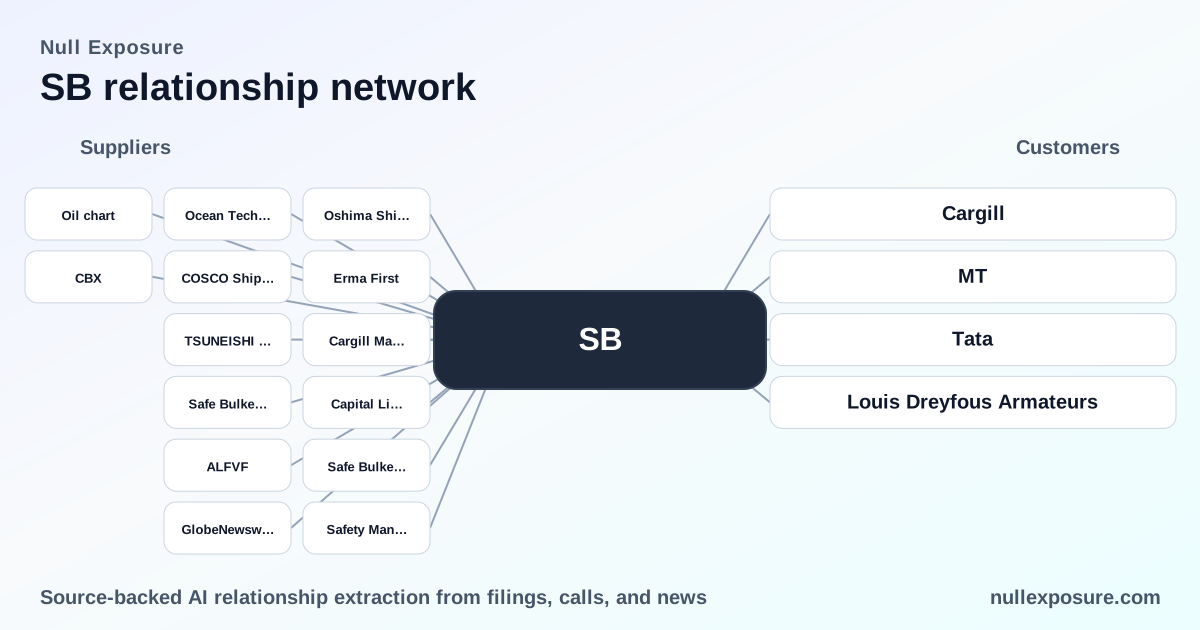
Safe Bulkers (SB): counterparty map and what it means for investors
Safe Bulkers operates a straightforward commercial model: own a fleet of dry-bulk vessels and monetize them through time charters and voyage charters to industrial shippers and commodity traders. The company converts ship-days into cash flow, and its public financials show a profitable margin profile (Revenue TTM $275.7M; EBITDA $125.2M) and a mid-cap market capitalization (~$687M) that prices the company as a capital‑intensive shipping operator with steady operating margins. For a focused counterparty read, see the company profile at NullExposure: https://nullexposure.com/
What the customer list reveals about Safe Bulkers’ operating posture
Safe Bulkers’ cited counterparties are large, creditworthy industrials and commodity handlers, which is consistent with a low-to-moderate counterparty credit risk profile for charter revenues. The relationships in the public record point to a commercial posture dominated by external charterers rather than captive long-term sales, which preserves fleet flexibility but leaves revenue tied to freight markets and chartering cycles. Concentration risk is present in the sense that revenues depend on a relatively small universe of first‑class charterers, but the company’s fleet exposure—spread across charter types—reduces single‑counterparty dependence.
There are no explicit contractual constraints or unusual counterparty encumbrances disclosed in the examined relationship records; this absence should be interpreted as a neutral company‑level signal rather than evidence of anything specific to a given counterparty.
For a fuller counterparty and risk view, NullExposure maintains the consolidated profiles investors use to track these connections: https://nullexposure.com/
Relationship snapshots — who is chartering Safe Bulkers’ ships
Cargill — charterer in biofuel trial
Safe Bulkers chartered at least one vessel to Cargill, which acted as the vessel’s charterer in a biofuel trial reported in March 2026; this demonstrates Safe Bulkers’ access to large commodity traders and to cargoes linked to energy transition experiments. Source: MarineLog article on the biofuel trial (March 2026), https://www.marinelog.com/news/safe-bulkers-partners-with-cargill-on-biofuel-trial/
Arcelor Mittal — likely cape-size charterer historically
An analysis published by gCaptain referencing Safe Bulkers’ disclosures identified Arcelor Mittal as a likely charterer for one of the company’s cape-size vessels, signaling exposure to large integrated steel producers that typically have stable, long-term shipping needs. The mention traces back to fiscal-period commentary in 2013. Source: gCaptain analysis (FY2013), https://gcaptain.com/safe-bulkers-success-story-uninspiring/
MT — duplicate reference for Arcelor Mittal (symbol)
The relationship record also lists MT as a counterparty entry; this is the market ticker associated with Arcelor Mittal and reflects the same historical identification of a cape-size charterer in the company’s disclosures. Investors should treat this as the same counterparty flagged in the gCaptain analysis from 2013. Source: gCaptain analysis (FY2013), https://gcaptain.com/safe-bulkers-success-story-uninspiring/
Tata — industrial steel charterer cited historically
The gCaptain piece also identifies Tata among probable charterers of Safe Bulkers’ cape-size vessels, confirming exposure to major Asian steel conglomerates that provide recurring cargo demand for dry‑bulk tonnage. This is a historical identification, referenced to fiscal-period commentary in 2013. Source: gCaptain analysis (FY2013), https://gcaptain.com/safe-bulkers-success-story-uninspiring/
Louis Dreyfous Armateurs — maritime charterer named in analysis
A third named charterer from the same historical analysis is Louis Dreyfous Armateurs, suggesting relationships with European shipowners and operators that act as charterers or cargo facilitators for cape-size liftings. This relationship is drawn from fiscal-period comments originally reported in 2013. Source: gCaptain analysis (FY2013), https://gcaptain.com/safe-bulkers-success-story-uninspiring/
How these relationships translate into investment-relevant signals
- Counterparty quality: The roster skews toward large trading houses and industrial shippers (Cargill, Arcelor Mittal, Tata), which supports a lower counterparty credit risk for charter revenues than a portfolio dominated by smaller trading firms.
- Commercial flexibility: Chartering to third-party shippers and traders preserves fleet redeployment optionality, which is strategically valuable in volatile freight markets but exposes revenue to spot and period charter cycles.
- Operational criticality: Charterers named are commercial customers rather than strategic owners; the relationships are revenue‑critical but not operationally exclusive (vessels can be rechartered), which reduces lock‑in but means earnings are tied to market demand.
- Maturity and provenance: Several cited relationships are historical (FY2013), while the Cargill engagement is recent (FY2022/FY2026 reporting), indicating a mix of long-standing commercial links and continuing access to major cargo owners.
Risks investors should monitor
- Freight-cycle exposure: Safe Bulkers’ earnings track global dry‑bulk demand; even with high-quality charterers, an industry downturn compresses charter rates and utilization.
- Concentration of volumes: If a small group of large charterers accounts for a material share of charter days, negotiating power and contract renewal outcomes become meaningful risk factors.
- Disclosure gaps: The public mentions are selective and historical; absence of detailed, current counterparty schedules in filings would limit visibility into near‑term revenue resilience.
Final read
Safe Bulkers’ customer footprint is anchored in blue‑chip charterers, which supports revenue stability relative to peers relying on smaller counterparties. The company’s flexibility to redeploy tonnage and its access to major commodity players are clear positives, but investors must weigh these against cyclical freight markets and the potential for concentration in chartering counterparties. For a consolidated view of Safe Bulkers’ counterparty connections and to track updates to these relationships, visit NullExposure: https://nullexposure.com/