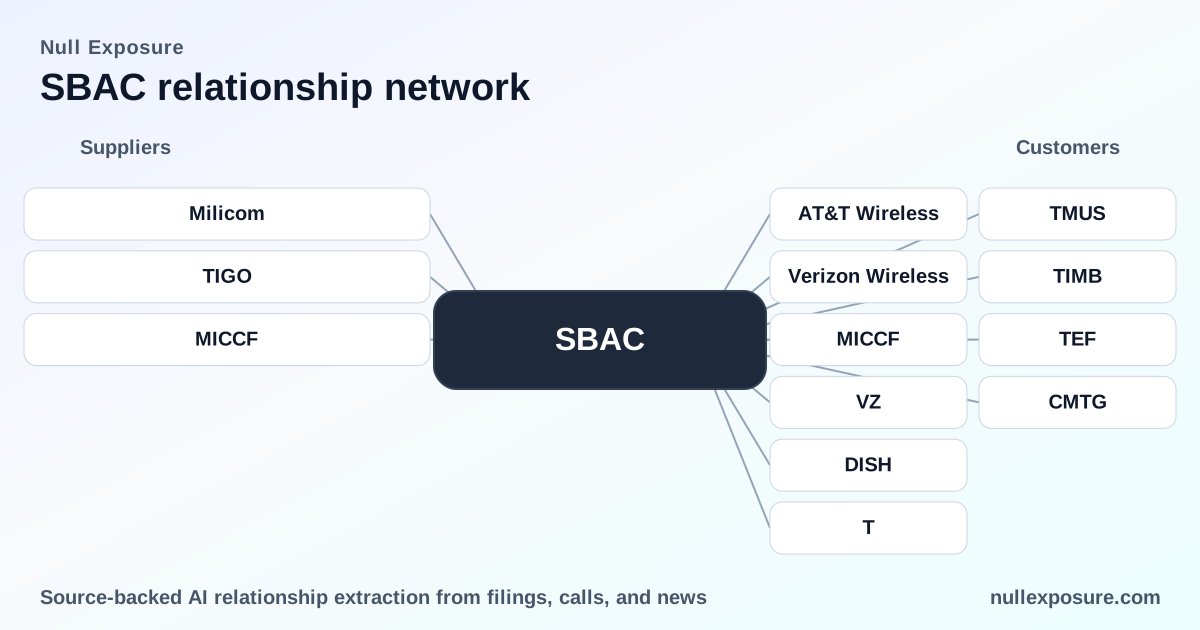
SBA Communications (SBAC) — customer relationships and commercial posture
SBA Communications is a pure-play wireless infrastructure REIT that owns and leases tower and rooftop space to wireless service providers worldwide. The company monetizes by selling long-term site leases and ancillary site development services; the economics are driven by durable, contract-based cash flows from a small set of large carriers, periodic rent escalations and master lease frameworks that cover large portfolios of sites. For investors evaluating counterparty exposure, concentration among a handful of carriers and material international footprints are the defining credit and growth vectors. Learn more at https://nullexposure.com/.
Quick investment thesis for counterside risk
SBA’s revenue model is highly recurring and contract-driven, with site leasing responsible for the overwhelming majority of profit and operating cash flow. The company’s tenant mix includes the three major U.S. carriers plus multinational operators in LATAM and other regions, producing high revenue concentration but predictable multi-year cash flows that support valuation premia typical of tower REITs. Key risk vectors are counterparty concentration, international country exposure, and the small but real potential for tenant payment disruption.
What governs SBAC’s customer economics
SBAC’s contracts and commercial posture shape cash-flow visibility and risk allocation:
- Long-term leases dominate: tenant leases commonly run five to fifteen years with multiple renewal options, creating durable, predictable revenue streams and limited short-term churn.
- Frameworks and master leases are standard: carriers sign master lease agreements that establish material terms across many sites while individual site agreements capture pricing and site-specific terms.
- Large-enterprise and government counterparties: SBAC’s accounts receivable are primarily with national/regional wireless carriers and some government agencies, concentrating counterparty credit risk among a few large tenants.
- Global footprint with LATAM materiality: operations span North America, South/Central America, Africa and other markets; Brazil and other LATAM customers represent a meaningful share of international revenue.
- Business criticality: site leasing is the core product, contributing roughly 94% of total revenue and over 98% of segment operating profit, so tenant relationships are strategic to SBAC’s entire business model.
- Spend scale: SBAC reports material revenue exposure consistent with $100M+ spend bands for top customers and identifiable shorter-term churn in the $10M–$100M band.
These characteristics explain why investor focus is on counterparty credit, contract duration, and geographic diversification rather than transactional volume.
(If you want a concise commercial map of customer exposures and contract structure, see https://nullexposure.com/ for an expanded view.)
Customer roster — what the filings and press list
Below are the entities referenced in SBAC’s customer-related disclosures and topical reporting, with a plain-English summary and the source context.
T-Mobile / TMUS
SBAC reported that T-Mobile generated 30.5% of total revenues for the year ended December 31, 2024, making T‑Mobile the largest single tenant by revenue. Source: SBAC Form 10‑K, FY2024.
AT&T Wireless
AT&T accounted for 20.6% of total revenues in FY2024, reflecting a major concentration of site-leasing receipts tied to a top-tier U.S. carrier. Source: SBAC Form 10‑K, FY2024.
Verizon Wireless
Verizon contributed 15.1% of total revenues for the year ended December 31, 2024, placing it among the three dominant U.S. carrier tenants. Source: SBAC Form 10‑K, FY2024.
Telefonica / TEF
On the international side, Telefonica represented 21.3% of SBAC’s international site-leasing revenue in FY2024, signifying large country/region-specific exposure. Source: SBAC Form 10‑K, FY2024.
TIM / TIMB
TIM represented 15.9% of international site-leasing revenue in FY2024, indicating another substantial carrier-level concentration in SBAC’s international portfolio. Source: SBAC Form 10‑K, FY2024.
Claro / CMTG
Claro accounted for 19.2% of the company’s international site-leasing revenue in FY2024, confirming that several Latin American operators are individually material to SBAC’s international results. Source: SBAC Form 10‑K, FY2024.
Millicom / MICCF / Millicom International Cellular S.A.
SBAC executed a strategic portfolio purchase in 2024: an agreement to buy more than 7,000 communication sites from Millicom for approximately $975.0 million in cash, with Millicom entering country-specific master lease agreements to lease back space for an initial 15‑year term. This transaction converts operator-owned estate into long-term landlord cash flow while preserving tenant relationships under 15‑year MLAs. Source: SBAC Form 10‑K, FY2024 (purchase agreement described in Q3/Q4 2024 excerpts).
Dish / DISH / Dish Wireless
Industry reporting in March 2026 flagged potential payment issues by Dish Wireless and noted that Dish signed a master lease agreement with SBA Communications in 2021; reporting did not confirm broad defaults but raised the possibility of payment disruption to tower owners including SBAC. Source: LightReading article, March 2026 (coverage of Dish Wireless payment situation).
TradingView summary of customer segments
Market coverage reiterates the commercial reality: site leasing revenue is derived primarily from wireless service provider tenants, with T‑Mobile, AT&T and Verizon as significant portions of total revenues (modern press summary referencing SBAC’s FY filings). Source: TradingView summary of SBAC 10‑K, March 2026.
MainStreet Bank (MNSB) — distinct referent (Small Business Administration context)
Two press items reference MainStreet’s relationship with the U.S. Small Business Administration (SBA) for lending programs; these items use the abbreviation “SBA” and are unrelated to SBA Communications. These mentions do not document a customer relationship with SBAC. Source: SahmCapital press release and The Globe and Mail press release, 2026.
John Marshall Bancorp (JMSB) — distinct referent (Small Business Administration context)
A TradingView Q1‑2026 summary notes an SBA 7(a) loan event for JMSB; again, this reference concerns the U.S. Small Business Administration and is not a customer disclosure for SBA Communications. Source: TradingView news summary, Q1 2026.
What this roster means for investors
- High counterparty concentration: the three major U.S. carriers collectively represent the majority of domestic revenue, leading to single‑customer economics that can compress or expand cash flow materially with carrier behavior.
- Contract durability reduces short-term revenue volatility: five‑ to fifteen‑year leases and MLAs create long dated, relatively predictable revenue that supports REIT-like yield expectations.
- International exposure is material and carrier-specific: Telefonica, Claro, TIM and Millicom account for meaningful slices of international revenue, concentrating regulatory, currency and country risk alongside carrier credit risk.
- Event risk exists but is bounded: industry reporting on Dish underscores that carrier distress can create localized payment risk; however, master lease frameworks and diversified geographies mitigate single-event systemic impact.
Bottom line
SBAC’s commercial strength is durable, contract-anchored cash flows with concentrated but highly visible counterparty exposure. For investors and operators, the trade-off is clear: premium predictability for a concentrated book of tenants. Focus diligence on carrier credit, the structure and renewal mechanics of MLAs, and region-level political/economic risk where Telefonica, Claro, TIM and Millicom operate.
For a consolidated mapping of SBAC counterparty exposure and contract characteristics, visit https://nullexposure.com/ for deeper insight and source-aligned analytics.