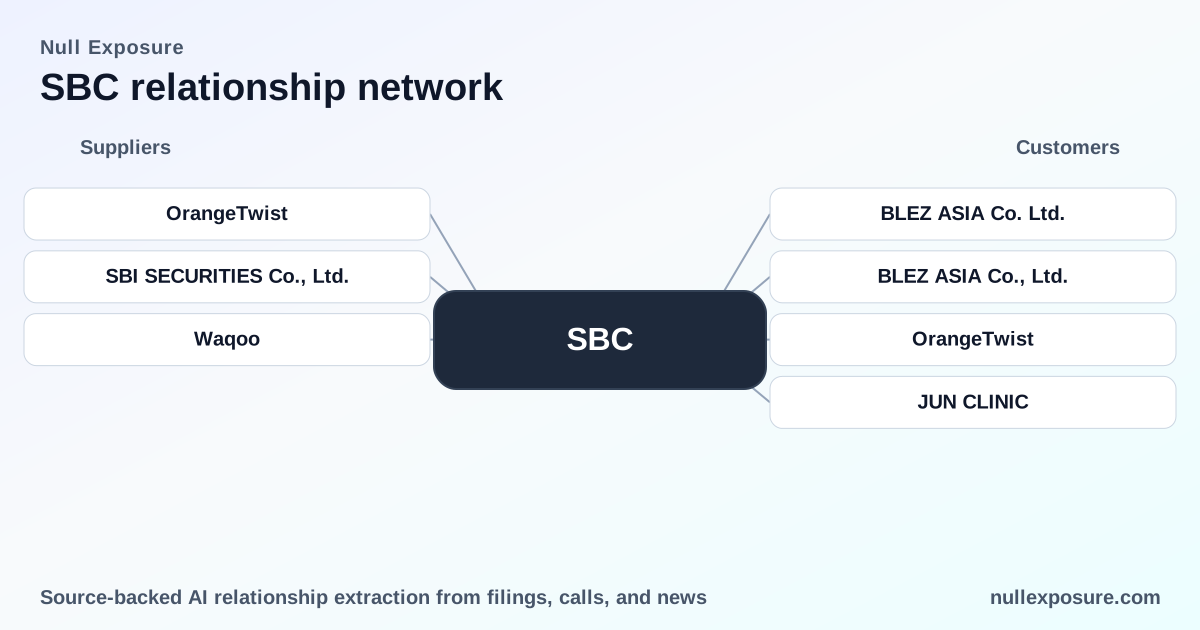
SBC Medical Group: customer relationships that drive revenue and expansion
SBC Medical Group operates as a management franchisor for cosmetic treatment centers, monetizing through recurring management fees and royalties, procurement and resale of cosmetic products, and ancillary IT and software services. The company’s model centralizes brand, training, procurement and certain medical technologies, collecting predictable franchise and management revenue while scaling clinic count in Japan and selected international markets.
For deeper background on SBC’s positioning and signals for customer credit risk and growth, see https://nullexposure.com/.
How SBC’s customer contracts shape the business — the operating thesis
SBC’s revenue stream is concentrated and contract-driven: more than 90% of revenue derives from management services paid by Medical Corporations (MCs) under multi-year franchise and service agreements. Those agreements combine licensing (royalty) mechanics with broad service delivery — advertising, staffing, procurement, IT, loyalty programs and medical-license support — creating high revenue visibility but also counterparty concentration risk.
Several company-level characteristics are material for investors and operators:
- Long-term contracting posture. SBC’s partner agreements include five- to nine-year terms with automatic renewals, supporting persistent royalty and service cash flow over investment horizons.
- Licensor + service-provider hybrid. SBC collects franchise royalties for brand and IP use while delivering hands-on management and procurement services, which increases both margin retention and operational dependency on franchisees.
- Customer mix and regulatory nuance. Counterparties include non-profit medical corporations governed by Japanese Medical Care Act provisions, while end customers are predominantly individuals aged 20–40; this introduces governance and cash-distribution constraints on partners that affect SBC’s pricing and enforcement levers.
- Regional concentration with international expansion. Substantially all long-lived assets and revenues are in Japan, but SBC is actively expanding into APAC and the U.S., converting local partnerships into cross-border licensing and product channels.
- Segment mix. The business is primarily services (management, consulting, loyalty and staffing) with distribution (product resale) and software (telemedicine, reservation and loyalty platforms) as strategic complements that increase customer stickiness.
- Materiality and spend scale. SBC classifies its MC-based relationships as critical to its results, and reported spend figures aggregate to the $100m+ band, indicating meaningful economic scale in supplier and partner flows.
These operational signals create highly recurring revenue but concentrated counterparty risk and regulatory execution risk, which are the dominant drivers for valuation and credit assessment.
Customer relationships that matter — what the press reveals
Below I cover every relationship in the public reporting accessible in the dataset and summarize what each partner contributes to SBC’s commercial strategy.
OrangeTwist — a U.S. foothold and product collaboration
SBC executed a strategic investment and partnership with OrangeTwist to accelerate U.S. expansion, with both companies planning to co-develop branded beauty products and cross-sell services in each other’s spas across the U.S. and Japan. This arrangement is positioned as a channel play to open U.S. distribution and product revenue opportunities (NewMediaWire / EQS News, FY2026).
BLEZ ASIA Co. Ltd. — Thailand consulting and clinic management
SBC signed an e-consulting/management agreement with BLEZ ASIA to provide comprehensive management support for a new dermatology-focused clinic in Bangkok, leveraging BLEZ’s network of pharmacies and clinics to extend SBC’s brand and services into Thailand (EQS News / NewMediaWire / Globe and Mail coverage, FY2025–FY2026).
Shonan Beauty Clinic — scale platform and product rollout testbed
Shonan Beauty Clinic, an extensive network that receives SBC’s management services, served as the pilot and roll‑out site for SBC’s proprietary interpretation app “Talk Bridge,” which SBC deployed across clinic locations to support patient communications and aesthetic healthcare delivery (Finviz / MarketBeat / Simply Wall St reporting, FY2026). This relationship evidences SBC’s strategy to convert software and digital tools into revenue levers across its managed clinics.
JUN CLINIC — premium service mix to increase ARPU
JUN CLINIC joined SBC’s network enabling SBC to offer more customized, higher-priced treatments, directly supporting the company’s effort to increase average revenue per visit through differentiated clinical services (EQS News corporate update, FY2026).
Medical Corporation Nasukai — clinical alliances and medical technology licensing
SBC-supported Medical Corporation Nasukai formed a strategic alliance with Daibi Medical Aesthetics, signaling SBC’s practice of forming clinical alliances that extend its licensed medical technologies and services across provider groups (Finviz news brief, FY2026).
(For full context and primary press, SBC’s partner announcements are captured across NewMediaWire, EQS News, Globe and Mail and industry aggregator coverage in FY2025–FY2026.)
For a consolidated view of SBC’s customer and partner strategy, visit https://nullexposure.com/.
What these relationships imply for investors and operators
- Revenue predictability is high because long-term franchise and management agreements embed recurring royalties and service fees; this supports stable cash flow multiples relative to peers.
- Concentration and counterparty governance are principal risks. With >90% of revenue tied to MCs, SBC’s cash flow and growth depend on franchisee operational health and compliance with Japan’s medical regulations.
- International partners shift risk/reward profile. Partnerships with OrangeTwist and BLEZ ASIA diversify geography and open product channels, but they require successful localization, regulatory navigation and execution capacity.
- Product and software rollouts can be margin multipliers. Deployments like the Talk Bridge app demonstrate an avenue to turn fixed-cost intellectual property into higher-margin recurring services.
- Contract maturity and termination dynamics matter. While most contracts are active and long-term, certain dispatched-staff clinic operation services were terminated in October 2024, illustrating that SBC can both scale and selectively exit lower-return operational roles.
Investment checklist — signals to monitor
- Track renewal cadence and any early-termination activity in multi‑year franchise agreements.
- Monitor revenue mix between royalties vs. hands-on services (services generate higher execution risk; royalties drive margins).
- Watch international partnership execution: clinic openings, cross-border product launches and regulatory approvals.
- Observe MC financial health and any regulatory changes affecting non-profit healthcare entities in Japan.
- Evaluate uptake and monetization of software tools like Talk Bridge across the clinic network.
Bottom line
SBC’s model combines recurring, contractual royalty income with hands-on management services and product distribution, delivering a high degree of revenue visibility and scalable margin opportunity, tempered by counterparty concentration and regulatory execution risk. The company’s recent partnerships—OrangeTwist, BLEZ ASIA, Shonan Beauty Clinic, JUN CLINIC and Medical Corporation Nasukai—illustrate a deliberate push from Japanese domestic scale into regional and U.S. channels while converting intellectual property into higher-margin services. For analysts and operators, the critical questions are: how renewals and franchise economics evolve, and whether international partnerships convert into material, repeatable profit streams.
Explore SBC coverage and data-driven relationship signals at https://nullexposure.com/.